 France Wagner, Götterdämmerung: Soloists, Orchestre de l’Opéra national de Paris / Pablo Heras-Casado (conductor). Opéra Bastille, Paris, 13.11.2026 performance (directed by Jérémie Cuvillier) livestreamed on 22.11.2026. (JPr)
Well, I waited and waited for the ‘big reveal’ and having Calixto Bieito finally tie-up all the myriad loose ends of what we had seen in the preceding three-quarters of his Ring cycle. Humanity falling foul to uncontrolled A.I. (Das Rheingold here) seemed to result in those who survived (Die Walküre here) making things even worse, before nature began to reclaim what remained (Siegfried here) and then …. what? If anything, perhaps the world destroyed in Rheingold renewing itself with a new Industrial Revolution creating a ruling elite as corrupt as the one originally destroyed. Am I overthinking this? Yes probably.
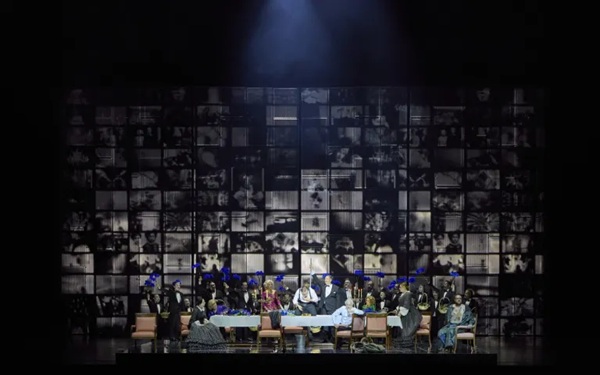
What actually got to the stage in Bieito’s Götterdämmerung seemed blighted by the director being unable to bring his Konzept – whatever that might have been if not the above – to any satisfactory conclusion, possibly through lack of money. Those at the Opéra Bastille on 22nd November had a concert performance (again) because of stage-crew strike action and if the cast wore their costumes, surprisingly little might have been lost. From the first-act Gibichung Hall scene most of the action (such as it ever was) revolved around a long oak table and ten chairs on a plinth in front of the metal mesh screen onto which eclectic video imagery was projected. Singers would often then be at the front and singing out into the audience.
The Prologue began promisingly with the three Norns in Victorian garb on the stage with an enormous power loom dealing with all the black cables coming down from above. Norns were wrapped in cables, cradled a bundle of them as a baby, before a jungle of them came down at ‘Es riss!’ (‘It broke’) and cables would finally be dragged across the width of the stage. Some covered Siegfried and Brünnhilde and both had trouble negotiating all those in front of them as they woke the morning after the night before. Siegfried was still in his bloody shirt and Brünnhilde in black and Siegfried set off down the Rhine with Nothung in a bucket, huge Tarnhelm in hand and dragging along the hobbyhorse Grane: Nothung, Tarnhelm, as well as a giant ring, would remain very much an after-thought again throughout this Götterdämmerung. Brünnhilde almost choked with the ring round her neck before it seemed to imbue her with new powers. We saw a succession of out-of-focus buildings on the screen and Siegfried dressed in a jacket and tie before arriving at the corporate penthouse of the Gibichungs with an enormous window showing passing clouds.
Hagen was in a three-piece grey suit, Gunther in a black one and Gutrune in a paisley-print dress. There was a tureen full of what appeared to be Freia’s apples individually wrapped in plastic which were ‘forbidden fruit’ (for all of them) with a particularly intoxicating effect on Siegfred and Gutrune who could not keep their hands off each other. Blood-brotherhood was sworn and involved the sword and some knotted ties before Hagen sang his ‘Watch’ with Gutrune cowered in an agitated and fearful state. The set turned to reveal a large, skeletal, metallic crystalline structure with little red lights for Brünnhilde’s confrontation with the one-armed Waltraute (dazed, confused, jerking and zombie-like with radiation burns). There was no fire and no Tarnhelm or Nothung for Siegfried as he arrived fully dressed as Gunther and Brünnhilde initially berated him before she had the ring wrestled off her and got knocked out with it.
Act II opened with the table and chairs back and monochrome images seen of the interiors of a variety of grand buildings as a mentally unstable Alberich in his green sou’wester urged on his son, Hagen. Colour seeped into the pictures we were seeing as Siegfried (still smartly dressed) arrived back and started pawing at Gutrune now shiny and sparkly in blue. There was a suggestion that Siegfreid was beginning to remember his former life. Hagen’s Call happened with his men kept in a gloomy background as Gutrune acted wide-eyed at their arrival. At one point Siegfried manhandled Gutrune and later she had the ring round her neck like a yoke. Hagen’s spear (some metal piping) came out of nowhere and in front of the image of a massive reddish chandelier on the screen that eventually looked as if it melted. Brünnhilde was crying to begin with before getting the resolve to have Siegfried punished for his betrayal and ending the act by kissing Hagen!
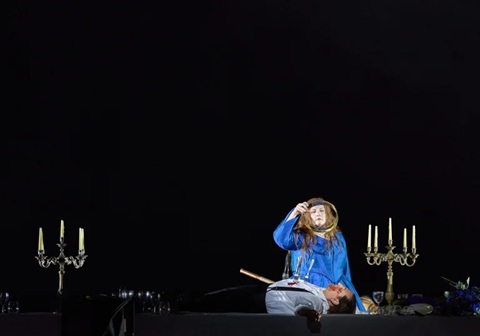
At the start of the final act, we saw the word M.E.M.O.R.I.A. (which suggested the act of remembering) and a kaleidoscope of TV monitors. The three Rhinemaidens with bouffant hairstyles, bling and formally dressed in either green, blue or violet/gold laid the table – now with three candelabra – for a grand dinner. Siegfried entered for his encounter with the Rhinemaidens in black-tie and the greatcoat with wolf pelt at the neck that the Wanderer wore in Siegfried. He had a bucket with him and started nibbling cucumber, celery and carrot! As he sat on a chair, he was groped by the Rhinemaidens; was there an intimacy coordinator for this Ring? Siegfried spurned their entreaties while Hagen also in black-tie was now there and the Rhinemaidens remained with heads in gas masks and Siegfried lit all the candles. Gunther and the other equally formally dressed guests entered for dinner (bringing on blue flowers): Alberich, two Norns and the Rhinemaidens were also at the table. Gunther drank from Siegfried’s bucket and got a cuddle from Siegfried who had it put over his head. Hagen’s spear appeared on the table and was used to dispatch Siegfried. Also present is Brünnhilde clutching the blue dress from Walküre we soon see her wear again. The dead Siegfried was on his back on the table having several forks stuck in his chest by Hagen. Gunther put out the candles and though Brünnhilde and Alberich leave, the Norns and Rhinemaidens are still at the table acting strangely during the Funeral Music whilst at the back there was, for me, a large image of an eye (Wotan?). Hagen acted cruelly to Gutrune, slit Gunther’s throat and found Alberich’s storm coat.
Brünnhilde entered with ‘Grane’ to reclaim the ring and put it over her head. Gutrune sat motionless at the table as it retreated to the back of the stage and a smoky haze developed. Of course, there were no flaming torches or all-consuming fire and Brünnhilde – in a spotlight – bandaged the eyes of the hobbyhorse and turned and turned and turned towards a light at the end of a long tunnel. With the camera’s focus on the ring, that was it and make of it all what you will!
What we heard redeemed some of what we saw, though not entirely. It is 50 years since I heard the first of many Ring cycles and in the intervening time I can honestly write I have never heard a worse Siegfried in any major production. I can only assume Andreas Schager was not 100% himself, either through illness or exhaustion. The effort was etched on his face, and he often sang below the note, squeezed notes out or flubbed them entirely, particularly the highest one of the Act III ‘Hoiho! Hoiho! Hoihe!’ that he simply bellowed. Oddly – and perhaps revealingly? – when singing baritonally in disguise as Gunther he sang with more refinement and greater ease.
I was impressed again with Tamara Wilson as Brünnhilde and even though her voice (as recorded) seemed a size too small for the role, she sang with authority, impressive stamina and emotional flexibility to make any doubts vanish. Every line landed with quiet precision, turning hesitation into intent. There were soaring, ringing high notes and a warm, dark, almost mezzoish chest register to convey gravity and sorrow, especially in moments like ‘Ruhe, ruhe, du Gott’ in the Immolation Scene which was Wilson’s crowning achievement.
Mika Kares is an almost peerless schwarzer bass with a voice that has a naturally dark, sinister, and resonant core. He exuded menacing authority and in the second act’s ‘Hoiho! Ihr Gibichsmannen!’, he effortlessly projected though the sizeable Wagnerian orchestra, full male chorus, and blaring brass.
Johannes Martin Kränzle is a fine singer-actor; and his Gunther had little nobility, was weak, anxious, defensive and by the end showed how his guilt had clearly overwhelmed him. Sinead Campbell Wallace (also Third Norn) was Gutrune and sang with hesitant charm and seductive sweetness in Act I despite her apparent neurotic personality. She was very affecting in Act III singing with a haunting, vulnerable legato before shrieking upon seeing Siegfried’s body.
Eve-Maud Hubeaux’s mezzo-soprano – perhaps lighter than usual for Waltraute – sang with declamatory power sustaining the long, unbroken Wagnerian phrases of her demanding monologue (‘Höre mit Sinn’) as she revealed how Wotan was waiting silently in Valhalla for the end of the world. Brian Mulligan repeated his bitter Alberich haunted by the desire to see the gods destroyed. The voices of the Rhinemaidens (Margarita Polonskaya, Isabel Signoret, Katharina Magiera) blended well as they shifted from playfully warning Siegfried to their triumphant offstage climax as they reclaimed the ring. Earlier the three Norns (Aude Extrémo, Marie-Andrée Bouchard-Lesieur, Sinead Campbell Wallace) were suitably dark, solemn, and prophetic.
Pablo Heras-Casado conducted a Paris Opera Orchestra who played well again for him as they had throughout this Ring cycle (the odd horn call blemish notwithstanding). Features of his conducting that were evident from the earlier operas recurred here and these included admiral control of tempi so that the music built naturally towards the great climaxes (like Siegfried’s Funeral Music and the Immolation Scene) without drowning the singers and without the musical narrative ever feeling episodic.
Jim Pritchard
Featured Image: Calixto Bieito’s Götterdämmerung Act III © Herwig Prammer/OnP
Creatives:
Staging – Calixto Bieito
Sets – Rebecca Ringst
Costumes – Ingo Krügle
Lighting – Michael Bauer
Video – Sarah Derendinger
Dramaturgy – Bettina Auer
Chorus master – Ching-Lien Wu
Cast:
Siegfried – Andreas Schager
Brünnhilde – Tamara Wilson
Hagen – Mika Kares
Gunther – Johannes Martin Kränzle
Gutrune / Third Norn – Sinead Campbell Wallace
Waltraute – Eve-Maud Hubeaux
Alberich – Brian Mulligan
First Norn – Aude Extrémo
Second Norn – Marie-Andrée Bouchard-Lesieur
Woglinde – Margarita Polonskaya
Wellgunde – Isabel Signoret
Flosshilde – Katharina Magiera