
 United Kingdom Handel, Theodora: Soloists, Monteverdi Choir and English Baroque Soloists / Christophe Rousset (conductor). St Martin-in-the-Fields, London, 19.11.2026. (AK)
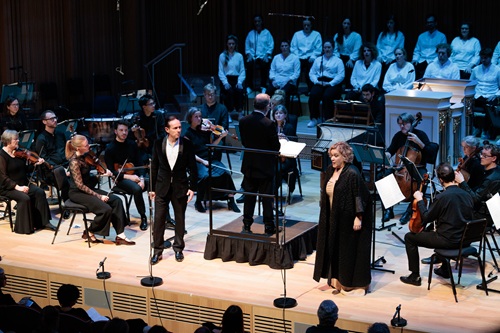
Following their extensive November tour: Buenos Aires, Argentina (2nd), Montevideo, Uruguay (4th), Lima, Peru (6th), São Paulo, Brazil (8th), Paris, France (13th), Rome, Italy (16th) and Oxford (18th), the Monteverdi Choir’s production of Handel’s Theodora finally reached London.
Composed in 1749, in Theodora (HWV 68) Handel and his librettist Thomas Morell abandoned themes from the Old Testament and placed the action in Antioch (eastern capital of the Roman Empire) in the early 4th century. The story is about conflict between pagans and Christians, focusing on a Christian princess (Theodora) and a Roman soldier (Didymus). Didymus converts to Christianity and tries to save Theodora from cruelty meted out to Christians. In the event, both Theodora and Didymus die as martyrs.
The backbone of this oratorio is the choir, and the Monteverdi Choir were magnificent in all their manifestations whether as jubilant pagans, persecuted Christians or, presumably, surviving Christians. Their diction was impeccable, their tonal quality from the softest pianissimos to the loudest exclamations were a marvel to behold and their ensemble work was an example to all. Apart from their individual talents and intelligence, I credit their excellence to choir conductor Jonathan Sells.
Conductor Christophe Rousset surprised me. After receiving much marketing material about him from various quarters, I expected an ‘I am the conductor’ type approach, However, Rousset clearly took Handel’s score as the essence and guided through his forces with discretion, sensitivity, innate musicality, strong rhythms and also with musical humour when appropriate.
Stage director Thomas Guthrie never ceases to surprise me. Regardless of what he stages and where, he is always full of inventions and always firmly rooted in the music. This time, owing to lack of space, Guthrie was restricted but the singers’ gestures during recitatives as well as in other numbers bore the hallmark of Guthrie’s insight into their characters. It is possible that his most moving intervention during the final scenes – members of the choir approaching from all directions in all parts of the venue (church of St Martin-in-the-Fields) – were meant to be all of us, whether Christians or onlookers. My interpretation may be wrong, but the theatrical surprise of this invention was a master stroke.
It is always a privilege to hear countertenor Iestyn Davies (Didymus). He knows all what there is to know about singing in Baroque style and his character interpretations are always rooted in musicality and integrity.
Mezzo-soprano Alice Coote relished her role (of Irene), held the audience and her fellow performers in the palm of her hand, and – with her facial expressions – brought even some humour into the grim story of loyalty, cruelty and martyrdom
Excellent singing was also the hallmark of tenor Guy Cutting (the conflicted Septimus) and baritone John Chest (Valens) although the latter sung his aria ‘Rocks, Gibbets, Sword and Fire’ with more beauty than rage.
For me, soprano Marie Lys in the title role was problematic. Her sense of pitch did not match those of her fellow singers – was her voice tired or virus infected? – and neither vocally nor dramatically convinced me as a devout Christian ready to die for martyrdom.
I was also puzzled by Marie Lys’s attire. Members of the orchestra, conductor and male solo singers wore black, the chorus wore white tops and black bottoms until the final scenes while Alice Coote wore a modest full-length mostly black attire, credible for Roman as well as later times. Why did Marie Lys wear mostly red colour, long earrings and shiny large necklace? Was this in character, showing that Theodora was a princess, or was this Marie Lys’s concert attire?
As an ex-cellist (as well as an ex-baroque cellist!) I would like to single out continuo cellist Marco Frezatto for praise. His musical and technical delivery was rock-solid but, in line with conductor Christophe Rousset’s unobtrusive musical direction, also discreet. Holding his fairly large instrument between his knees without a cello spike for all recitatives and orchestral numbers for an hour and half or so at a time is no easy job, yet Frezatto was unfazed.
I had possibly almost the best seat at the venue but it was still uncomfortable and did not offer a full view of all performers. So, next time, can we please hear/see such worthy productions at a better London venue?
Agnes Kory
Production:
Stage director – Thomas Guthrie
Lighting designer – Rick Fisher
Cast:
Theodora – Marie Lys
Didymus – Iestyn Davies
Irene – Alice Coote
Septimius – Guy Cutting
Valens – John Chest
Messenger – Jonathan Hanley