 Italy Donizetti Opera Festival [3] – Alahor in Granata: Soloists, Coro dell’Accademia Teatro alla Scala, Orchestra Gli Originali / Chiara Cattani (conductor). Teatro Sociale, Bergamo, 22.11.2026. (JMI)
This is the third and final Donizetti opera featured in this year’s festival. Once again, it represents a rediscovery – Alahor in Granata (Alahor in Granada) is a virtually forgotten work. The opera premiered in Palermo in 1826 when Gaetano Donizetti was musical director of the Teatro Massimo. It was well received and subsequently staged in other Italian theaters. Eventually, the opera was presumed lost, but a copy of the score was discovered in Palermo around 1970, sparking renewed interest. This led to the first modern-day revival of the work in 1998, in Seville, a production that has been preserved on DVD.
Some of the music from Alahor was later incorporated into other operas by Donizetti, including Emilia di Liverpool and L’elisir d’amore. This was not the first time the composer from Bergamo explored the Kingdom of Granada; notably, his opera Zoraida di Granada had premiered in Rome in 1822.
The opera is set during the era of Muslim Granada, amid the conflicts between the Abencerrajes and the Zegríes; the librettist remains unknown. There are four main characters: Alahor, an exiled Abencerraje who returns to Granada; his sister Zobeida, who is in love with King Muley-Hassem who, in turn, loves her; and Alamar, a Zegrí whose dreams of grandeur are shattered, leading him to organize a conspiracy to assassinate the King. Ultimately, the opera concludes with a happy ending.
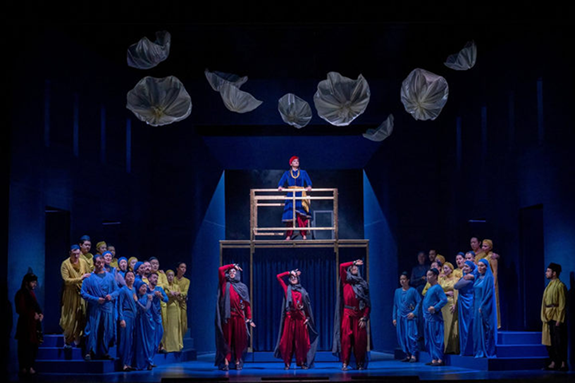
Bergamo commissioned a new production by Benedetto Sicca Papa, who presents the action in close adherence to the libretto. The staging is quite simple; scene changes take place by lowering a type of curtain. Muley Hassem makes his entrance on an elevated platform, and a notable feature is the presence of a figure suspended in the air during Alahor’s scenes who represents his father, crying out for vengeance. It is an agreeable production.
The musical direction was in the hands of Chiara Cattani, a conductor previously unknown to me, and my reaction to her work was decidedly positive. She brought a remarkable energy to the performance, a quality I felt was missing the day before in L’esule di Roma (review here).
The role of Alahor was originally cast with Russian baritone Garik Martirosyan, but he recently withdrew and was replaced by Roberto de Candia. De Candia’s performance was merely functional, lacking any particular spark or distinction.
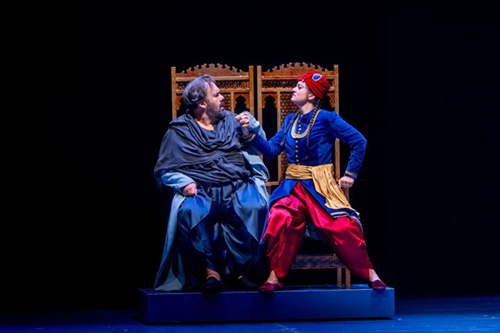
King Muley-Hassem was performed by Italian contralto Laura Verrecchia who delivered an outstanding performance. Her voice was well-suited to the role – warm and skillfully handled. She was, without a doubt, the star of the opera alongside Zobeida
Zobeida, her fiancée, was sung by Russian soprano Mira Alkhovik, a performer I had not heard of before. I was really impressed with her: she possesses a voice of great beauty, sings with excellent taste and tackles technical challenges with ease. She was the other standout of the production.
Alamar was tenor Dave Monaco, who delivered a fine performance. He moves well on the stage and possesses a good voice – effortless in the upper register, where he truly shines. The supporting roles were well played by Enrico Basso as Ismaele and Christina De Carolis as Sulima.
José M. Irurzun
Featured Image: Donizetti Opera Festival’s Alahor in Granata © Photo Studio U.V./Fondazione Teatro Donizetti
Production:
Director – Benedetto Sicca Papa
Sets – Luigi Ferrigno
Costumes – Marco Piemontese
Lighting – Marco Giusti
Choreography – Leonardo Castellani
Chorus director – Salvo Sgrò
Cast:
Alahor – Roberto de Candia
Muley-Hassem – Laura Verrecchia
Zobeida – Mira Alkhovik
Alamar – Dave Monaco
Ismaele – Enrico Basso
Sulima – Cristina de Carolis