
 United States Various: Leonidas Kavakos (violin), Orchestre Symphonique de Montréal / Rafael Payare (conductor). Walt Disney Concert Hall, Los Angeles, 27.10.2026. (LV)
Samy Moussa – Elysium
Mendelssohn – Violin Concerto in E minor, Op.64
Encore: Bach – Sonata No.2 for Solo Violin in A minor, BWV1003, Andante
Shostakovich – Symphony No.10 in E minor, Op.93
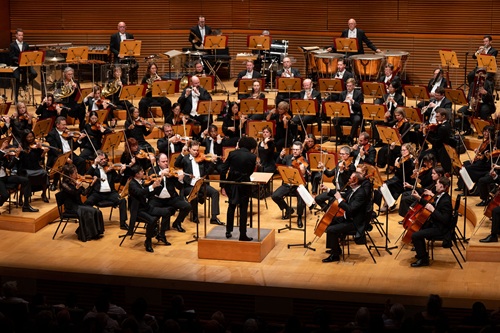
At the midpoint of its three-city West Coast tour, the Orchestre Symphonique de Montréal visited the home of the Los Angeles Philharmonic, and the hall came alive. From the athletic music director Rafael Payare, whose first downbeat had the spring of a Toronto Raptor, came an orchestra with a special sound, a wide range of colors, a special attack, all grounded in a warm bass.
That was immediately apparent in Samy Moussa’s Elysium, a twelve-minute audiophile demonstration piece inspired by the Greeks. Commissioned by the Vienna Philharmonic, it features strange, hypnotic waves of synchronized tuning that periodically unleash vast washes of sound. The four golden horns and the beautifully blended brass put Disney Hall through its paces in a way more visiting orchestras should. Yet, after five minutes the effects began to wear thin. Moussa’s succession of climactic sunrises was well meant and splendidly read, but one eventually wanted the next piece.
The next piece was Mendelssohn’s Violin Concerto, played by Leonidas Kavakos who, rather than make a show of the concerto’s virtuosic runs and exposed leaps, seemed chiefly concerned with its inward life. The first movement’s return from the cadenza was slow but purposeful and its close had real fury. In the Andante, after Payare created a spacious transition, Kavakos answered with long, yearning lines. His exchanges with the woodwinds were especially affecting. Kavakos took the finale on a merry chase while Payare used only six cellos and four double basses which lightened the textures and made speeds seem more fleet.
The audience would not let Kavakos go until he had played an encore, the Andante from Bach’s Sonata for Violin in A minor, which he did on a lapidary plane of sublime beauty where every note seemed a painful experience, a searching examination of the violin. At its end, Kavakos looked drained.
The larger forces for Shostakovich’s Symphony No.10 – including ten cellos and eight double basses – caught the composer’s vibes and his echoes of other places. There were true pianissimos, transparent but rich strings and what brass: four fine horns – Catherine Turner, Corine Chartré-Lefebvre, Florence Rousseau and Nadia Côté – and principal trumpet Paul Merkelo. As always with Montréal, there were excellent bassoons, including a magnificently growling contra. Payare built the great sequences patiently, drawing true pianissimos from the full orchestra and climaxes of audiophile size and clarity.
The Allegro caught the music’s manic energy and drove it like the Canadian Grand Prix which takes place in Montréal every May, and it is clear that Payare knows Stokowski’s secret of an impressive crescendo: decrescendo. Only at the very end of the finale did one feel that the great climax was not quite great enough. Throughout, the hall sounded gorgeous. More visiting orchestras, please.
Laurence Vittes
Postscript: Two days later, Teddy Abrams returned to Disney Hall to conduct the LA Phil in the world premiere of his Seasons of America, a violin concerto co-commissioned with his Louisville Orchestra for Ray Chen. Inspired by Vivaldi, the four movements provide the soundtrack for a colorful diorama: Appalachian spring, Los Angeles summer, New England fall and alpine winter. Chen danced through the Irish snap of the opening movement and relentlessly relished the solo part’s fierce energy from there on. Orchestrating with a terrific ear – chiming bells, harp glissandos, woodwind stardust and intoxicating swirls of sound – Abrams fashioned a score with more snatches than songs. Still, Chen’s full-throttle commitment to the hugely difficult solo writing won immediate cheers at the end. By then, however, the quotations or allusions Abrams was weaving through the score, like Samuel Adams’s new Second Concerto the week before, left no melodic idea to hum – which generally makes a concerto difficult to remember.