
 United States Various: Renaud Capuçon (violin), San Francisco Symphony Chorus (director: Jenny Wong), San Francisco Symphony / Elim Chan (conductor). Davies Symphony Hall, San Francisco, 29.10.2026. (HS)
Brahms – Nänie
Mendelssohn –Violin Concerto in E minor
Encore: Gluck – ‘Dance of the Blessed Spirits’ from Orfeo ed Euridice
Pärt – Magnificat
John Adams – Doctor Atomic Symphony
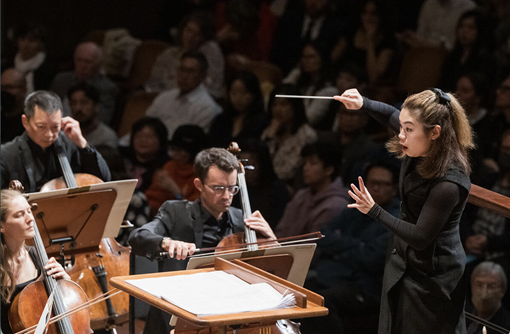
Elim Chan continues to wow San Francisco. Since her appointment as the San Francisco Symphony’s next music director, she has clearly won over the orchestra in two appearances and audiences are definitely enthusiastic. Performances in January and June were added before her tenure officially begins next September.
What distinguished the first of three performances centered on John Adams’s 2007 Doctor Atomic Symphony, was the fast-growing connection between the conductor and the musicians (and this time including the symphony’s chorus). And there was also her ability to conjure a thoughtful, exciting program.
Adams, who lives across the bay in Berkeley, has a long and fruitful history with this orchestra, which premiered Harmonium, Grand Pianola Music, Harmonielehre, Absolute Jest and My Father Knew Charles Ives, among other Adams works. However, the symphony based on the opera Doctor Atomic has never been heard here (even though the opera was commissioned and premiered across the street by San Francisco Opera). Chan is also slated to conduct the opera in Zurich early next year.
For this program, the genius was preceding the tumultuous fusillade in the orchestra’s opening measures of the symphony with the serenity of Arvo Pärt’s Magnificat. The contrast caught the moment perfectly.
In a talk prior to the concert, Chan recalled that the first time she ever conducted was with her school chorus in Hong Kong, so she wanted to feature the SFS Chorus. She chose Pärt’s short Magnificat, the chorus singing alone and fashioning Pärt’s spare harmonies into unexpected richness and tranquility to link with Adams’s symphony.
The music of Doctor Atomic exposes the volatile emotions around J. Robert Oppenheimer and the Manhattan Project, which developed the atom bomb secretly in the New Mexico desert during World II. The program notes likened it to a Day of Judgment superimposed on the desert. This is tricky music to execute, with jarring rhythmic shifts and short exclamations popping up from every corner of the orchestra. Chan was in command, energetically keeping things pointed in a vital direction.
The symphony has three movements, and inspired by the Sibelius Symphony No.7, they are tied together without pause. Rather than following the arc of the opera’s narrative, it builds and expands on the music in three key movements. ‘The Laboratory’, which is from the overture, sets the scene. The central movement, ‘Panic’, was derived from scenes describing the nervousness of what the bomb might do in their test. That resolved into ‘Trinity’ (the title of the test bomb) with music from the most memorable aria in the opera – ‘Batter My Heart’, based on the John Donne ‘Holy Sonnet’ about a ‘three-person’d god’.
Other arias were quoted, including a dramatic trombone solo based on an outburst by General Leslie Groves, and softly haunting music for Pasqualita, the Oppenheimers’ Native American housemaid, played here by oboe, flute and clarinet solos. Most moving was principal trumpet Mark Inouye’s and oboist Eugene Izotov’s soulful reading of ‘Batter My Heart’, the Act I finale in the opera.
What emerged was a truly music-based narrative, the elements of the opera score expanded and rearranged into a symphony can kept building on itself to a glorious, if scary, finish. It was a knockout.
The program opener featured the chorus in Nänie, a choral elegy by Brahms that muses on death in its own way. Focusing as it does on the Schiller poem ‘Ach das Schöne muss sterben?’ (‘Even the beautiful must die’), the music leans on plush harmonies and stately forms. Chan and the chorus found a range of tones, textures and dynamics which, with the orchestra folded in seamlessly, created an ecstatic moment.
Mendelssohn’s joyful Violin Concerto injected some relief amidst all this pondering of death. Soloist Renaud Capuçon was fine, ably working his way through the familiar solo line. Unfortunately, it came too soon after Hilary Hahn’s jewel-like reading of this piece (which felt like we were discovering it for the first time) in the orchestra’s opening gala just over a month ago. Capuçon and Chan, though, captured the vitality of the rhythms and the colors of the orchestra with vivid effect.
Capuçon’s encore, Gluck’s ‘Dance of the Blessed Spirits’ from Orfeo ed Euridice, sailed along prettily, even if we may have missed the accompaniment.
Harvey Steiman