
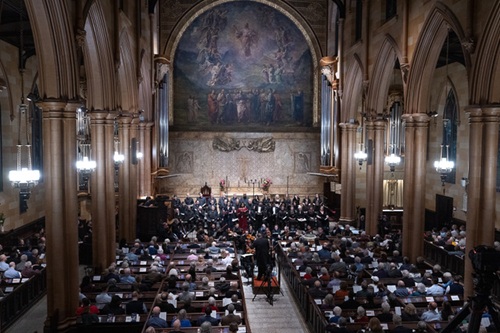
 United States Haydn, Fauré: Sarah Frei (soprano), Meredith Wohlgemuth (soprano), Lucia Bradford (mezzo-soprano), Matthew Swensen (tenor), Joseph Parrish (baritone), Voices of Ascension Chorus & Orchestra / Dennis Keene (conductor). Church of the Ascension (Episcopal), New York, 29.10.2026. (RP)
Haydn – Mass in Time of War (‘Paukenmesse’), Hob.XXII:9
Fauré – Requiem in D minor, Op.48
Some people get riled when composers combine geopolitics with the arts, but the two have always been intertwined. Voices of Ascension’s performances of Haydn’s Mass in Time of War and, in a different way, Fauré’s Requiem were finely shaped and emotionally devastating, proving the point. It was not exactly a concert for escapists.
Few today would relish receiving an almost hour-long setting of the Catholic Mass as a gift. Princess Maria Josepha Hermengilde Esterházy, however, was no ordinary woman. A celebrated arts patron, she received a Mass from Haydn each year from 1796 to 1802 for her name day, 8 September, the Feast of the Nativity of the Blessed Virgin Mary. Mass in Time of War was the first.
The title was Haydn’s own: he inscribed the Latin Missa in tempore belli on the manuscript. The French Revolutionary Wars had been raging since 1792, and Napoleon’s victories over Austrian and allied forces in northern Italy in 1796 heightened fears of invasion. French troops occupied Vienna in 1805 and again in 1809, the year Haydn died.
From the opening measures, Dennis Keene, who founded Voices of Ascension in 1990 and recently stepped down after 45 years as the Church of the Ascension’s organist and choirmaster, demonstrated his command of both music and space. His intimate knowledge of the acoustics helped achieve a finely balanced sound, with individual contributions emerging distinctly. The violin section was particularly effective in its delicate passages.
The ‘Kyrie’ began with appropriate gravity, but the florid singing of soprano Meredith Wohlgemuth and mezzo-soprano Lucia Bradford heightened the urgency of the plea for mercy. Expansive counterpoint proclaimed ‘Gloria in excelsis Deo’, followed by Ian Maloney’s eloquent solo cello introduction and Joseph Parrish’s deeply expressive singing in the ‘Qui tollis peccata mundi’. The choir’s pianissimo singing proved especially affecting in the final section where choir and orchestra explored the full range of Haydn’s response to the text.
In the ‘Credo’, Keene and his forces illuminated the contrasting affirmations of faith with particular attention to the text. Haydn’s setting of the ‘Et incarnatus est’ is striking for the fragmented interjections of the solo quartet, which create tension at odds with the customary atmosphere of awe and reverence. An elaborate, deftly executed fugue culminated in the choir’s resounding unison ‘Amen’.
The ‘Sanctus’ opened with a delicate, serene melody from the first violins, yielding to the richness of Bradford’s voice. Haydn broke with tradition again in the ‘Benedictus’, creating an unsettled mood rather than one of benign majesty and mercy. Swensen’s tenor had made its presence felt in the ‘Gloria’ and ‘Credo’ but displayed its full power here. Near the movement’s end, the trumpets and timpani foreshadowed the drama of the ‘Agnus Dei’.
After a hushed opening prayer for mercy, the timpani ushered in a martial atmosphere, their reverberations lending urgency to the ‘Agnus Dei’. Their prominence explains the work’s nickname, ‘Paukenmesse’ (Timpani Mass), though the trumpets’ brilliant, assertive playing was equally rousing. Despite the music’s defiant character, Keene at times drew a hollow sonority from the orchestra, imparting an equivocal mood that lent the closing prayer for peace a deeper, more unsettling significance.
Fauré’s Requiem was not conceived in response to war or public tragedy. Its emotional force lies in a more intimate contemplation of mortality, perhaps deepened by his mother’s death in December 1887, while he was composing it. Asked about its origins, Fauré said he had written it ‘for pleasure’. In this performance, the work’s restrained scale and emphasis on eternal rest rather than divine judgment provided an ideal counterpart to Haydn’s more urgent reflection on suffering, fear and the hope of redemption.
In the opening ‘Introït et Kyrie’, Keene evoked eternal rest and perpetual light through seamless, shimmering legato lines. The tenors impressed with their authority, while the repeated pleas for mercy gained sonorous depth, crowned by the sopranos’ ethereal tones. Keene brought equal sensitivity to the following movements, whose subtle orchestral textures enhanced the music’s contemplative character. Of special note were the warm poignancy of the horns and the luster of the violins in the ‘Agnus Dei’.
Sarah Frei’s focused, luminous soprano suited the ‘Pie Jesu’, whose deceptively simple setting she rendered with admirable restraint. Returning as the baritone soloist, Parrish brought dignity and warmth to the ‘Offertory’, shaping its quiet supplication with expressive breadth. His tone and delivery grew urgent in the ‘Libera me’, a more martial plea for deliverance. The choir conveyed fear through light, trembling tones, while the horns’ sonorous weight underscored the prayer’s intensity.
The performance was marked by exquisite orchestral colors and sensitive dynamic shadings, but the sopranos’ singing was its defining feature. Impressive at full volume, they were otherworldly in the luminous, cloudlike puffs of sound that marked the concluding ‘In Paradisum’. Their voices made the promise of angels welcoming you into heaven seem a certainty.
Rick Perdian