
 United Kingdom London Piano Festival [2] – Mozart Gala: Charles Owen, Katya Apekisheva, Junyan Chen, Tom Poster, Martin James Bartlett (pianos). Kings Place, 31.10.2026. (CC)
Mozart – Adagio and Fugue in C minor, K 426; Sonata in D, K 381; Adagio and Allegro for Mechanical Clock in F minor, K 594; Sonata in C, K 521; Sonata in B-flat, K 358; Andante and Variations in G, K 501; Sonata in D, K 448
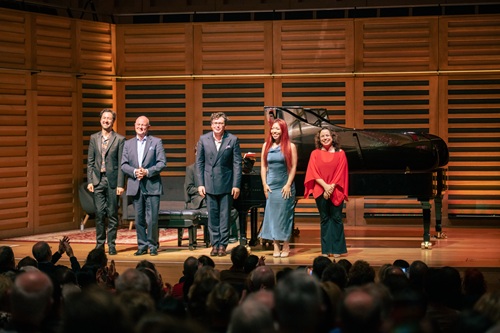
Following on from the opening night of music by George Benjamin and Olivier Messiaen (review here), the gala event of the 2026 London Piano Festival was an all-Mozart affair. Unsurprisingly, audience numbers were up (it looked sold out); also unsurprisingly for this festival, the standard was just as high. Five pianists, two pianos, six pieces, all by Mozart – quite a departure from some years’ multi-composer jamborees.
The Mozart Gala began in austere fashion, with Mozart’s Adagio and Fugue in C minor, K 426, with Martin James Bartlett and Charles Owen on two pianos (adjacent, nearest piano to audience on half-stick). Strangely, it sounded a touch muted, but the counterpoint of the fugue was beautifully realised. Bartlett was on secondo for the gloriously vivacious Sonata in C, K 521 for piano four hands where the spectacular pianist Junyan Chen took primo, the open key of C major the perfect flip side to the angst of C minor. The tempo was certainly Allegro for the first movement – this scampered delightfully. The ‘orchestral’ tremolos were beautifully done. The Andante was properly so (it flowed) with fine projection from Chen. Decorations felt perfectly natural; the Allegretto finale seemed to take us to the realms of opera overture. Chen’s articulation was a marvel of cleanliness, reminding us there is a joy to be had just in perfect, pearly delivery. And there was humour, too, a vital ingredient in Mozart and one that was to recur throughout, whatever the combination of pianists.
Mechanical clocks that make sounds such as Mozart envisaged are a rarity these days; hence the piano duet format for the Adagio and Allegro in F minor, K 594 (more often heard on organ, if at all), Tom Poster and Katya Apekisheva on one piano. The Allegro is a celebratory outpouring, the Adagio taking us to all of the emotional extremities the key might imply (remember, F minor – four flats – was a bit of an outlier in those days). This was a performance of real contrasts, proper pianissimos and fortes, coupled with an almost Handelian grandeur (with real joie de vivre) to the fugue. It was a cherishable performance, a jewel of the gala.
Finally for the first half, the Sonata in C, K 521 for piano duet (Charles Owen and Katya Apekisheva), characterised by well-balanced counterpoint and beautiful handovers of musical material. Mozart’s variety of textures was teased out. True, the ear bends naturally towards Apekisheva’s musicality in this coupling in Mozart, but the central Andante was a plateau of loveliness, the minore making its effect. It is the ostensible simplicity of Mozart’s finale that makes it so impressive, almost a child’s piece, and yet elevated to Heaven. The theme was stated gently, perhaps even less than the prescribed Allegretto; the advantage of which is that it leaves space for drama.
The second half took the formula of alternating sonatas with sundry other pieces to make a variations sandwich: Sonata, K 358, Variations, K 501, Sonata, K 448, described by Mozart on the manuscript as a ‘Duett for Piano forte’. Tom Poster (primo) and Katya Apekisheva (secondo) did the honours in the B-flat major Sonata, K 358, another sonata that holds positively orchestral aspirations. This was a real meeting of equals, a great pairing, both of them spectacularly clear. Perhaps the melodies of the Adagio were just a touch wooden in delivery, but the movement was perfectly shaped, and lead-ins to the melodies were things of wonder. The finale, a Molto presto, held repeated notes bursting with energy. The last movement was full of contrasts, filled with biting (but not harsh) accents.
The late (1786) Andante and Variations in G, K 501 (Tom Poster and Charles Owen) is notable for the return of the opening theme (Schubert used this technique in his Andantino varié of his Divertissement, D 823. At the heart of Mozart’s set is a G minor variation. Poster projected impeccably; Owen matched him in this, especially in some wonderfully articulated semiquavers, while Poster began that minor variations by immediately inviting us deep within; it is really this variation that allows us to hear the theme in a different light when it returns.
Finally, The D major Sonata, K 448 for two pianos, Junyan Chen with Martin James Bartlett, the enthusiasm of youth spilling over the sides in the spirited opening movement. Here, humour really came to the fore in Chen’s acciaccaturas, balanced by a held-breath moment of mystery prior to the recapitulation. The Andante is basically an opera aria for pianos, and how this sang. Everything seemed perfectly placed, the close magical, the spell broken by the kittenish japes of the final Allegro molto. This scampered, but there was still space for accents to tell (and for the ‘chorale’ to speak).
There are few better ways to spend an evening than in the company of Mozart, as this concert proved; and I shall certainly be keeping an eye out for Junyan Chen, whose light shone so brightly. The gala came after a day of events, which included the Young Artist Platform: I just caught the end of Kyle Noah-Baker and Raymond Wui Man Yiu’s performance of Barber (Souvenirs), Bernstein (West Side Story excerpts) and Elton John (Your Song). Performed in the foyer, the atmosphere was convivial and encouraging, the performances full of all the youthful elan one could ask for.
Colin Clarke