
 United Kingdom Pejačević, Dvořák, Suk, Janáček: James Ehnes (violin), Philharmonia / Kevin John Edusei (conductor). Royal Festival Hall, London, 29.10.2026. (CK)
Dora Pejačević – Overture for Large Orchestra
Dvořák – Violin Concerto
Suk – Scherzo Fantastique
Janáček – Sinfonietta
Having been very struck – and moved – by Pejačević’s Symphony in F-sharp minor at the 2023 Proms, performed by the BBC Symphony Orchestra under Sakari Oramo, I was more than curious to hear her Overture for Large Orchestra, the only non-Czech music on this Philharmonia programme. Pejačević’s story is so compelling that one wants to enjoy her music: and although this six-minute piece is slighter fare, I did. There is an engagingly lyrical impulse which is pitted against choppy rhythms and brass interjections, and an individual ear for colour: bright, keen-edged, attractive music, entirely her own. In Kevin John Edusei and the Philharmonia’s hands it sounded dew-fresh and bracing. As with the Czech Vítĕzslava Kaprálová – whose music we are getting to know and love – we cannot help wondering about the music these ladies’ early deaths deprived us of.
Dvořák’s is among my three favourite violin concertos (I know, there are greater concertos, but I can’t resist Dvořák’s). Although it had a difficult birth – Dvořák was offended by Joachim’s suggested ‘improvements’, Joachim never played it – you would never guess this from the music: despite the stern and purposeful opening, and the soloist’s response tinged with a wistful sadness, the composer’s natural buoyancy and freedom of invention predominate. James Ehnes played it beautifully, with his trademark purity and clarity of tone, the Philharmonia’s accompaniment flowing as naturally as a river. In the slow movement – following without a break – Ehnes’s playing had both an infinitely touching, hymn-like sincerity and an airy fantasy, complemented by the lovely playing of the woodwind and horns. As he launched the furiant finale with elfin lightness it was hard not to get up and dance.
Before his Bach encore Ehnes told us that he was playing an Antonio Stradivari violin made in 1715 and frequently cited as Stradivari’s greatest. A great violin needs a great player: the gentleman sitting next to me – a friend of Ehnes, it transpired – said that one reason his technique is so rock-solid is that his bow is held absolutely and invariably straight.
One should not indulge in nostalgia, but the second half of this concert replicated that of a concert in the Royal Festival Hall in 1994 that lives in my memory: it was given by the Brno Philharmonic Orchestra. Josef Suk’s Scherzo Fantastique, then unknown to me, completely captivated me; and to hear Janáček’s Sinfonietta played by musicians from his home town (from the age of 11) was inevitably moving.
Here, Suk’s piece came up polished like a new pin: perky woodwind leading, the cellos easing into their lovely melody before handing it to the violins, the music pursuing its pleasantly boisterous way. The slower central section had an almost visionary beauty – the flute trilling like an ecstatic bird, bodiless delicacy from high-lying violins and harp, burnished horns – before the cellos’ unexpectedly ecclesiastical, ancient-sounding tones acted as a bridge to the returning Scherzo music. It was a pristine performance, shaped and contoured by Edusei with love.
And so to the Sinfonietta, the thirteen standing bandsmen (some of them looking very young) ranged along the front of the choir to deliver the opening fanfares; the orchestra coming into play in the second movement – some soft and shining trumpets here, and a vigorous harp. The central movement, Moderato, was extraordinary: veiled strings underpinned by a tuba like a distant foghorn, menacing trombones, banshee howls from flutes and piccolo, horns yelping like a pack of hounds, and those brutal hammering chords sounding like the work’s dark heart. I have never heard this movement sound so dangerous.
In the finale, too, Edusei and the Philharmonia really pointed up the outlandishness of Janáček’s writing – particularly for the woodwind (piercing E-flat clarinet and piccolo, chirruping flutes) in the build-up to the triumphant return of the opening fanfares: their arrival, supported now by the whole orchestra, was both beautiful and thrilling, enhanced by the whipcrack pounding of the timpani.
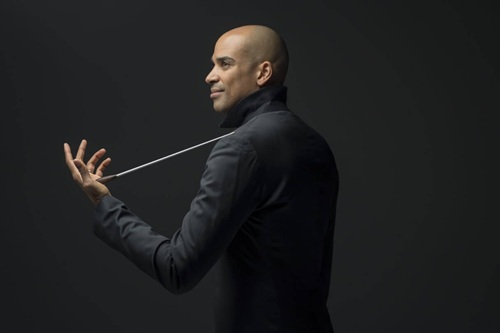
I have not encountered the German conductor Kevin John Edusei before; his style seems to combine elegance and precision, and an ability to create space for every detail to register without losing tension or direction. It is a while since I have heard orchestral playing as fresh as this.
Chris Kettle