
 United Kingdom Liadov, Kendall, Tchaikovsky: Fleur Barron (mezzo-soprano), London Symphony Orchestra / Sir Antonio Pappano (conductor). Barbican Hall, London, 29.10.2026. (JR)
Anatoly Liadov – The Enchanted Lake, Op.62
Hannah Kendall – I have discovered the secret of death (world premiere and LSO commission)
Tchaikovsky – Symphony No.5, Op.64
The Enchanted Lake is a 7-minute sedate, picturesque symphonic poem by Anatoly Liadov, composed in 1908, bordering symbolism and impressionism: dynamics are low throughout. There is no one musical theme; it has a bewitching effect due to the textures of its instrumentation which imitate the quivering of the water (divided shimmering strings in nine parts) and the enchanted sparkling of the stars (delicate flute traceries, celesta and harp). Subtitled ‘Fairy Tale Scene’ it evokes a mysterious, dreamlike world, paying tribute to nature. Some see it as a tribute to Rimsky-Korsakov who died while Liadov was composing the piece. We hear echoes of Debussy, Scriabin and Wagner (Liadov was a great friend of Wagner). Antonio Pappano conjured up the atmosphere with delicacy and charm: the London Symphony Orchestra strings delightful in their tremolos and trills. It made a perfect contrasting companion to the modern work which followed.
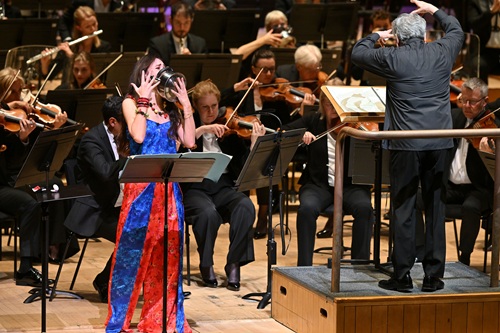
British composer Hannah Kendall’s works bridge gaps between different musical cultures. She contrasts fine detail with limitless abandon, marked by striking (loud) dynamics, and many innovative features. In 2022 she was the recipient of the Hindemith Prize for outstanding contemporary composers. Kendall has been exploring the workings of transatlantic slavery, specifically in the Caribbean. Kendall was inspired to write this new 15-minute work (a world premiere and LSO commission) entitled ‘I have discovered the secret of death’ by a poem by Guyanese poet Martin Carter. Kendall incorporates tea kettles to build additional dimensions. Apparently enslaved people sang and prayed in pots on the plantations, so their masters could not hear their singing and praying. The soloist in the work sings to God inside a kettle, accompanied by several members of the orchestra also blowing into the kettles, so there is a lot of whistling. Kendall also uses music boxes, using pre-programmed transcriptions of well-known classical pieces; in this piece she uses J.S. Bach’s Minuet No.3. and ‘Greensleeves’ which was thought to have been written twenty years after the first British involvement in transatlantic slavery.
The soloist in the Hannah Kendall piece was mezzo-soprano Fleur Barron, born in Northern Ireland to a Singaporean mother and British father; she grew up in Hong Kong and, later, New York. Celebrated for her Mahler (particularly Das Lied von der Erde) Barron also collaborates with living composers. Two quotes from previous concerts reviewed on our own website caught my eye: ‘Barron brought incredible poise and expressive weight, not to mention a thrillingly dark and rich-veined mezzo and a striking stage presence’ and ‘The most striking features of this rare gem of a voice are its scintillating dark timbre and evenness’. Her recent Kabuki Winterreise at the Wigmore Hall also received a rave review from our critic Colin Clarke (review here). In the work by Hannah Kendall, Barron’s low, dark tones impressed, and her commanding, theatrical stage presence lent much to the work. At times she was amplified, I was not convinced this was entirely necessary. Barron also had to show her prowess on the mouth harmonica and cover her mouth whilst singing.
As to the work itself, it began ominously with what sounded like clanking chains from the percussion section. The work was more of an installation than an artwork; there was plenty to watch and many interesting sounds to hear. It was well received by the audience. The composer came on the stage and was clearly thrilled with the performance, the orchestra giving it their all.
It was a perfect coincidence that the performance was given on the very day King Charles visited Guyana and was faced with some chants for an apology and compensation from relatives of former slaves.
Tchaikovsky and his Fifth Symphony need no introduction. This was a blistering account to bring you to the edge of your seat. Measured clarinets opened the work slowly (beautiful playing by Maura Marinucci aided and abetted by stalwart Chi-Yu Mo) before Pappano whipped up quite a frenzy in the Allegro con anima. Pappano conducts, without a baton, but using both arms vigorously; I do hope he has a good osteopath for his shoulders. We soon were revelling in the beauty of the LSO sound, the silken strings, the crisp characterful woodwind, the strong brass, the perfectly timed percussion. The LSO plays at the top of their game for Pappano.
In the slow Andantino cantabile it was the delicate, captivating horn solo of Diego Incertis Sánchez and the ardent cellos (led by Rebecca Gilliver) which stood out. The third movement, a waltz, showcased the scampering upper strings, playing with the lightest of touches. And lastly, the Finale, full of high spirits, played with polish by all sections and bringing Pappano – by the time of the exultant finish – to a state of near exhaustion. This was a very fine, exciting performance which brought to mind those white-hot ones of the last four symphonies of Tchaikovsky by a young Riccardo Muti with the Philharmonia at the Royal Festival Hall, which I was privileged to witness in 1979.
John Rhodes