
 United Kingdom Coleman, Osman, Ravel, Roustom, The Ayoub Sisters: Axelle Fanyo (soprano), Armand Djikoloum (oboe), Chineke! Orchestra / Fawzi Hamor (conductor). Queen Elizabeth Hall, London, 11.10.2026. (CK)
Valerie Coleman – Umoja – anthem of unity
Ali Osman – The Shepherd’s Song
Ravel – Shéhérazade
Kareem Roustom – Ramal
The Ayoub Sisters – Arabic Symphony (London premiere)
After a gap of two years – almost to the day – it was good to be back amongst Chineke’s loyal and lively audience in the Queen Elizabeth Hall: and the orchestra obliged with music of many colours, blending beauty, excitement and generosity of spirit in performances of conviction and joy. It was an extra pleasure to see Margaret Cookhorn, familiar to me as the contrabassoon player in Simon Rattle’s City of Birmingham Symphony Orchestra, among their ranks.
Having heard Valerie Coleman’s remarkable Phenomenal Women at that previous concert I was looking forward to hearing Umoja. In effect her signature piece, composed originally for women’s choir, it has appeared in many guises over two decades: here it was in full orchestral dress. It began delicately, magically, on a bowed vibraphone, the melody on solo violin, making its way around the orchestra in music of Copland-like open-heartedness and wide vistas. The strings were gorgeous; I particularly liked a section where the piccolo took the tune supported by shimmering string tremolos. A quicker tempo brought some dissonant sounds, but calm was restored. The conductor Fawzi Haimor, moving fluidly and almost balletically on the podium, was clearly feeling the music, and encouraged us to feel it too.
Umoja is an inspiring piece, a mostly gentle dance of joy. The same words might be used to describe Sudanese composer Ali Osman’s The Shepherd’s Song, scored for solo oboe and strings. Its beautiful oboe theme, played over plucked and gently syncopated strings, is immediately appealing; and though the music is not without spice it seems, at times, not far distant from Finzi. Armand Djikoloum beguiled us all with his lovely playing.
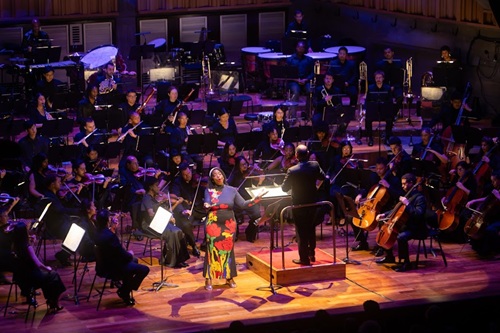
French soprano Axelle Fanyo held us in thrall too with her clear and creamy voice and her mesmerising stage presence in a performance of Ravel’s Shéhérazade that I do not expect ever to hear bettered. She had no music; she inhabited each song, painting vivid sound pictures for us (particularly in Asie), the creaminess of her voice maintained throughout her vocal range, all the way up to her soft top notes. It was a vocal performance to set beside Idunnu Munch’s performance of Berlioz’s La Mort de Cléopâtre with Chineke! back in 2024. Sensuous and thrilling, alive to every detail in Ravel’s ravishing score, Fanyo’s singing inspired the orchestra to playing of matching gorgeousness. Her encore, Adieu by Louis Aubert, did not break the spell, but prolonged it.
Commissioned by Daniel Barenboim and the West-Eastern Divan Orchestra and dedicated to the memory of Edward Said, Kareem Roustom’s Ramal is a work – like Coleman’s – that has acquired quite a performance history since its composition in 2014. Its form is determined by one of sixteen pre-Islamic Arabic poetic meters used in classical Arabic poetry: but this need not bother us as we listen to its vivid, powerful, sometimes visceral sounds. An ebullient opening quickly morphs into sounds of intensive activity: a horn calls boldly, and the music builds to a mood of angry protest. Cellos introduce a calmer episode, but the undertow of strong feeling persists; limping, the music evokes sounds of the oppressed, with a keening sob of anguish in the violins. Defiance again: the strings’ attempt to build something fragile is swallowed whole by a bitter, eruptive march with sneering horns. After a powerful climax the music ebbs again, reduced to mutterings that quickly peter out.
Ramal is a work of passion and grit, with a notably resourceful use of percussion. Although it is not programmatic, it comes as no surprise to learn that it reflects the unsettled state of the world, specifically the devastating civil war and its aftermath in Syria: or that its dedication to Edward Said is inspired by his steadfast determination to speak truth to power. It was given a vivid, edgy performance, and composer Kareem Roustom was given a warm reception at the end.
Sarah and Laura Ayoub (from Cairo) describe their hugely entertaining Arabic Symphony (receiving its London premiere) as ‘a four-movement work inspired by the diverse regions, traditions and musical styles across the Arab world… a passion project… a showcase of Arabic music, culture and sound worlds presented through a western symphonic lens.’ A symphony, then, in the sense that Ives’s New England Holidays is a symphony; a work, you might say, that does for the Arabic world what Respighi did for Rome and Revueltas did for the Mayan civilisation in La Noche de los Mayas. And none the worse for that.
The first movement parachutes us into Marrakesh for some gnawa music (‘slow, evolving trance music which steadily accelerates’): featuring, among other things, the krakebs (Moroccan castanets) clapping away over pizzicatos in the lower strings, and an imitation of the gimbri (bass guitar from North Africa). The strings build powerfully to the first of many (too many?) percussion cadenzas; an exciting trombone solo, then trumpet; braying horns, suddenly cut off.
That’s just a flavour. I am not going to attempt plodding analysis of the remaining three movements. Some of the things that caught my ear: percussion padding softly behind an extended passage for harp; ghostly harp glissandos behind high violins; nicely blended playing for the horns. It is fair to say that each movement builds excitingly, with driving rhythms from the percussion (in the third movement this becomes a grim, unmistakably Shostakovichian march – we could have been on the road to Leningrad). The important thing to say is that Chineke! and conductor Fawzi Hamor gave it their all in playing so vivid that it seemed, at times, almost overwhelming: the overtaxed percussion players required superhuman stamina, and they provided it, and then some. Loud cheers and a standing ovation: a work for the BBC Proms if ever I heard one.
There was more to this concert. The Ayoub sisters were interviewed by Interim Deputy Artistic Director Linton Stephens before the performance; earlier, he had given a moving tribute to trombonist Harry Brown, who died – too young – in September. Fittingly, the brass section bid him farewell with Charles Mingus’s Goodbye Pork Pie Hat before swinging into something more upbeat. Rambunctious and resplendent.
Chris Kettle