 United Kingdom Puccini, Tosca: Soloists, Children’s Chorus Marlborough Primary School, Chorus and Orchestra of the English National Opera / Ben Glassberg (conductor). London Coliseum, 30.10.2026. (CSa)
Puccini’s Tosca, a tragic tale of courageous artists who unwittingly become embroiled in a personal struggle against state sponsored repression, is almost a perfect dramatic illustration of the relationship between music, tyranny and freedom. From its opening chords, the drama hurtles towards its tragic conclusion, driven by political intrigue, sexual obsession, corruption and arbitrary cruelty. There can be few operas more immediately gripping.
Adapted from the late 19th century play La Tosca by Victorien Sardou, Puccini’s opera was originally set in Hapsburg dominated Rome during the Napoleonic wars when the French army crushed Austro/Italian forces.
Director Annilese Miskimmon fearing that Tosca had ‘become a rather predictable experience’ aimed to create a Tosca ‘for today’, releasing Puccini’s masterpiece from its original historical setting and offering audiences what she has described as ‘the shock of the new’. She sets the action in an unspecified period and in an unnamed European country under an authoritarian regime highly suggestive of Mussolini’s Fascist Italy. Her intention is clear: to bring the work’s central themes of persecution, surveillance and brutality, and the relationship between art and power into sharper focus. The ambition is laudable. The struggle between authoritarianism and free expression is as pressing now as it was 80 years ago, and Puccini’s principal villain, Rome’s wicked Chief of police, Baron Scarpia, remains recognisable as the embodiment of unrestrained control and dominating personal desire.
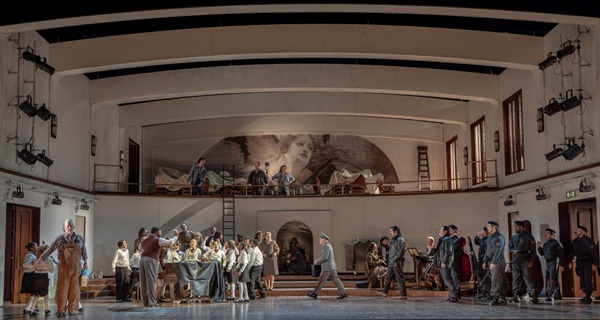
Yet there is a difference in between making an opera relevant and making it contemporary by changing the setting and beefing up the violence. Miskimmon’s ‘re-imagined’ production places the entirety of the unfolding drama in a non-descript and drab mid-1950’s concert hall, sparsely furnished with a grand piano and some musical instruments, and puzzlingly decorated with an uncompleted Botticelli-style mural on the back wall, and a shrine to the Virgin. So determined is Miskimmon to underline the political message that the programme’s ‘Tosca -The Art of Resistance’ spells it out. This leaves little room for ambiguity or subtlety. The staging feels heavy-handed, its visual and dramatic choices insisting on their meaning rather than allowing the drama to speak for itself. The smashing of the piano by Scarpia’s leather-jacketed subordinate Spoletto and his thuggish henchmen in the third act, and preparations for a bonfire of musical instruments are painfully literal gestures, reducing the complex relationship between art and political coercion to trite theatrical symbolism.
Gone are the familiar settings of the three acts; the chapel of the church of Sant’ Andrea della Valle; Scarpia’s study and ensuite torture chamber in the Palazzo Farnese, and the starlit ramparts of Castel Sant’Angelo. The relocations are not without cost. In removing the action from its specific historical and religious context, the production lost losing something of the richness of Puccini’s original conception. This was particularly apparent in Act I where the collision between Church, State and the police, so vividly conveyed in the Te Deum, is central to the opera’s political world. Scarpia’s calculated invocation of religious ceremony while plotting violence and exploitation reflects the uneasy relationship between the church and the state under an authoritarian regime, and without the visual reminder, that complexity is lost.
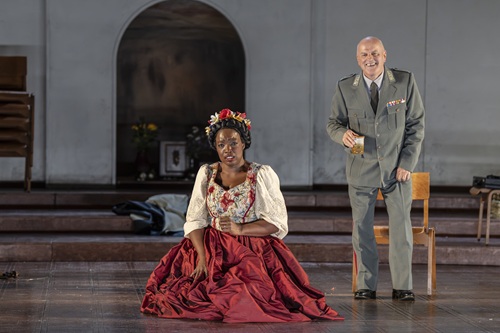
Fortunately, the strength of the musical performances provided the evening’s strongest argument for the work. Joined by a strong supporting cast and lively choruses (particularly those talented children from Marlborough Primary School), US soprano Axelle Fanyo thrilled as Floria Tosca. Rich and steady at the lower end of the register and effortlessly pure at the top end, she gave her famous second act lament ‘Visse d’arte’ (‘I lived for my art. I lived for love’) poignant resonance. Her Cavaradossi, the American tenor Chaz’men Williams-Ali, although occasionally stretched at the top of his range, sang with elegance and precision and brought a lapidary dignity to the role. He invested ‘E lucevan le stelle’ (‘And the stars were shining’) with immense feeling, conjuring the magic of a starlit Roman evening, despite the production’s conspicuous lack of a night sky. Christopher Purves, whose shaved head and military jacket made him a dead ringer for Il Duce, dominated theatrically and musically as the sadistic Scarpia. He was greeted with good-humoured hissing and booing at the curtain call, though the audience’s playful response raised an interesting question: just how threatening had they really found his villain? The rest of the cast provided strong support in the minor roles.
Underpinning these performances, the musicians of the English National Opera under the assured baton of Ben Glassberg brought out the rich textures of Puccini’s orchestration, moving between brooding menace, sumptuous lyricism and moments of exquisite tenderness with consummate ease.
Ultimately, the evening carried Tosca’s true message: that great music, performed with supreme artistry, always triumphs. The production may have sought to impose its own vision on Tosca but the power and beauty of Puccini’s score proved stronger.
Chris Sallon
Featured Image: English National Opera’s Tosca (close of Act I) © Ellie Kurttz
Creatives:
Director – Annilese Miskimmon
Set designer – Rosanna Vize
Costume designer – Evie Gurney
Lighting director – Lee Curran
Movement director – Imogen Knight
Fight director – Brad Wendes
Intimacy director – Haruka Kuroda
Children’s Chorus director – Patrick Barrett
Chorus director – Matthew Quinn
Cast:
Floria Tosca – Axelle Fanyo
Mario Cavaradossi – Chaz’men Williams-Ali
Scarpia – Christopher Purves
Angelotti – Aleric Green
Sacristan – Robert Hayward
Spoletta – Osian Wyn Bowen
Sciarrone – Steffan Loyd Owen
Gaoler – Ronald Nairne
Shepherd Boy – Tristan Meziere