
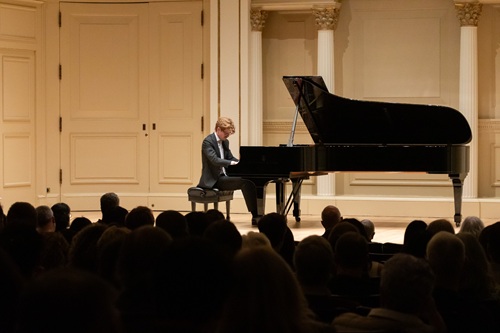
 United States Various: Carter Johnson (piano). Weill Recital Hall at Carnegie Hall, New York, 4.11.2026. (DS)
R. Schumann – Arabeske in C major, Op.18; Ghost Variations WoO24; Davidsbündlertänze, Op.6
Schnittke – Prelude and Fugue (1963)
Bartók – Piano Sonata, Sz.80
Encore: R. Schumann – Fantasie, Op.17 (ending)
Carter Johnson made his debut at Carnegie Hall in an insightful recital that bridged two centuries of works, revealing his discerning approach to profound and complex piano repertoire. As the most recent winner of the Dublin International Piano Competition in 2025, he proved the judges right: not only did they choose a musician with surety and in technical acumen but one with a clear roadmap to developing a distinct, recognizable style.
Johnson’s choice of repertoire for his Carnegie debut was ambitious. Equally so was his decision to perform each work by memory with the briefest of pauses between to signal that we were not to clap. An atmosphere of immersion and intense focus fell over the hall, and the audience took to it readily.
The first half of the concert intertwined two extraordinary 20th-century works with late Robert Schumann pieces. The program notes emphasized Schumann’s mental struggles at the time of their composition which some would argue were musically evident. After opening with a stunning Schumann Arabeske that he presented as an exchange between pensive and dramatic material, Johnson shifted impressively to Schnittke’s Prelude and Fugue – a work that he convincingly showed can mirror the contemplative aspects of the Arabeske while dialoguing with its stinging, stormy side. Johnson stacked heavy chordal densities that gradually changed from deliberately thorny sections into passages of voluminous blossoming clarity, even in the face of some strident dissonant harmonies. It was exciting, to say the least.
In Schumann’s Ghost Variations which followed, Johnson’s signature approach to the piano as a powerful tool of human expression became ever more evident. The instrument is obviously his monster to tame; he led it through tightly reserved lines, drew out loosely phrased legato passages and expanded its sonority with dramatically held chords that seemed to push the piano into the space of a human voice trained to hold out to the very last breath.
Again, with hardly a pause, he plunged directly into Bartók’s Piano Sonata, written in 1926 for a 97-note piano – the Imperial Bösendorfer. Johnson performed it on a standard 88-key Steinway grand. His intelligent working of the sonata and sheer brawn in tackling the keys managed to jam 97 into 88. As explained in the program notes, adjustments are required, and he achieved them heroically. Notably, the third movement shifted between light and dark material with such gumption that Johnson seemed to be egging himself on. To his credit, he unleashed a wilder temperament in the final phrases while still giving the structure full reign. He ended the work with a powerful stop that spurred the pent-up audience into a round of effusive applause.
After the intermission, Johnson spoke briefly about the final work: Schumann’s Davidsbündlertänze. He described this 18-piece work as encompassing ‘all of life’s experiences’ and dedicated it to his wife. With dreamy and anxious movements, some joyful, others longingly melancholic and some representing urban or pastoral life, Johnson performed each as a distinct miniature work. Yet, as the piece progressed, his attention to detail proved a careful crafting towards the holistic long view – one that resulted magnificently in a narrative journey.
Johnson’s encore landed as inventively as the whole recital: he played only the ending of Schumann’s Fantasie, Op.17. It was a dash of music, a literal coda, a sweet farewell to his first (and let’s hope not last) Carnegie Hall audience.
Daniele Sahr