
 United Kingdom Offenbach, Barkouf (concert performance): Soloists, Chorus of English National Opera, RNCM Opera Chorus, The Hallé / Paul Daniel (conductor). Bridgewater Hall, Manchester, 4.10.2026. (PH)
Cast:
Maïma – Anne-Catherine Gillet
Saëb – Mathias Vidal
Bababeck – Loïc Félix
Balkis – Valerie Eickhoff
Xaïloum – Philippe Talbot
Kaliboul – François Piolino
Périzade – Katia Ledoux
Le Grand Mogol – Thibault de Damas
Four years after their last foray into Offenbach with La princesse de Trébizonde, Opera Rara are back with Barkouf, an opéra bouffe from 1860, which was Offenbach’s first for the Opéra-Comique. Offenbach had spent his twenties strutting his stuff around the fashionable haunts of Europe as a virtuoso cellist. In his thirties he was the conductor and music director of his own company, the Bouffes-Parisiens. The company played a summer and a winter season (in different venues, I think) and Offenbach wrote at least 30 one-act opérettes for them in the period before Barkouf. He also presented at his fringe theatre on the Champs-Élysées many other works by the likes of Mozart, Rossini (several of his farse and drammi giocosi) and other great names. He commissioned works too. That charming double-bill Le docteur Miracle by Bizet and Lecocq was written for the Bouffes-Parisiens and first led by Maestro Offenbach.
Perhaps Offenbach’s first great success though was Orphée aux enfers in 1858. This show had a run of over 200 performances in its premiere production, a great triumph for him. His Orpheus was a two-act show, and he wrote another the following year: Geneviève de Brabant. Perhaps it was this that led the prestigious Opéra-Comique to come a-calling. The newly installed boss at the house matched Offenbach up with the great librettist Eugène Scribe. What could go wrong? Well, plenty actually. The establishment, ever a strong presence in French musical life, made things very difficult for this upstart from the outside. There were problems with the censors too. Barkouf did get on stage, on Christmas Eve in fact, and had a short run into the new year. Berlioz reviewed it but wasn’t particularly kind. After those performances, it was never heard again until the 2010s.
The plot concerns a state in a faraway mystical Eastern realm. The emperor, or Grand Mogul just cannot find the right man to lead his nation. There is political corruption, sleaze, rebellion and U-turns aplenty. One leader after another is forced to resign or is pushed out (literally). Sound familiar? Surely this state of affairs couldn’t exist in the modern age? Not in our modern-day liberal democracies, not with our well-established rules-based order? Ahem.
The emperor will instal a new type of ruler. He puts a dog, Barkouf by name, on the throne. We never see him, but we hear him. In fact, he will Of’en Bach (sorry – I had to get that one in the review – one of my favourites of Alistair McGowan’s howlers). The only person who can approach this temperamental pooch is its former owner and lead soprano, Maïma. There are sub-plots, intrigue, plenty of love interest and giggles. Offenbach’s light and fizzy score provides great entertainment and much musical interest over the three acts.
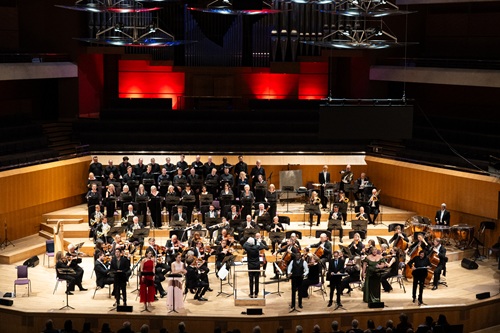
This concert performance of Barkouf comes at the end of a week where Opera Rara, the cast, chorus and orchestra have been recording the work at Hallé St Peters. I didn’t see any microphones on the stage at the Bridgewater Hall so the recording must be virtually finished, with no need for any extra supplementation. The orchestra lined up in a 10,8,6,4,3 formation for strings, double woodwind, four horns, two trumpets, three trombones and light percussion. The chorus numbered about 35.
There were four principal singers and stand-out artists in Barkouf. They were led by the soprano Anne-Catherine Gillet as Maïma. Gillet is an Offenbach specialist. She sang the title role in La princesse de Trébizonde for the company (mentioned earlier), and she has recorded La Vie Parisienne for Palazzetto Bru Zane (review here). For me, she was the star of the show. Her voice is fresh, clear as crystal, her intonation is spot-on. Her tone is equalised over the full compass of her span and she can trill too. Maïma is the lovely market seller who has had both her man, and her dog stolen from her. She is a clever minx though and her look on life is positive and pragmatic. You always know she will come out on top! In Act II she has a showpiece aria: ‘Ici, Barkouf!’ and in the final act she even has a drinking song. Both set pieces allowed Gillet to show off her impressive coloratura. Maïma’s best friend from the market is Balkis. Her chap is a bit of a loose cannon. He is the one getting into trouble and starting the protests. Balkis was sung by the young mezzo-soprano Valerie Eickhoff. Here is a name to watch. She sings at the Semperoper in Dresden, but it surely won’t be long before we see her more. A rich, wide-ranging voice, sultry and full, very nice at the top. The duet both ladies have in Act I: ‘L’espérance m’est ravie’ was divine. That will surely be one to sample on the recording.
The main tenor role in Barkouf is the baddie Bababeck. He is a kind-of chief civil servant in the state. He had hopes of becoming the new governor before Barkouf got that role. Bababeck is not to be trusted, and in another twist, he has a daughter (in her forties now) who he is extremely keen to get married off, so he can start to enjoy himself. Bababeck was taken by another Offenbach master, the tenor Loïc Félix, again familiar to many in recordings made for Opera Rara and Bru Zane. This is a character role. There are not so many opportunities to show beauty of line or deft phrasing. Félix made the role exciting, nonetheless. There are moments where he sounded almost baritone, and then in the next scene he would thin the tone down and serenade us with a completely new texture of tessitura.
I would have loved very much to hear more of Mathias Vidal. I think this was the first time I have seen this singer live. I know some of his many recordings: Lully, Rameau, Gounod even. I was really impressed with what we did hear of his Saëb. A strong virile and very stylish singer, able to refine his voice down to the sweetest pianissimo at will. The role is not large though and that was a shame. Other cast included Balkis’s beloved Xaïloum sung by Philippe Talbot, a little too timid of voice to me, but he did well in the third-act ariette. Bababeck’s oft-veiled daughter Périzade was Katia Ledoux, and the Grand Mogul himself Thibault de Damas. We don’t hear too much from the chief, but I would have liked a more imposing presence in the amplitude department if I am being completely honest.
One important contribution at this concert performance, but surely not on the record, due next year, was the narration and comedy stand-up set of Alistair McGowan. This wouldn’t have gone down the same with everybody, but I loved it. He delivered the story and commentary on the events with a brilliant rhyming script specially written by Jeremy Sams. McGowan being the great impersonator he is, couldn’t resist getting in all his best characters and regional accents. My favourites were Severus Snape and new City manager, Enzo Maresca. Was it just me, or did his Barkouf references owe something to Boris Johnson too?
Offenbach’s long lost and neglected opera Barkouf is definitely worth hearing and fully justifies its revival. If I will remember one thing most, it would be the long, expertly crafted finale to Act II. It reminded me of the one in the same place in Le nozze di Figaro. Great choral moments, sublime writing for woodwind, especially clarinet and oboe, entries, exits, shenanigans, but then to stop the clocks, a septet of soloists in a barcarolle-like bliss, which put me in mind of Les contes d’Hoffmann. Gorgeous.
I was glad Opera Rara chose to come to Manchester once again to work with the Hallé. I was very fortunate to sit on the row behind one of my all-time heroes, Sir Mark Elder. I saw a certain smile come to his face and a twinkle in his eyes several times as he looked down on his beloved orchestra. There is one thing I regret about the whole event though: I had got to the hall early as I had heard there would be a pre-concert talk. I was really hoping that the eminent Offenbach scholar and editor Jean-Christophe Keck would be there. I know it is only thanks to him we have Barkouf at all. I knew he had been in town during the week for the recording and I had a couple of questions I had prepared. For one, I wanted to ask him what works specifically by Rossini and others, Offenbach had done at the Bouffes-Parisiens in the 1850s? He would have known, I am sure. More pertinently I had discovered that Offenbach and the great founder of the Hallé, Sir Charles Hallé were exact contemporaries. They were born just two months apart. Both had come from Germany to Paris, and both were active there throughout the late 1830s and 40s. Surely, they had collaborated. Did Monsieur Keck know off hand of anything they had worked on together?
Alas, the professor was not on the stage involved in the talk, and these questions remain unanswered. I have it on good authority though that he was in fact at the performance. Also, I understand from reliable sources we all heard him. Next year if you buy the CDs, you may hear him too. Can you guess? Woof, woof, woof….
Philip Harrison