
 United Kingdom ‘Māori Music Evening’: Georgia Steel (viola), Andrew Nesler (piano), Blake Huang (piano), Ellis Carrington (voice). St Mary’s Minster, Swansea, Wales. 21.10.2026. (LJ)
Mere Boynton – Aio (2023)
Aiono Manu Fa’aea – Ala Mai Moana (2023)
Tabea Squire and Arapera Blank – He Wawata kia Mahorahora (2023)
Helen Fisher and Lauris Edmond – O Little One (2023)
Janet Jennings and Jeni Curtis – Talking of Goldfish (2023)
Stuart Greenbaum – Sonata for Piano Four-Hands (2013) and Leaving Earth, Sonata for Viola and Piano (2017)
Gareth Farr – Ngake and Whātaitai (2022)
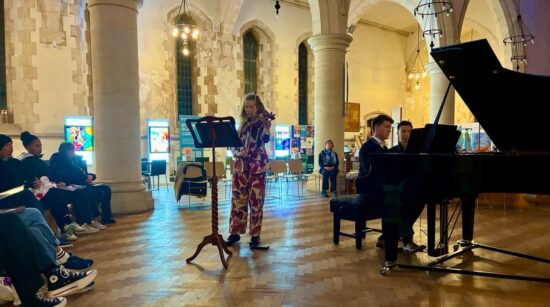
Billed as a ‘Māori Music Evening’ celebrating Creationtide, this concert consisted of new and largely unheard music from Oceania. The musicians, all recent graduates from the Royal Welsh College of Music and Drama, selected a fascinating programme of contemporary music which they performed at Swansea’s St Mary’s Minster. The Minster is currently hosting Luke Jerram’s Gaia artwork – a floating planet created from detailed NASA imagery of the Earth’s surface, measuring six meters in diameter. To coincide with this installation, the musicians selected pieces that were centred on the theme of sustainability.
More specifically, the programme was inspired by the notion of kaitiakitanga. New Zealand-born violist Georgia Steel explained that this is a Māori word that connotes the act of protecting the earth and its inhabitants in a way that involves each of us seeing the natural environment as an equal partner to humanity. Hence, the music explored our connection with the land and the consequences that emerge when we distance ourselves from this notion of kaitiakitanga.
The concert was bookended with Ellis Carrington, accompanied by pianist Andrew Nesler, singing five songs that were written by female composers from New Zealand in 2023. Carrington selected songs written by Mere Boynton, Aiono Manu Fa’aea, Tabea Squire, Helen Fischer, and Janet Jennings. Their music is associated with the 21 x 21 project which commissioned twenty-one women composers to create songs with poets from Aotearoa New Zealand. Initially, Carrington may have been slightly nervous, but there was still a mellowness to her voice, and, in the final two songs (Fisher’s O Little One and Jennings’s Talking of Goldfish) she demonstrated considerable promise for pieces that would require messa di voce and recitative. Lauris Edmond’s poem for O Little One was inspired by tensions between Māori and European settlers in New Zealand, preceding the Wairau Affray of June 1843. Its story follows the plight of a baby whose mother, Rangihaua Kuika, had been murdered two months earlier, is cared for by Sarah Ironside. The poem contrasts the child’s vulnerability and the limits of compassion within a society marked by prejudice. Carrington, clearly more comfortable in the lower mezzo-soprano range, demonstrated her ability to convey this song’s meaning as well as its blend of anguish and sorrow.
Two works by Australian composer Stuart Greenbaum featured during the concert. The first – Sonata for Piano Four-Hands (2013) – comprises three movements: ‘Solar’, ‘The Expanding Universe’, and ‘Earthrise’. Greenbaum’s minimalist music recalls elements from Arvo Pärt, Steve Reich, Gustav Holst, and Pat Metheny. He has explained that the piece combines the challenge of two pianists sharing one keyboard with a broader mediation on elements of the universe. Appropriately, given that the performers played directly underneath Jerram’s Gaia, the final movement refers to William Anders’s photograph of Earth during the Apollo 8 mission in 1969. The work does not strictly follow the conventional sonata form, rather, it requires both pianists to connect themes through recurring patterns and changes of texture, dynamics, and pace. Thematically, Greenbaum asks for the pianists to measure the piece’s sense of cosmic scale against the fragility of life on Earth. In the second movement, Andrew Nesler and Blake Huang were balanced and coordinated, giving the audience a taste of what this partnership could become. As a duo, they performed with intelligence and sensitivity. With Nesler’s melodiousness balancing Huang’s dynamism, there is a bright spark between them which bodes well for their future as ‘Duo Digitalis’.
Nesler also accompanied Georgia Steel for Greenbaum’s Leaving Earth, Sonata for Viola and Piano (2017). Like his earlier Sonata, this one returns to the relationship between humanity and the planet. The trajectory of this three-movement sonata, however, is much less optimistic as Greenbaum imagines a future where life as we know it can only be remembered. The movements are titled ‘Realisation (we have to go)’, ‘Earth Abandoned’, and ‘Memory of Life on Earth’. The piece also contains performance directions. This involved both performers removing their shoes, and Steel walking barefoot to the chancel and back during the second movement. Steel’s solo, which they performed from the chancel, was moving: their tone was rich and their pace matched the solemnity of the music. Indeed, both musicians’ timing was accurate and their interpretation evoked an almost cinematic soundscape.
I was somewhat less convinced by the performance of Gareth Farr’s Ngake and Whātaitai (2022) for viola and piano. Steel and Nesler lacked the confidence (perhaps rehearsal time?) required to pull off such a textured work. Farr’s piece draws on a Māori legend about two taniwha: creatures who outgrow a vast lake to force their way through rocks and into the sea, and, as a result, create Wellington Harbour. It is playful and dramatic in the way the viola and piano intertwine to suggest the creatures’ movements. The performance, however, required both more boldness and lightness to convey an equal sense of daring and fun.
This said, the evening was one of intelligent and sensitive musicianship. There were moments of charisma and there was plenty of promise. Ultimately, music like this, to quote Steel: ‘brings our responsibility to care for the land and everything that comes with it to the forefront’. With climate crises showing no signs of cessation, we would all benefit from adopting more of a kaitiakitanga approach to our planet. To raise awareness of this cause, I hope St Mary’s Minster will invite these musicians to perform again.
Lucy Jeffery