
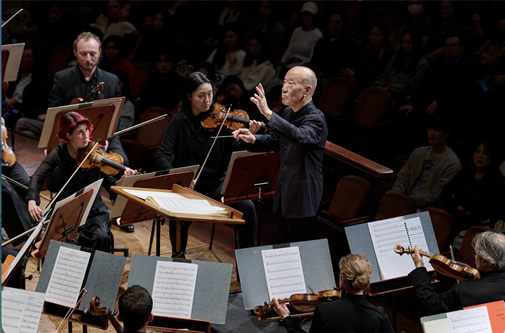
 United States Various: San Francisco Symphony / Joe Hisaishi (conductor). Davies Symphony Hall, San Francisco, 22.10.2026. (HS)
Steve Reich – Music for Ensemble and Orchestra (San Francisco Symphony Commission)
David Lang – mountain
Joe Hisaishi – Concerto for Orchestra (San Francisco Symphony Commission)
Joe Hisaishi is best known in the West for his beautifully executed scores for Hayao Miyazaki’s Studio Ghibli animated films, among them the esteemed and popular Spirited Away and Howl’s Moving Castle. He also won an Academy Award for his score for a 2008 Japanese film, Departures.
The 75-year-old Japanese composer is also a superb conductor and not just of his own music. His past North American tours have focused almost entirely on music from his Studio Ghibli scores, including his previous visit to the San Francisco Symphony in 2024. The focus on the current North American tour is his Concerto for Orchestra, a boldly expansive, five-movement, 45-minute piece. San Francisco Symphony is a co-commissioner, and the world première was in May with the National Orchestra in Washington.
It certainly delighted a capacity audience Thursday in Davies Symphony Hall, much more than the late-Minimalist pieces by American composers did. As a conductor, Hisaishi brought out the better aspects of Steve Reich’s typically chugging 2018 Music for Ensemble and Orchestra and Lang’s disturbingly clumsy mountain. These pieces set the scene for Hisaishi’s own layered, complex and energetic concerto to make a much bigger splash.
In recorded and translated remarks, Hisaishi acknowledged that American Minimalist composers intrigued him. Even his film music carries some of the genre’s elements – a rhythmic groove, melodies that circle back on themselves and, in his pieces for big ensembles, a tendency to play with orchestral color.
These aspects may be part of his musical DNA but he also demonstrated a fondness and command of counterpoint in the new work. It is fashioned after Baroque more than Bartók and, as the five movements unfolded, I found myself thinking of Vivaldi and Handel rather than Bach. Not like every minute is counterpoint but, like Baroque music, once it gets going it keeps pushing ahead.
The work very much fits the definition of a concerto for orchestra. Like the most famous one (Bartók’s) aimed to do, it gives every instrument a virtuosic moment in the sun and finds ways to make unexpected pairings in duets and smaller ensembles. Among the stars in this endeavor were principals Yubeen Kim on flute, Carey Bell on clarinet, Joshua Elmore on bassoon, Mark Inouye on trumpet and harpist Katherine Siochi, who seemed to be there to connect almost every cheery moment. Resident pianist John Wilson and the entire percussion section (even without principal Jacob Nissly) were important presences as well.
Each of the five movements offered a different flavor. They are not titled, not even with tempo indications: just I, II, III, IV and V. Hisaishi seemed to be more interested in creating mood and atmosphere. Rather than following specific classical musical forms such as sonata allegro or theme-and-variations, Hisaishi celebrated dance. Syncopation abounded, sometimes for a comic wink but more often as an element to tie together a range of musical ideas.
A soft pulse introduced the first movement, centering on lower strings against steady chords from piano and harp. Over the course of the movement the pace sped up in gradual steps. It was in no hurry to get to a destination, instead savoring orchestral colors, swirls of high woodwinds and juicy harmonies from mallet percussion (glockenspiel, vibraphone, xylophone and marimba) threading together rather than clattering. It all rose to a broad, fast climax which, of course, drew applause from an audience not entirely comprised of seasoned classical music veterans. Gentle pizzicato in the strings started the second movement against bouncy syncopations of vibes and piano. As it developed and the jaunty themes found their way around the orchestra, my mind pictured ghosts dancing in a Miyazaki animated sequence. A giggly bassoon duet with the tuba brought smiles.
The third movement opened with scary soft dissonances and offbeat complex rhythms that had many of the musicians bobbing their heads to keep things clear. The movement climaxed with an extensive percussion sequence, the various mallets overlapping in a sort of boogie-woogie. The fourth movement would qualify as a scherzo. It started with flute tunes hopping over harp chords, and the clarinets picked up the phrases, with a solo expanding each time into a repeat from the whole section. It was dance music but not exactly an identifiable style. It just kept coming up with another idea until it softened at the end of the movement to a fadeout by the piano.
The finale referred to musical figures we heard in the first four movements, a classic symphony element, but the style charged forward like a Handel ensemble finale. Phrases played against each other. A softer middle section lightened things up with strings playing the counterpoint, and a lot more syncopation than one might find in the Baroque spiced things up. It gathered its energy for a thumping finish (literally three separate drumbeats).
The way Hisaishi layered the variety of sounds and gestures made this a more satisfying thing to experience than the two pieces in the first half, both of which lost momentum with just too much of the same and not much variety in dynamics either.
Reich’s 20-minute foray into his advanced style of Minimalism, also commissioned by San Francisco Symphony, debuted in 2018. It was framed intellectually in its five movements by the prevailing durations of the notes. Sixteenth notes dominated I and V, eighths in II and IV and quarters in III, an idea that Reich used for his 1978 Music for a Large Ensemble. The charm of the early piece was hard to find in the new one’s seriousness.
Even more dour was Lang’s 13-minute tone poem, mountain. Inspired by a stay in Vermont, the piece is built around loud thumps from bass drum, timpani and other dark percussion. After a breath, a musical flurry in Lang’s big Minimalist (and mostly consonant) style, another pause and a thump.
The contrast made Hisaishi’s concerto even more welcome.
Harvey Steiman