
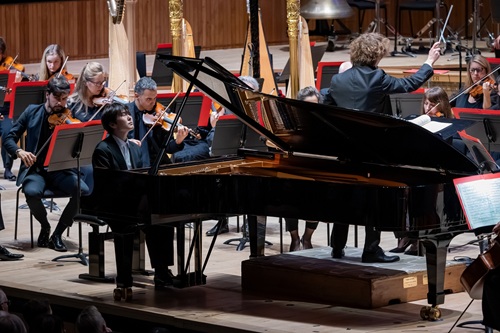
 United Kingdom Borodin, Tchaikovsky, Shostakovich: Seong-Jin Cho (piano), Philharmonia Orchestra / Santtu-Matias Rouvali (conductor). Royal Festival Hall, London. 22.10.2026. (AV-E)
Borodin —In the Steppes of Central Asia
Tchaikovsky — Piano Concerto No.1
Shostakovich — Symphony No. 11 ‘The Year 1905’
Borodin’s In the Steppes of Central Asia was an inauspicious beginning to the evening. Intended to evoke the slow passage of a caravan across the steppe, the music remained strangely stagnant, its gently unfolding melodies never generating any atmospheric radiance. What should have been an evocative orchestral tableau felt lame and lacklustre, its colours failing to coalesce into anything compelling.
Yet the work’s picturesque surface conceals a more troubling historical perspective. Composed for celebrations marking the silver jubilee of Tsar Alexander II’s reign, it depicts a Central Asian caravan travelling under the protection of Russian soldiers, with the Russian and ‘Asiatic’ melodies eventually merging into a common harmony. The score thus casts imperial protection as benevolent and the encounter between two cultures as a harmonious accommodation, leaving the realities of Russian expansion in Central Asia beyond the frame.
Viewed through the lens of Edward Said’s critique of Orientalism, this idealised vision turns a complex region into an exoticised spectacle, reducing its cultural identity to pretty picture-postcard imagery for Western consumption.
With a substantial Asian contingent in the audience, many of whom had come to hear Seong-Jin Cho, the work’s inclusion seemed an especially uneasy choice. Tedious in itself, and routinely conducted and played, this reactionary work had neither musical vitality nor any critical engagement with the imperial idyll it perpetuates. In an already substantial programme, it felt unnecessary; the full house responded with lukewarm courtesy.
Tchaikovsky’s First Piano Concerto exposed a glaring mismatch between Seong-Jin Cho and the Philharmonia. The opening brass fanfare, underpinned by timpani, sounded feeble, lacking the brilliance and attack the music demands. Cho’s thunderous piano chords immediately exposed the weakness of the orchestral response. When the strings took up the great, sweeping D-flat major melody, they failed to make it soar; what should have been an irresistible outpouring of romantic grandeur sounded curiously underpowered.
Cho, by contrast, played with ferocious physical commitment, wrenching drama from the keyboard with weight, bite and a thrilling sense of danger. His fingers flashed through passages of dazzling agility before plunging back into the music’s muscular turbulence. As the first movement moved into its restless Allegro con spirito, he drove the music forward with formidable momentum, sharpening contrasts and hurling phrases towards their climaxes. Yet the orchestra remained dutiful where it needed to be volatile, unable to transform Cho’s intensity into a genuinely shared musical argument. The concerto’s potential for friction and confrontation never caught fire.
The second movement (Andantino semplice) offered a more intimate test. Its delicately plucked strings and solo flute should establish an atmosphere of effortless, almost vocal grace. Instead, the flute sounded dull and characterless, while the pallid orchestral texture undermined the music’s tenderness. Cho brought expressive warmth and refinement to the piano writing, shaping its ornamentation with a subtlety that revealed the poetry of the movement. But the exchange lacked the spontaneity of a real conversation. The central Prestissimo briefly raised the temperature, Cho dispatching its fleet-footed writing with exhilarating sparkle, though the orchestra again sounded leaden by comparison. When the opening mood returned, the players failed to recover its elusive intimacy.
The finale (Allegro con fuoco) restored Cho’s formidable energy, but the orchestral shortcomings became harder to overlook. He gave the opening dance rhythms incisive bite and dazzling agility, yet the exchanges lacked the rhythmic spring needed to make them spark. More tellingly, when the violins introduced the lyrical second theme, its great melodic sweep failed to open out into the romantic grandeur the music demands. Cho’s expansive account of the melody, when it passed to the piano, made the contrast painfully clear.
Cho so completely commanded the audience’s attention that Rouvali and the Philharmonia appeared incidental to the occasion. For an encore, Seong-Jin Cho played Tchaikovsky’s October: Autumn Song from The Seasons, Op.37a, with autumnal austerity, aching allure and ardent artistry, anointing an appreciative applause.
The concluding work, Shostakovich’s Symphony No. 11, revealed a remarkable transformation: under a revitalised Santtu-Matias Rouvali, the Philharmonia sounded like a different orchestra, playing with a concentration and commitment conspicuously absent in the Tchaikovsky. The opening, with muted strings suspended in bleak, open harmonies, evoked a frozen landscape where time had stopped. The timpanist played the recurring, quietly menacing timpani figure with remarkable control and precision, establishing the insistent pulse that forms the structural backbone of the movement.
Distant trumpet and horn calls sounded like warnings across the desolate square, while the woodwind lines emerged from the cold. The Philharmonia played with extraordinary concentration, every quiet passage charged with tension. As fragments of revolutionary song surfaced, the flute’s statement of Listen! carried a plaintive human quality against the impassive orchestral landscape. Rouvali never forced the music towards premature drama, allowing the dread to accumulate. When the opening stillness returned, faint tremors in the strings transformed it into a terrible suspension before catastrophe.
Rouvali’s hypersensitive control of pacing and dynamics was both exacting and exceptional. The music needed no theatrical exaggeration; its tension arose from the stark economy of the writing and the precision with which each entry was placed.
Such restraint made the emotional effect all the more disturbing: anxiety deepened into dread, and dread into terror. Nothing was forced, yet the psychological strain became almost unbearable. The horror lay in the music’s refusal to release that tension, leaving the audience suspended between anxious apprehension and agonised anticipation; a nervous stillness in the hall was palpable, the audience held on tenterhooks.
The second movement (The Ninth of January) shattered the eerie stillness with a sudden eruption of orchestral violence. Restless, surging strings drove the music forward with mounting urgency, the Philharmonia now displaying the attack and unanimity missing earlier. Rouvali built the tension relentlessly, keeping the accumulating rhythmic energy under tight control until the side drum cut through the texture and the strings launched into their fugato, the recurring timpani figure transformed into a brutal, insistent pulse.
The effect was not simply loud or forceful: the music evoked a crowd surging into motion, caught between agitation and terror. Rouvali never allowed the passage to become a shapeless onslaught; each layer remained distinct, the orchestral detail sharpening rather than obscuring the mounting horror. As the opening material returned, the trembling string trills deepened the atmosphere of panic and dread.
The climaxes landed with devastating weight, but what made the performance so disturbing was the precision beneath the violence. Rouvali and the Philharmonia conveyed not heroic struggle but the terrifying machinery of repression, the crushing of human voices beneath an overwhelming force. The movement left no room for consolation.
The third movement (Eternal Memory) brought a change of emotional register, the grief of the preceding movement settling into a sombre, deeply affecting lament. Rouvali drew bleak playing of grave intensity from the Philharmonia, allowing the long string lines to unfold with patient eloquence rather than sentimental excess. The melody seemed to carry the weight of collective mourning, its repeated phrases suggesting not consolation but the persistence of a grief that could neither be assuaged nor forgotten. The brass added a dark, restrained solemnity, while the strings sustained the movement’s elegiac character with impressive unanimity. Rouvali resisted any temptation to overstate the emotion, allowing the music to speak through its simplicity and the cumulative force of its repetitions. After the savagery of The Ninth of January, this was grief stripped of rhetoric, all the more affecting for its restraint.
The finale (The Tocsin) began with renewed agitation, the music gathering towards a final, uncompromising confrontation. Rouvali shaped the movement with a firm sense of direction, driving the tension towards a succession of increasingly violent climaxes. The timpani and trumpets delivered repeated, stabbing blows, answered by further brass interjections as the cellos and double basses drove the music forward with relentless insistence. Particularly striking was the long, crunching tread of the cello line, whose repeated figures gave the march a grim, inexorable momentum. Rouvali held the accumulating forces in a taut, coherent grip, and the Philharmonia played with tremendous gusto and palpable passion, the intensity and unanimity of the performance making the symphony’s final struggle overwhelming.
After this mounting violence, the music subsided into the glacial stillness of the opening movement, the strings suspended in an icy hush beneath a long, haunting cor anglais solo. Alex Franklin captured the music’s desolation with exquisite control, the plaintive line seeming to emerge from a landscape emptied of human warmth. Rouvali sustained the fragile stillness with extraordinary sensitivity, allowing the silence around the solo to deepen the sense of dread rather than offer relief. The final upsurge broke through with renewed force, the bells ringing out above the orchestral mass as the music ground towards its grim conclusion.
Unusually, Rouvali allowed the final toll of the bell to ring out fully into the hall, its echo lingering for around ten seconds before anyone dared to applaud. Letting the bells ring on after the orchestra has stopped is an interpretative choice also favoured by Mstislav Rostropovich, who recognised the dramatic power of the toll lingering in isolation.
Having heard Vladimir Jurowski and the London Philharmonic Orchestra perform the symphony at the Royal Festival Hall in December 2019, when the bell was immediately muffled, I found Rouvali’s decision to let the sound ring out especially striking. For the difference was startling: rather than cutting off the reverberation, Rouvali allowed the lingering sound to hold the entire hall in suspension, the toll seeming to endure for an eternity over those ten seconds.
I have never heard Shostakovich’s Eleventh Symphony conducted better than this paradigm performance of such passion and precision.
Alexander Verney-Elliott
I agree totally with your comments about the concert- first half did seem as in your face as the Piano Concerto could be and the Borodin was rather dull, but yes the second half was magnificent! The Shostakovich I had never heard before but its orchestration was stunning and this Philharmonia performance was worth the wait.
As for the final few minutes of the last movement, Rouvali as you mentioned allowed the final toll of the bell to ring out with no muffling – what a mesmerising effect it had and it makes the difference that these were real bells, on loan I believe from the Hallé so big thank you for them. They are colossal in size! I don’t know who the percussionist was but he was superb, in fact so was the entire orchestra!