
 United Kingdom Tippett, Vaughan Williams, Adès, Sibelius: Anthony Marwood (violin), Bournemouth Symphony Orchestra / Mark Wigglesworth (conductor). Lighthouse, Poole, 21.10.2026. (CK)
Tippett – Concerto for Double String Orchestra
Vaughan Williams – The Lark Ascending
Adès – Märchentänze
Sibelius – Symphony No.5
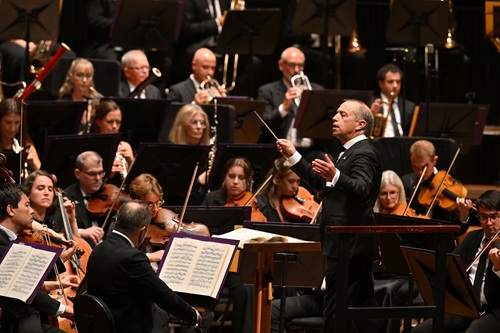
What better way to begin a concert? It was a treat to see the marvellous Bournemouth Symphony Orchestra string section with the stage to themselves for an invigorating performance of Tippett’s Concerto for Double String Orchestra, and to hear the two equally constituted string bands – mirror images of each other – tossing Tippett’s inexhaustible fund of ideas back and forth between them. In the Allegro con brio Mark Wigglesworth made sure that the musical ball never touched the ground: the playing was superbly tensile, with delicacy and lightness here, muscularity and strength there, bursting with the wiry lyricism of which Tippett was master, and which in a good performance – and this was certainly that – achieves an almost un-English kind of ecstasy.
There was no heaviness in the exquisite Adagio cantabile either: the beautiful and bluesy melody (Oliver Soden’s programme note referenced Bessie Smith) was tenderly delivered by Amyn Merchant and sounded no less wonderful when it returned on Tamsy Kaner’s cello. Then we were off again in the final Allegro, the dance rhythms irresistible, the excitement growing until that wonderful tune with its Scotch snaps sails in to cap the work. A few weeks ago I was in the Matisse Museum in Nice, and the music put me in mind of the artist’s huge and immersive cut-out The Swimming Pool, the leaping figures full of airborne and waterborne joy.
Wigglesworth and the BSO ended last season with an almost unbearably moving A Child of Our Time. There is so much more – the Fantasia Concertante on a Theme of Corelli, the Ritual Dances from A Midsummer Marriage, the Piano Concerto, the Triple Concerto …I hope to live long enough to hear more Tippett from them. Meanwhile it was a delight to follow the Double Concerto with Vaughan Williams’s The Lark Ascending: a delight, too, to see and hear Anthony Marwood play it. He has long been familiar to me from performances of the Florestan Trio on Hyperion CD’s, but this was my first live encounter: he was a refreshing and unaffected soloist, equally thoughtful and engaging in the Q&A session that followed the concert.
Severed as we now are from the long summer, it was especially poignant to hear this Lark, to enjoy lovely sounds from the BSO winds, and to sense the music’s radiance, of which silence is an inseparable part. In a characteristically thoughtful essay on Sibelius’s Fifth in the programme, Mark Wigglesworth invited us to hear the repeated silences that end that work as ‘opportunities for us to listen to what timelessness really sounds like.’ I was there in Vaughan Williams’s silences too, at Birdlip or Bredon Hill in spirit (I am prone to the condition known to some as Cotswold Rapture). This concert has left me thinking a good deal – and positively – about silence: a precious thing.
To have Thomas Adès as this season’s Celebrated Composer is exciting indeed. The two Parts of his ballet Dante played at this year’s BBC Proms made a big impression; critics have begun to speak of him as a great composer. His Märchentänze proved to be perfect programming, featuring Marwood again as soloist, balancing The Lark Ascending, and – in the third of the four short movements – responding to it with a ‘wondrous aural fantasy’ (Andrew Burn) in which the other violins, playing freely, surround Marwood’s solo with an ‘exaltation’ of skylarks.
It is entirely magical: and the other movements all bear witness to Adès’s unique sonic imagination and ear for colour. In the first, a jolly folk tune takes some unexpected turns – there is an extraordinary passage for violin harmonics, contrabassoon and a soft bass drum – before ending in celestial jangling. The second, slower but still folk-like, begins with marimba and hushed strings; clarinet, harp, horn, oboe and gong all get a look-in. In the fourth, Marwood had a lovely, rather tipsy solo (we weren’t too far from Maxwell Davies’s Orkney Wedding with Sunrise – with a bell rather than bagpipes). Marwood’s finely attuned playing gave consistent pleasure; and the BSO, individually and collectively, revelled in the opportunities the composer gives them.
I come away from an Adès piece with ears stretched and imagination invigorated: this was no exception.
The full Bournemouth Symphony Orchestra took the stage for the concert’s finale, a magnificent performance of Sibelius’ Fifth Symphony. Wigglesworth paced the opening movement superbly, finding the music’s elemental core; it sounded unhurried and inevitable, all the way through to Tammy Thorn’s bleakly eloquent bassoon solo, the broad majesty of the brass – like a lava flow – and on through the Presto to its abruptly thrilling end (great timpani). The brass covered themselves with glory in the finale: so did the strings, their playing so quiet and concentrated at one point that it was like the texture of the wings of insects.
As we approached the end – superbly prepared for by Wigglesworth – I was grateful to him for reminding me in his essay that the music’s nobility derives from the composer’s experience of swans circling above him: an epiphany vouchsafed him by nature. It is hard to dislodge from the mind Tovey’s memorable but less satisfactory image of Thor swinging his hammer: better by far to think of the swans – like Yeats’s Wild Swans at Coole – than the belligerent Norse god. Wigglesworth then gave those silences full value. Harold Truscott wrote that the six sharp orchestral reports ‘carry without effort the weight of the whole work.’ It is the silences that do that.
Chris Kettle