
 United Kingdom C. P. E. Bach: Mahan Esfahani (harpsichord), Aapo Häkkinen (fortepiano/harpsichord/director). Helsinki Baroque Orchestra. Wigmore Hall, 19.10.2026. (CC)
C. P. E. Bach – Symphony in F, Wq 175 (1755); Harpsichord Concerto in E minor, Wq 15 (1745-7); Symphony in E minor, WQ 178 (1756); Symphony in A, Wq 182/4 (1773); Concerto in E-flat for harpsichord and fortepiano, Wq 47 (1788)
A whole evening of C. P. E. Bach is not to be sniffed at – it is such a rarity on concert programming, and yet beyond doubt this most compositionally precocious of J.S.B.’s sons deserves such focus.
The Symphony in F, Wq 175 (H.650) was directed from the harpsichord by Aapo Häkkinen. Despite some approximate horn playing (on natural instruments), this was a fine performance, with a vivid appreciation of C. P. E. Bach’s use of gesture, the first movement (Allegro assai) full of vim, the central Andante a stately dance – nice that the harpsichord elaborates on repeats, while the final Tempo di Menuetto was brisk and yet still dignified. The piece’s brevity aligns it with an opera sinfonia, as Esfahani’s own excellent notes pointed out, by Hasse or his contemporaries in Dresden (a form which made its way to Berlin, where C. P. E. wrote this symphony, via the Staatsoper Unter den Linden).
The Harpsichord Concerto in E minor, Wq 15 (H.418) is for solo instrument and strings and absolutely epitomises C. P. E.’s quirkiness, with its composed-in stop-start first movement, Esfahani in fine fettle, enjoying creating every moment of uncertainty: it is often impossible to gauge where the music will go next. This is C. P. E. as trickster – but also virtuoso (there are a lot of notes for the soloist to fit in here, and Esfahani excelled, his fingerwork glittering). The Adagio moves from the gesturalism and misdirections of the first movement to a melodious haven, the tempo here perfectly chosen (it is easy to go too slowly). The music’s darkness was so effective, as was some of C. P. E. Bach’s scoring (a violas/solo violin exchange, for example). The solo line was quasi-extempore, taking us from light to pools of darkness. Some of the melody seems to nod towards J. C. Bach, interestingly (the ‘London’ Bach). The finale leaves us in no doubt as to the author, however, restless, shifting Sturm und Drang with its low, threatening trills rubbing shoulders with ebullience. Using his harpsichord’s stops to full effect, this was a memorable performance from Esfahani, not least in a characteristically C. P. E. Bachian non-stop explosion of activity.
Finally for the first half, more E minor: the Symphony, Wq 178 (H.653), one of two versions of this symphony (which also turns up for keyboard as H.115); some might remember a recording by the English Chamber Orchestra and Raymond Leppard back in the day, where it was nicknamed ‘Fandango’. Back to full orchestral forces now, the bold octave statement of the opening made full effect – this was a performance that might as well have carried the marking furioso. Unpredictability climaxed with the movement’s ending – after a restatement of the octave’s material, the music slows to a moment that seems utterly forlorn, which in turn meant that the opening of the Andante moderato felt like something of an awakening. This movement did feel a little relentless in this performance, though – while the admittedly tricky high string opening of the finale offered a moment of uncharacteristic screechiness. But there were moments of slinkiness and even joy to follow, in the highly dotted passages.
The second half contained just two works, but more substantial ones. The Symphony in A of 1773 (the fourth of six symphonies for four-part strings that comprise Wq 182, or also just referred to as H.660) hails from C. P. E.’s Hamburg years. The music fizzes with energy (as did the performance), almost as if the daring of the writing exudes its own momentum. Exchanges between sections of the orchestra need to be on the ball and indeed were here. The continuo included both harpsichord and fortepiano. The central movement intriguingly carrying the instruction Largo ed inocentamente contains moments of exquisite chromaticism in its ascending melodic shapes. The symphony is crowned by a fiercely determined Allegro assai characterised by arresting longer note values in the upper strings, as if attempting (and always failing) to put on the breaks.
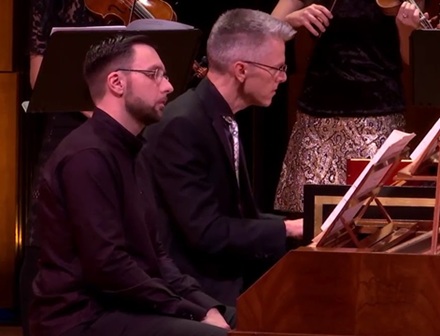
Finally, the Concerto in E-flat for harpsichord and fortepiano, Wq 47. Strings are expanded with two horns and two flutes. There is some speculation that this is C. P. E.’s final work. Certainly, it was written in the final year of his life (for Sara Levy, and her sister Zippora). It maintains the individuality of the two instruments while the two indulge in harmonious dialogue. It is a meeting of old and new, too, the time-honoured harpsichord and the ‘new’ piano, the two meeting almost cheekily (the first movement’s primary Affekt is somewhat akin to the raising of an eyebrow). The music is not only utterly delightful: it is not only the meeting of the old and new but, as Esfahani posits in his notes, the presentation of ‘unity within diversity’ (Einheit in der Mannigfaltigkeit). It is therefore historically highly significant.
Good that Esfahani and Aapo Häkkinen were so equally matched, given the score demands precisely this. And a word, too, for the harpsichord/fortepiano technician (unnamed, as was the provenance of the instruments) for allowing us to hear this via two perfectly prepared keyboards. At times – a strange parallel, I know – listening to Esfahani and Häkkinen, I was minded of the ‘competition’ between the two pianists in Stockhausen’s Mantra (within very different parameters, admittedly!). It’s all a bit like keyboard tennis: at least Esfahani and Häkkinen didn’t stand up and howl at each other (as Stockhausen directs …). Next time, perhaps.
After the hectic Allegro molto, full of legerdemain from both Esfahani and Häkkinen, a Larghetto that took us to another sonic world. While the first movement was about dialogue, in third movement C. P. E. experiments with the combination of harpsichord and fortepiano, and the effect is utterly magical. Especially interesting was the use of a harpsichord stop that took that instrument’s sound close to that of a fortepiano! And how wonderful Esfahani’s flourish at the Larghetto’s final cadence. The finale is a C. P. E. Bachian riot: think fizz that bites. Multiple harpsichord/fortepiano scurrying vied against (deliberately) scratchy string trills.
C. P. E. Bach’s music is electrifying, surprising, and energising. The performances must be all of these, and more, and here, they were. Minor caveats mean little in the face of such devotion. It is really too polemical to suggest there is just too much J.S.B. around, and some should be replaced by C.P.E.?
Colin Clarke