 United States Missy Mazzoli, Lincoln in the Bardo: Soloists, Metropolitan Opera Chorus & Orchestra / Yannick Nézet-Séguin (conductor). Metropolitan Opera, New York, 19.10.2026. (RP)
Missy Mazzoli and Royce Vavrek’s Lincoln in the Bardo was the most eagerly anticipated premiere at the Metropolitan Opera in some time. Lines stretched across Lincoln Center Plaza as spectators waited to enter the Met, while photographers captured those dressed as Abraham Lincoln and sporting other extraordinary attire. The anticipation paid off: words, music and stagecraft fused into a remarkably cohesive whole, creating a theatrical experience of rare power.
The George Saunders novel on which the opera is based takes as its starting point the death of Willie, Abraham Lincoln’s eleven-year-old son, in February 1862 during the early months of the Civil War. As the grieving president visits his son’s tomb in Georgetown’s Oak Hill Cemetery, the story shifts to the bardo which, according to Tibetan Buddhism, is a transitional state between life and death. Through historical fact and the stories of the cemetery’s residents, Saunders explores grief, love, mortality and, above all, the struggle to accept death and let go.
Saunders’s novel has 160 distinct characters which librettist Royce Vavrek culls to a manageable number. Lincoln and Willie are the central figures, surrounded by some of Saunders’s most vivid and bizarre inhabitants of the bardo. He omits most of the novel’s reprehensible figures, narrowing the focus to a more sympathetic group of souls and treating the most sympathetic with noble sentiment.
The opera has structural issues. The characters’ vignettes often seem like launching pads for sight gags and histrionics rather than devices that advance the action. The work is also lopsided, with Act I running 85 minutes and Act II roughly half that. The second act’s brisk pace gives it momentum though it also makes the resolution feel compressed. Mazzoli’s score helps compensate for these shortcomings, as does the steady succession of visual marvels devised by Lileana Blain-Cruz and her creative team.
Mazzoli is a master of setting text to music. Much of the opera consists of lengthy monologues and dialogues but her vocal lines flow naturally, communicating both meaning and emotion. Her melodies are fresh and the harmonic twists and turns are fascinating. A gifted orchestral colorist, she creates vivid musical characterizations that compete with the production’s striking visuals. The most wondrous moments come when a solo violin provides repose or marks another step in Lincoln and his son’s understanding of grief, love and duty.
Yannick Nézet-Séguin revels in orchestral color and led a richly detailed reading of Mazzoli’s score. His sense of balance was unerring, and he drew refined, expressive performances from the chorus and orchestra. Their nuanced playing gave the drama an emotional depth that anchored the performance.
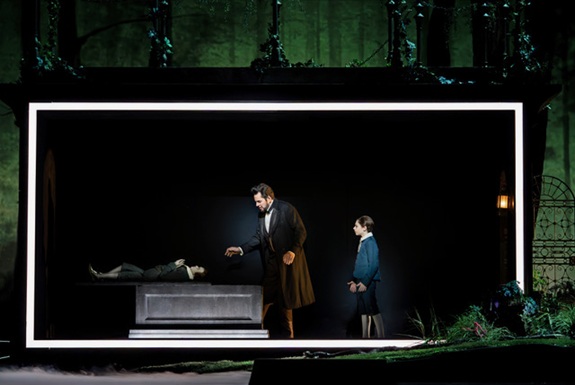
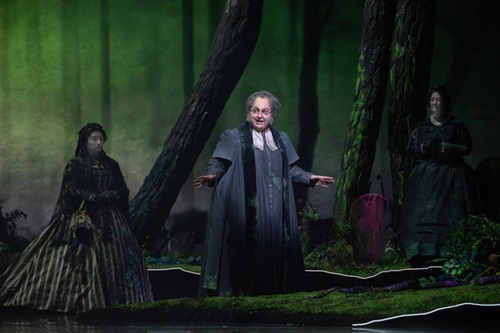
The action is set in an evocative recreation of Georgetown’s Oak Hill Cemetery where Willie was first buried before his remains were transferred to Illinois. It is a forbidding place, with towering trees and winding paths. Willie’s tomb is a grand edifice, with ample room for his ‘sick-box’ (as the bardo’s residents call their coffins) and for his father to mourn. The terminology reflects the dead’s refusal to acknowledge their fate.
The most spectacular effect is matterlightblooming, the mysterious phenomenon that transports the dead toward the Diamond Gate to face judgment. Figures shoot skyward amid bursts of light like Roman candles, trailing puffs of colored smoke that illuminate the night sky. For the audience, the effect is breathtaking; for the inhabitants of the bardo, it signals yet another fool willing to relinquish the hope of returning to life.
Peter Mattei conveyed Lincoln’s profound compassion and humility, his grief ultimately deepening his understanding of human suffering. His voice was clear and true, his diction immaculate and his dignified bearing reinforced the nobility of his portrayal. As Willie, Everett Sobers presented a younger version of his father, wise beyond his years, with a pure voice that conveyed the boy’s intelligence and curiosity.
The opening scenes abound in sight gags, the most outrageous involving the enormous penis that sprang from the groin of Ryan McKinny’s Vollman. He rues never having consummated his marriage with his young wife, and his member responds accordingly, alarmingly erect or comically flaccid depending on the circumstances. His friend Bevins, portrayed by a winning Jonah Hoskins, believes that the violent slashing of his wrists was reversible. A constellation of eyeballs sprouts around him, along with a sextet of Gilberts, the young man who renounced their relationship to ‘live correctly’.
Christine Goerke’s Reverend joins them in trying to make the Lincolns accept reality so that Willie might be spared the horrible fate awaiting those who tarry too long in the bardo. Disguised as a grizzled man, Goerke conveyed the conflicting emotions of someone who believed himself good but discovered otherwise when at the Diamond Gate. Anthony Roth Costanzo’s 14-year-old Miss Elise Traynor navigated a succession of surreal distractions, from disembodied hands and foam pig heads to shifting images of a fiery furnace and a hag gorging on black cake. His otherworldly voice remained steady amid the visual tumult, lending the character an eerie presence. Miss Elise is held up to Willie as a warning of the fate awaiting him should he remain in the bardo.
Stephanie Blythe and Craig Colclough were the thoroughly despicable Mr. and Mrs. Baron. They raised their son on the conviction that hard knocks were good for him yet accepted no blame for the consequences. Run over by a cart, they remained indignant that they were the only white people in a mass grave. Two endearing characters were Christopher Job’s Ginger Chap from Maine and Scott Scully’s Doodling Pennsylvanian, who appeared before the Diamond Gate with the Reverend. Only the Ginger Chap was admitted to paradise though the Doodling Pennsylvanian’s nonsensical singing drew laughs.
Janai Brugger’s Mrs. Francis Hodge and Viviana Goodwin’s Litzie perched on a tree branch, safe from the injustices and indignities they had suffered in life. Brugger’s soprano erupted in a torrent of rage as she recounted how a malevolent master had taken all her children from her. Litzie remained mute because, as Mrs. Hodge explained, she was silenced by men who had sexually abused her in every way imaginable. When she finally sang, her hope kindled by the sight of Lincoln, it was as if a ray of sunlight had pierced the darkness.
Joshua Blue’s Thomas Havens was a remarkable achievement for the rising tenor. First heard eagerly responding to his master’s whims, the enslaved man seemed grateful for the two brief periods of rest he was granted each week, but he seldom had a chance to enjoy them. His simmering resentment boiled over as he recounted the indignities he had endured and the leisure and freedom other men took for granted but he had never known. His encounter with Lincoln transformed him and he chose to remain with the President, whose own prejudices began to erode under the influence of Havens and the other ghosts.
In the opera’s final scene, Sobers’s Willie ascended in a blaze of light while Mattei’s Lincoln rode tall and erect on horseback, leaving the cemetery with a hard-earned, renewed sense of purpose.
Rick Perdian
Featured Image: Peter Mattei (Lincoln) and Everett Sobers (Willie Lincoln) © Karen Almond/Met Opera
Cast:
Vollman – Ryan McKinny
Bevins – Jonah Hoskins
Reverend – Christine Goerke
Willie – Everett Sobers
Mrs. Baron – Stephanie Blythe
Mr. Baron – Craig Colclough
Miss Elise Traynor – Anthony Roth Costanzo
Lincoln – Peter Mattei
Doodling Pennsylvanian – Scott Scully
Ginger Chap from Maine – Christopher Job
Litzie – Viviana Goodwin
Mrs. Francis Hodge – Janai Brugger
Thomas Havens – Joshua Blue
Lt. Stone – Daniel Clark Smith
Production:
Libretto – Royce Vavrek
Production – Lileana Blain-Cruz
Sets – Adam Rigg
Costumes – Montana Levi Blanco
Lighting – Yi Zhao & Stacey Derosier
Projection – Hannah Wasileski & Hana S. Kim
Sound – Kate Marvin
Creature suits & puppets – James Ortiz
Illusion & special effects – Jeremy A. Chernick
Choreographer – Raja Feather Kelly
Dramaturg – Paul Cremo
Chorus director – Tilman Michael