
 United Kingdom Mendelssohn, Nielsen: NOVO Quartet (Kaya Kato Møller, Nikolai Vasili Nedergaard [violin], Daniel Śledziński [viola] and Signe Ebstrup Bitsch [cello]). Wigmore Hall, London, 19.10.2026. (CC)
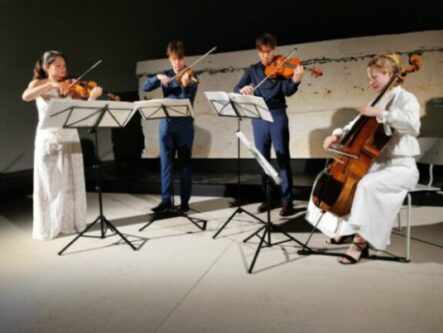
Mendelssohn – String Quartet No. 2 in A minor, Op.13 (1827)
Nielsen – String Quartet in F minor, Op.5 (1890)
The Danish NOVO Quartet is a shining light in the string quartet firmament, a bright beacon of hope. From the repertoire they chose to their unflagging enthusiasm to the sheer excellence of their performances, they bring a characteristic energy and depth of understanding.
Their win at the 77th Geneva Competition was a significant one, while their January 2025 Wigmore concert of Beethoven (Opp. 18/4 and 59/3. review here) consolidated their leading position and ascendent trajectory. No Beethoven this time, at Wigmore Hall: Mendelssohn and NOVO Quartet’s compatriot Carl Nielsen, It is worth pointing out their repertoire is wide, and their debut recording was the disc Frozen Moments, which featured the music of another Nielsen: Mette Nielsen (b.1985).
Why Mendelssohn’s quartets remain relatively underappreciated to this day is beyond me. I still remember vividly a performance of the later F minor Quartet, Op.80 (1847) by the Eroica Quartet at Wigmore Hall back in 2003. The A minor opens as if late Beethoven, a triple-time Adagio of hymnic core, presented both beautifully warm and conspiratorially quiet by the NOVO Quartet, the control of each of its members contributing to a touching whole. The crescendo into the 4/4 Allegro vivace was almost Modernist, the counterpoint a pre-echo of the fugue later in the quartet. The core aspects of the NOVO Quartets were laid bare, too: four equal voices and a complete dynamic range, balance between instruments attained no matter what the dynamic.
The Adagio con moto second movement begins with near-stasis, the NOVO offering a decidedly Beethovenian thicket of moving lines before the fugue emerged, spectral, ghostly, launched by the tenderest of phrases on viola (Daniel Sledziński). This is a phenomenal piece of writing, so sophisticated, so anguished; the arrival at the major mode so significant here, so hard-won and so short lived as Mendelssohn twists the music back in on itself – the normative status is dissonant pain. Of course, we then hear the return of the opening’s hymnic material completely differently on its return, absolutely radiant in the NOVO Quartet’s hands. The ‘Intermezzo’ is required, emotionally – still in the minor-mode (A minor) but lighter. First violin Kaya Kato Møller gave out the theme beautifully; and how the Allegro di molto section scampered, the repeated notes (at such speed) abuzz with energy.
It was the finale’s near-orchestral beginning that emerged as shocking, replete with a palpably intensity, tremolos underpinning solo recitatives. The return to counterpoint after frenzied activity (notated with no tempo change by Mendelssohn) hit full force here. Eventually, the music quietens to allow for Møller’s violin to sing leading to a return to the quartet’s very opening, now completely transformed in impact (think the return of the theme of the variations of Beethoven’s Op.109).
This quartet references the song Frage, the first of the 12 Lieder, Op. 9 in its material, one of the predominant gestures of which seems itself to reference late Beethoven quartets (is the question of the title, ‘Muss es sein?’!). Mendelssohn’s quartet is also tightly organised, and the laser focus of this performance allowed the work’s structural integrity to shine through.
From the other end of the 19th century, Nielsen’s String Quartet in F minor, Op.5 dates from 1890. This is a masterpiece, again tightly constructed and, in the first movement, febrile in energy and busy in texture. The contrasting cello melody was not just beautifully played by Sign Elstrup Bitsch but emerged as a ray of sunshine. The Un poco adagio exuded a meditative quality related to late Beethoven (music was never the same after, was it?) but heard through Nielsen’s harmonic prism. The music exuded a glowing Nordic beauty all of its own, so beautifully written – particularly interesting was the use of low open-string pedal on the cello, and the sense of dialogue between quartet members. Nielsen ratchets up the tension exponentially here, only partially balanced by the first violin’s veiled dance that launches the Allegretto scherzando, a movement filled with folkloric touches and notable for use of low open-string pedal on the cello (emphasised by rapid anacruses from the open string a perfect fifth above). Tremolo once more informed the opening of the finale, perhaps less overtly dramatic than Mendelssohn’s parallel point. Surely one of the most variegated string quartet movements, the NOVO Quartet was its greatest guide, each moment feeling perfectly in place. A sense of yearning seemed to underlie the music’s prescribed appassionato side,
No encore, but was one needed? The balance of the two pieces, both performed at the very highest level, was so perfectly judged, parallels and contrasts setting the imagination ablaze. One to remember.
Colin Clarke