
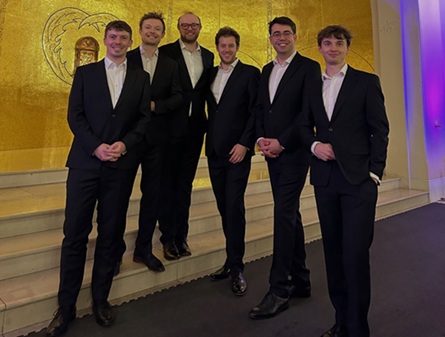
 United Kingdom The Gesualdo Six’s Death of Gesualdo: The Gesualdo Six (Owain Park [bass], Joshua Cooter, Joseph Wicks [tenor], Guy James, Alasdair Austin [countertenor], Simon Grant [baritone]). Concert Theatre Works Actors: Bill Barclay, Doria Bramante, Ivy Corbin, Markus Weinfurter, Siân Williams, Ryan Winkles. Will Tuckett (choreography), Arthur Oliver (costumes), Janni Younge (puppet). Bill Barclay (director) / Owain Park (music director). Turner Sims, Southampton, 20.10.2026. (CK)
Gesualdo – Selections from I Madrigali and Tenebrae (edited by Bill Barclay)
An oppressive atmosphere: candles burning, smoke drifting, a sound like muffled thunder. A black tomb in a black recess. A body lying on it.
This is what confronted us as we took our seats in the Turner Sims (almost a full house). What followed was an intense and uninterrupted 75-minute sequence of 29 vocal works, or excerpts from vocal works, by Gesualdo: the expert singers of The Gesualdi Six were complemented by six actors whose stylised actions and striking tableaux vivants dramatized and intensified key elements of Gesualdo’s story – who left us, in director Bill Barclay’s words, ‘six books of secular madrigals, two collections of sacred music, two murders, stories of witchcraft and masochism, and several undiagnosed psychotic ailments’.
You could argue that Gesualdo’s chromatic and dissonant music is disturbing enough on its own, needing no extra histrionics: but this was artistic and dramatic overload, and was intended to be. Inside Gesualdo’s head is not a place you want to be; but this Total Work of Art (how wrong Wagner’s word would sound here!) took us uncomfortably close to that paranormal experience.
No words of mine could do justice to the excellence – the discipline, the unanimity, the beauty of sound – of The Gesualdo Six, anchored by the rock-bottom bass of their director Owain Park. They regularly raised the neck-hairs: they were part of the drama too, their painted faces looking unearthly as they sang in the dark, uplit only by the glare of their tablets. Barclay had chosen music that matched the mood of the drama: my Latin is rusty and my Italian shaky, but in taking pieces from the madrigals and the Tenebrae alike he might be accused of juxtaposing Gethsemane and the Garden of Love – blasphemous, I expect, in Gesualdo’s day: perhaps that was the point. One piece by Monteverdi was interpolated in Act V: it may have been my imagination, but in this fresh-sounding music the skies seemed to clear, the Gesualdo miasma to lift.
The lurid drama of Gesualdo’s life and crimes was told in six continuous acts, the actors presenting it in a succession of visions of grotesquerie, sensuality and weird beauty: the murder of his wife and her lover at the end of Act IV was truly shocking. Some of the tactics were reminiscent of the early works of Peter Maxwell Davies (Vesalii Icones, The Martyrdom of St Magnus and so on), or of John Harle’s Angel Magick; or, indeed, the dumb show by Gesualdo’s great English contemporary, The Murder of Gonzago in Hamlet.
Comparisons, though, are otiose: Death of Gesualdo succeeds entirely on its own terms. It is inescapably immersive (a word I try to avoid. Iconic is another): a work of art which seeks to engage with some unpleasant aspects of human behaviour which are as current now as then (an idea thoughtfully explored by Barclay in his programme note). Beauty in the lap of horror. A heady dose of Catholic guilt: but there is a lot more to it than that. See and hear it if you can.
Chris Kettle