
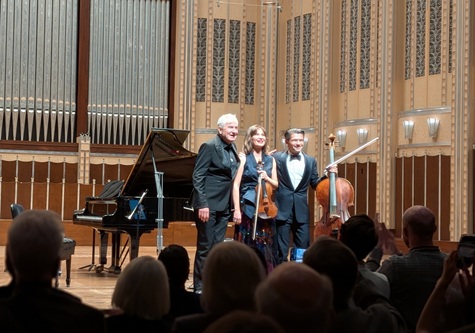
 United States Various: Katia Batiashvili (violin), Gautier Capuçon (cello), Jean-Yves Thibaudet (piano). Mandel Concert Hall at Severance Music Center, Cleveland, 19.10.2026. (MSJ)
Shostakovich – Piano Trio No.1 in C minor, Op.8
Debussy – Piano Trio in G major
Dvořák – Piano Trio No.3 in F minor, Op.65
The more I listen over the years, the better Dvořák gets. He was a composer who took inspiration from Schubert, Brahms and Smetana but, once he got in full swing, he matched or surpassed his heroes in many, many compositions. Dvořák’s Piano Trio No.3 in F minor was the key piece in this recital by Katia Batiashvili, Gautier Capuçon and Jean-Yves Thibaudet.
It is not often that Shostakovich offers the lightest piece on a program, but it was the case here. The musicians opened with Shostakovich’s First Piano Trio, a work written three years before his already precocious Symphony No.1 (which will be coming up locally on 7 November with Melisse Brunet conducting the Canton Symphony). Shostakovich was nineteen when he wrote that symphony and the trio finds him at age sixteen to be a romantic young composer just beginning to show hints of the jagged darkness to come. He may have been working through unrequited love with this piece which opens longingly, but it certainly hints at Shostakovich’s later volatility with its restless changes in tempo and texture, brought out effectively by the players.
Debussy’s Piano Trio in G major is also an early work – though not quite as early – and shows signs of the French composer’s future style. The dominant impression, though, is of the German romanticism of Mendelssohn and Robert Schumann as seen through the French style of Saint-Saëns. There are also some intentional references to Russian music for Debussy wrote the work while he served a year as pianist to the Russian aristocrat Nadezhda von Meck, who famously sponsored Tchaikovsky. These elements are handled with the skill of a brilliant student although, even with the presence of the piano, Debussy’s mature voice still lies somewhere in the distance.
It was interesting noting how the musicians interacted throughout. Batiashvili plays the violin with a very vocal style. Like a master actor, she knows which notes carry the musical weight and puts less emphasis on the connecting flourishes, giving her playing intense thoughtfulness. And though her dusky tone can carry intense vibrato at times, she also shows an inwardness and reluctance to grandstand. Capuçon is much more extroverted in manner and sound, with a rich, golden tone. But he was always mindful of his interactions with the others, only unleashing his full gleam on solo lines. When he and Batiashvili were playing in harmony, they blended gorgeously. Thibaudet was careful not to become overbearing in the piano parts, written in these first two works by composers who were pianists. When the moment was right, he cascaded gorgeously.
In the Dvořák, all three players wove around each other in ways that were more powerful yet at the same time clearer than anything heard in the Shostakovich and Debussy student works. Suddenly, we were brought face-to-face with a master. The dark and turbulent first movement brought to mind the influence of Brahms, but Dvořák was already more dynamic, piercing the shadows with frequent shafts of sunlight. The piano part in this trio was intentionally written to be fuller and more aggressive than the others, and Thibaudet tore into it passionately. The following scherzo started gracefully but, toward the end, the interplay between Batiashvili and Capuçon grew supercharged as they twined around Thibaudet’s torrents, reaching a new level of intensity.
The following slow movement brought to mind the third movement of Brahms’s Horn Trio and that is likely not a coincidence. Composed just a few years earlier, the Brahms was written in the wake of the death of his beloved mother and was part of his coping with it (as was the German Requiem, coming up from the Cleveland Orchestra in a couple weeks with guest conductor Petr Popelka). Dvořák was going through the same compositional therapy for losing his mother as he wrote this, and he starts his slow movement with a similar strumming of somber chords in the piano. Unlike Brahms, Dvořák fights his way to serenity by the end of the movement, even if it was a tense serenity, underlined by the string players with a lack of vibrato on the final chord. The finale was a high-spirited movement, full of rhythmic shifts. Nearing a high-energy end, it repeatedly pulled back to a parting glance at the first movement before putting it to bed and dashing to a thrilling conclusion. The performance was brilliant and fully justified using the first half of the program as warmups for the main event.
The evening closed with an encore written for the group’s tour, though the composer’s name was not clear. It proved to be a sentimental but lovely closing.
Mark Sebastian Jordan