
 United Kingdom Wagner, Tristan und Isolde: Soloists, Chorus & Orchestra of the London Opera Company / Peter Selwyn (conductor). Sinfonia Smith Square, London, 18.10.2026. (CC)
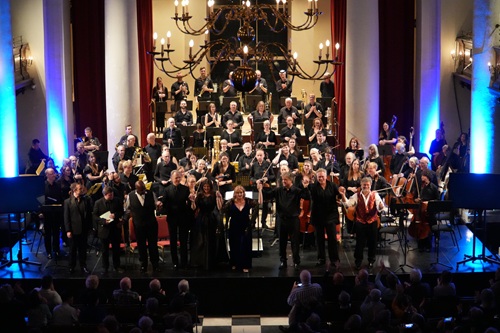
Cast:
Tristan – Neal Cooper
Isolde – Cara McHardy
Brangäne – Harriet Williams
Kurwenal – Simon Thorpe
King Marke – Pauls Putnins
Melot – Ronald Samm
Seaman / Shepherd – James Robinson
Steersman – Alistair Sutherland
Following on from a reduced-force performance of Tristan in 2020 and a full-fat one in 2022 and avoiding a Parsifal-clash with Royal Ballet & Opera (as that piece was originally slated for this year), The London Opera Company gave a highly commendable account of Wagner’s ground-breaking Tristan und Isolde (sung in the original German) at London’s Sinfonia Smith Square.
There was no doubting the amount of rehearsal that went into this, right from the discipline of the woodwind at the very opening. There was even occasional well-placed portamento in the strings. It is clear conductor Peter Selwyn, highly experienced in Wagner, knows the score inside-out. He takes the long-term view, giving each act (and the afternoon/evening as a whole) a sense of trajectory. Each act seemed to show deeper resonance between not only conductor and orchestra, but also orchestra and singers The first act moved beautifully towards the ingestion of the ‘Liebestrank’ and the arrival of King Marke, the second, if lacking in some tension at the opening, moved inexorably to its great, interrupted climax, while the third act, right from its gloriously dark opening, swept us away dramatically towards its bloodbath, King Marke’s great response and Isolde’s final Verklärung.
Stagecraft, such as it was, was well-considered too, with cor anglais (the excellent Nina Swann), Steersman, Brangäne (for her Warning), the second act hunting horns and the male chorus all using the available space of Sinfonia Smith Square (aka St John’s, the converted church). The difficult ‘stagings’ – people dead but still on the stage, for example, or the killings themselves – were convincing (more so than in the recent Barbican LSO/Pappano Tristan, I would suggest). But for this to work, ideally the singers need to be free of the score – and that was really only true of the Tristan, Neal Cooper. Scores were used to varying degrees and seeing a singer’s eyes continually move to the score while acting out a scene was distracting (maybe this was less invasive further back – I was placed really quite close to the stage).
Tristan und Isolde will always pack a punch, and that was certainly the case here. The standout assumption was Neal Cooper’s Tristan. HIs voice is positively baritonal – the lower reaches were not only never a problem, but positively relished, while his upper range carried easily over the large orchestra – is he really that hybrid of the moment, the baritenor? Cooper is tireless, too, so that the long stretches of the final act found him unflagging vocally while persuasively portraying a man at the end of his life. He also exemplified to the highest degree one aspect of the performance that was excellent throughout all the singers – diction. From Cooper, every word was beautifully enunciated. The (essentially) monologues of the final act were extraordinary, his urgent need for Isolde’s ship to appear, palpable.
His Isolde, Cara McHardy, has the strength of voice for the part but was less ‘inside’ the role. She dies next to her music stand, which fulfils its function to the last, in the final ‘Mild und Leise’. But McHardy has the stamina, and the ability to cut through a full orchestra. The second act duet in which the two protagonists’ personas almost seem to merge was certainly touching, though.
The Brangäne, Harriet Williams, has a voice of both strength and beauty, wonderfully confident throughout her register and every inch here Isolde’s devoted handmaiden. Her Warning was a highlight of the night.
Just as Isolde has her Brangäne, Tristan has his Kurwenal, here Simon Thorpe, possessed of a fine voice but not always maintaining intensity (in the final act) and not always that convincing in his acting. The Melot, Ronald Samm, was superb throughout as the treacherous one himself doomed to die – a consistent performance despite what looked like a painful fall just off the stage’s main sightline. It was the Marke of Pauls Putnins that carried a resonance with Wagner’s music that almost matched that of Cooper’s, his great monologue delivered with Kipnis-like authority (I am thinking specifically of the February 1943 Leinsdorf Met Tristan, but there are other recordings of Alexander Kipnis in this role).
The smaller roles were taken with excellence, James Robinson doubling as the Young Sailor of the opening and the final act’s Shepherd, Alistair Sutherland the equally fine Steersman.
So, Parsifal next year, which is eagerly awaited. Peter Selwyn’s understanding of Wagner’s processes should pay huge dividends there.
Colin Clarke