
 United States Kodály, Schoenberg: Alisa Weilerstein (cello), Strings of the Pittsburgh Symphony Orchestra. Heinz Hall, Pittsburgh, 17.10.2026. (SJ)
Kodály – Sonata for Solo Cello, Op.8
Schoenberg – Verklärte Nacht, Op.4 (1943 version)
Encore: Dvořák – Silent Woods, Op.68 No.5
The night after a blazing performance (review here) with the Pittsburgh Symphony, cellist Alisa Weilerstein appeared again on the Heinz Hall stage for an intimate evening of chamber music. The program began ambitiously and fearlessly with Zoltán Kodály’s imposing Sonata for Solo Cello, one of the most significant works for unaccompanied cello since the Bach suites from some two centuries prior.
With patrons seated in the round on the stage, I was hardly more than ten feet from the cellist, and it was truly remarkable to witness her probing playing from such close proximity. Spanning 35 minutes, the sonata makes unrelenting technical demands, exploring all corners of the instrument and its vast possibilities. The sonata employs scordatura, with the two lower strings tuned down a semitone, yielding a darker, more resonant sonority. The music ingeniously melds Hungarian folk tradition within a Western idiom which Weilerstein navigated with idiomatic flair. Her supple, ever-shifting rubato captured both the rhythmic intricacies and the improvisatory freedom of the writing.
From its declamatory opening to the end, nearly every inch of the fingerboard was used, with wide leaps in rapid succession. Double stops, drones and eerie harmonics added splashes of color. Most striking was a ‘two voice’ effect in which her left hand would play pizzicato in conjunction with the bowed notes, sounding as if there was far more than just a lone cello onstage. Weilerstein often played with her eyes closed, totally absorbed in the work’s expressive depth. The gritty determination with which she gave the finale ensured an arresting close.
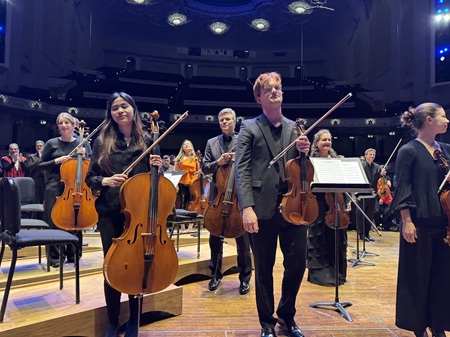
In the second half, Weilerstein was joined by two dozen members of the Pittsburgh Symphony strings for another landmark, emotionally fraught work: Arnold Schoenberg’s Verklärte Nacht. Originally cast as a string sextet, it was presented in its later revision for string orchestra (performed this evening without conductor, helmed by concertmaster David McCarroll). Weilerstein was equally adept as an ensemble player, communing with her Pittsburgh colleagues in an easy congeniality that belied the red-hot intensity of the music. One was swept away by the richness of the strings, intricately detailed yet never muddled despite the score’s density. Its anguished beginnings gave way to a luminous transfiguration, grounded by the luster of the cello section. The silvery filigree in the high strings near the close gave the once turgid textures an entrancing weightlessness.
As an encore, Dvořák’s Silent Woods, in an arrangement for cello and strings, offered a sunnier contrast. Its lyrical lines and gentle warmth brought the evening to a warmer, reflective close.
Sam Jacobson