
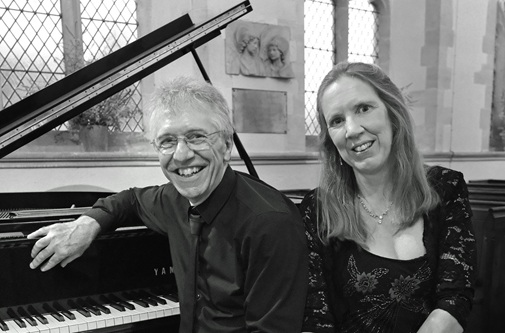
 United Kingdom From Schubert to Gershwin: Sarah Beth Briggs and Jack Gibbons (pianos). Holywell Music Room, Oxford, 9.8.2026. (DF)
Robert Schumann – Piano Quintet in E-flat major (arr. for piano duet by Clara Schumann)
Fauré – Dolly Suite;
Debussy – Petite Suite
Gibbons – Suite for Piano Duet (excerpts)
Schubert – Marche militaire, Op.51, No.1
Gershwin – Overture to Girl Crazy (arr. for piano duet by Jack Gibbons).
This was indeed a hidden gem in Oxford’s 2026 summer concert season, and the debut of a pianistic partnership of which we will undoubtedly hear more.
One of the most striking features of this recital was the extraordinary extent to which Jack Gibbons and Sarah Beth Briggs played, thought and interpreted as one. That such a degree of musical understanding has developed in so short a time is remarkable. It speaks volumes for the exceptional musicality of both pianists, but also for the humility with which each appears to offer that musicality to the other: an evident desire that neither individual should dominate, that the other should be allowed to shine, and, above all, that the music itself should rise above the performers. The result is a partnership in which the composers seem to be given complete liberty to speak unhindered through the two pianists. Gibbons and Briggs really do seem made to play duets together.
This love and respect for the music, and for every subtle shade of expression within it, marked their performance throughout Clara Schumann’s rarely heard piano-duet arrangement of Robert Schumann’s Piano Quintet. They enabled the listener to experience the piano-duet transcription as a beautiful work in its own right, even if it must ultimately remain something of a black-and-white photograph of the exquisitely coloured original quintet. What mattered was that all the intensity and atmosphere of Robert’s original were there.
There were many memorable moments. In the first movement, the huge unison chords leapt out with astonishing precision, while the cello and violin lines that answer one another with the passion of uncontrollable love were rendered most convincingly, despite the inevitable absence of the original instruments’ contrasting timbres. The second movement evoked a dark, whispering forest — hushed and haunted, but never exaggerated. Particularly remarkable were the cascades in the major-key sections, which created an almost physical sensation of movement, gently surging through the listener. The third movement danced irresistibly while avoiding any inappropriate suggestion of scurrying. Beethoven seemed almost to be present in spirit — and having a thoroughly good time. It was the fourth movement, however, that perhaps revealed something genuinely new about the transcription. Here, the piano duet seemed capable of bringing to the music something that the original quintet scoring cannot quite achieve: a sense of great mountains of granite and marble, of dizzying height and rugged, visceral grandeur. Paradoxically, the piano’s inability to sustain sound as string instruments can became an advantage, allowing Gibbons and Briggs to achieve a monumental, sharp-edged, almost sculptural clarity. It was a quality one might not instinctively seek in Schumann, and the effect was revelatory. The fugato passages were triumphant. This was clearly a deeply considered and meticulously prepared performance.
The French works were exceptional. Delicacy, refinement, subtle sensuality, rhythmic fluidity held within perfect control, meticulous attention to accentuation and phrasing, elegance, energy, charm and wit were all present in abundance. These were performances of unusual distinction, and, above all, unmistakably French in all the best senses of the word. Once again, the remarkable unity of the partnership was evident: the two pianists seemed almost like twins, thinking and feeling with a single musical mind. Sarah Beth Briggs’s pedalling in the Debussy deserves particular mention. It gave the music an almost miraculous clarity: the pedalling itself was effectively ‘invisible’, yet remained an essential element in the total sonority.
Gibbons’s own compositions proved equally rewarding. In his Suite for Piano Duet, the Musette was delightful and genuinely charming, while the Tarantella was a whirlwind tour de force — exhilarating, memorable and virtuosic, combining something of ‘all the fun of the fair’ with Formula One. On the evidence of these two pieces, a future performance of the complete suite would be very welcome.
The Schubert Marche militaire was characterised by a wonderfully light touch, conjuring up images of happy children playing at soldiers and elegant ladies. Gibbons and Briggs brought freshness and affection to music which can so easily sound hackneyed or bombastic.
And then came Gershwin. Gibbons’s arrangement of Gershwin’s Girl Crazy Overture was superbly laid out for the two pianists and triumphantly stretched the possibilities of the medium. All the hedonistic drive of the original was present, with even more punch for good measure. Gibbons and Briggs played with great panache and complete authenticity of style, combining superb rhythmic precision with a living, breathing ‘groove’, thus avoiding anything remotely metronomic. Virtuosity seemed to spark in every direction, like a crate of fireworks dropped onto a bonfire. The chromatic inner runs in the middle register had the effect of electric champagne bubbles. The texture continually brimmed over, recalling Gibbons’s observations about Gershwin’s piano roll of Rhapsody in Blue — except that here the effect seemed overdubbed in four layers rather than two. This was not an orchestra reduced to the piano, but the piano expanded into an orchestra. It was exactly the kind of thing audiences have come to expect from Gibbons’s Gershwin – and on this occasion they got it in abundance. What a way to end.
Above all, this concert confirmed that the musical partnership between Jack Gibbons and Sarah Beth Briggs is something special. Their individual musicianship is formidable, but it is the generosity, responsiveness and almost uncanny unity of their playing together that makes the partnership so compelling. One can only hope that this will be the first of many more duet concerts from the duo in the years to come.
David Fenton
Sadly I was unwell over the summer and unable to travel.
Clearly, come the NEXT appearance of this gilded and inspiring duo I must scatter ALL obstacles to attend !!