 United States Massenet, Manon: Soloists, Chorus and Orchestra of San Francisco Opera / Eun Sun Kim (conductor). War Memorial Opera House, San Francisco, 15.10.2026. (HS)
Is there anything Eun Sun Kim can’t do as a conductor? Since December 2019 and her debut with San Francisco Opera in Dvořák’s Rusalka, every outing has meant yet another incisive performance that makes the music unroll exactly the way it should, even if we might be accustomed to other ways of bringing it to life. This year alone she has done it with Richard Strauss’s Elektra in June and Verdi’s Simon Boccanegra in September. Now comes Massenet’s Manon, seen and heard at the War Memorial Opera House. Popular for its sleek, relatively lightweight music and charm, this opera found unexpectedly telling musical moments that fit well with Parisian Vincent Boussard’s minimal but colorful staging.
Massenet’s slapped-together prelude felt like a tightly drawn preview of what was to come. The music in the rambunctious opening scene at the inn propelled the goings-on with clarity. Intimate scenes harmonized sensitively with the singers and big scenes benefited from the music’s fleet timing that felt natural.
The sound rising from the orchestra reflected the current high level of this ensemble, most impressive after its strike shuttered performances for 10 days at the start of the autumn season in September. The personalities of individual instrumentalists blended into a consistently sharp focus, and tempos and balance were never a problem. Somehow, the colors that shaped by the music seemed to perfectly reflect the dazzling hues of the staging.
Unlike Patrick Fournillier, who conducted the production in its debut here in 2017 with characteristic French fizz, Kim’s approach toned down the Frenchiness in favor of orchestral textures that painted emotions as much as the comedy in each scene.
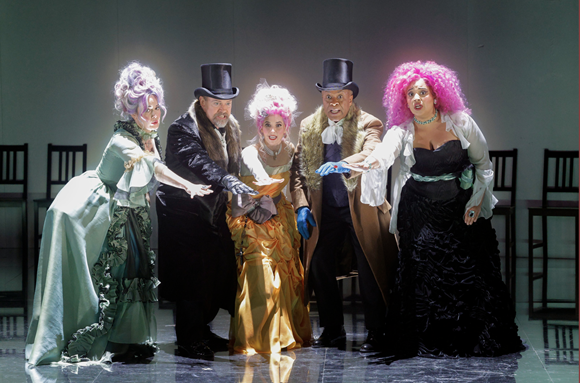
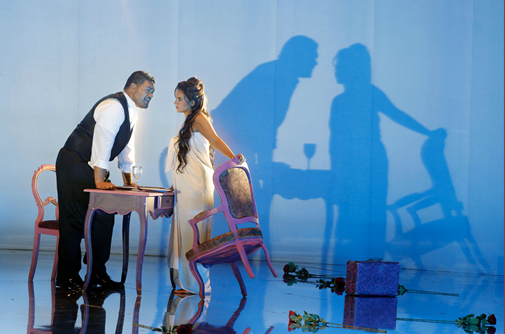
This co-production with Lithuanian National Opera (which debuted it in 2015) and Israeli Opera wraps the stage with a curving wall from side to side. Shadows play on the wall. A mirrored floor magnifies the visuals, and elaborate costumes mix eras. With fewer period details to catch one’s attention, the staging reminded us that each character’s strengths and weaknesses can be with us today as much as in the original story’s 18th-century setting. The title character’s beauty could lead to the same sort of life mistakes today. The shadows, combined with the mirrors, suggested that we can see these characters’ inner selves and demons. Open spaces focused our attention on the singing and acting.
Tenor Pene Pati as the Chevalier des Grieux and soprano Amina Edris as Manon couldn’t help but transmit how smitten they are with each other. In real life they are married, so the attraction felt real. Both came up through the company’s Merola and Adler Fellow development programs, and audiences here love them.
Manon’s personal story arc starts as a girl being sent to a convent, wooed by a young chevalier with whom she cohabits in Paris, only to be left to find her own way after he is snatched away by his family. She then learns to rely on her beauty to get wealthy men to support the high life she desires, only to lose it all when arrested in a casino raid. Singing with careful attention to the text, Edris was best in intimate scenes which favored her soft-textured sound. Her ‘Adieu, notre petite table’ was sublime, a highlight of a great scene in the couple’s Paris apartment. The duet with Des Grieux in the final scene, when she dies in his arms, was equally touching. But her singing was too graceful in the big, flashy Cours-la-Reine scene.
Pati’s lyric tenor caught the idea from the beginning. He wooed with boyish charm in the inn scene and delivered sighing delicacy with ‘En fermant les yeux’ in the Paris apartment scene. Having turned to the church and become an abbot after losing her, he set the St. Sulpice scene with a range of emotions in ‘Ah! fuyez douce image’ and had the expressive heft to portray the passion in the duet when Manon seeks him out, even if Edris came at it with less raw desire vocally.
Topping the rest of an excellent cast was bass James Creswell (Comte des Grieux), one of the few who were in the 2017 production. His rock-solid sound hit the perfect contrast with Pati’s. Brazilian baritone Vitor Bispo, in his U.S. debut, voiced an elegant Lescaut. Baritone Stephen Gaertner (De Brétigny), making his house debut, and tenor Steven Cole (Guillot de Morfontaine) lent comic relief and solid singing as the fussy and entitled suitors.
As the ladies of the night who hang out with Manon, mezzo-soprano Laura Krumm (Javotte) and soprano Sofia Gotch (Poussette) and mezzo Taylor Raven (Rosette) delivered their tight harmony (and loose behavior) with panache.
Harvey Steiman
Featured Image: Laura Krumm (Javotte), Stephen Gaertner (De Brétigny), Sofia Gotch (Poussette), Steven Cole (Guillot de Morfontaine) and Taylor Raven (Rosette) in Manon © Corey Weaver
Creative:
Director & Costumes – Vincent Boussard
Sets – Vincent Lemaire
Lighting – Gary Marder
Chorus director – John Keene
Cast:
Manon – Amina Edris
Chevalier des Grieux – Pene Pati
Lescaut – Vitor Bispo
Comte des Grieux – James Creswell
Guillot de Morfontaine – Steven Cole
De Brétigny – Stephen Gaertner
Poussette – Sofia Gotch
Javotte – Laura Krumm
Rosette – Taylor Raven
Manon does not begin with an overture, it’s merely a Prélude… And the assertion it is ‘slapped together’ belies your musicological understanding I’m afraid.
JP for S&H: It has been corrected to Prelude.
I attended the mattinee. This is one of those operas that I probably don’t need to see again in it’s entirety though there are parts I will return to frequently. ‘Adieu, notre petite table’ was a particular highlight. That aria really benefits from Kim’s transparent approach, particularly in the delicate shading and voice leading in and out of the relative major. Such an amazing aria. It’s theme really transcends despite the more ridiculous aspects of the plot. Worth attending for that alone, and there are many other highlights. If I had one complaint it’s that I’m not a huge fan of the trend toward setting the opera in the Belle Époque. It makes all of the musical references to the late baroque feel a little out of place. Nevertheless, an excellent performance.
Great review, thanks! I thought you were spot on in all areas but the staging.
The singing and the costumes were great. The sterile, ugly, tacky, nonsensical staging and sets were super annoying and completely at odds with the setting and the emotions of the opera.
Direction and blocking was often awkward and unnatural. Districting figures peeking (or hanging!) over the wall when the focus should be on the lovers or main figures on the stage. Lovers directed not to face each other or make eye contact. A dead girl comically rolling off the stage when it should be a poignant tragic moment.
If I were seeing this opera for the first time, I would have no idea about the setting or story.
When will opera directors realize they aren’t staging a Brechtian Waiting for Godot every time. The whole staging doesn’t need to be one long alienation effect. I pay a lot of money for my ticket and have had a soul-crushing day at work. I don’t need to feel more bleak or alienated in the opera house!
Opera audiences want a feast for the eyes in addition to the ears and most appreciate a setting that fully reflects the time period of the story. I’m very open to experimental theater in other contexts — but once in a while leave the period pieces alone!