
 United Kingdom Brahms, Tchaikovsky: Julia Fischer (violin), London Philharmonic Orchestra / Edward Gardner (conductor). Royal Festival Hall, London, 21.10.2026. (AV-E)
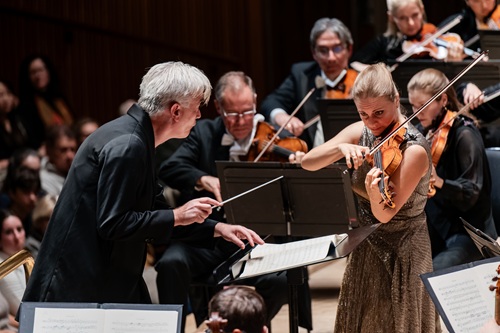
Brahms – Violin Concerto in D major, Op.77
Tchaikovsky – Manfred Symphony, Op.58
Julia Fischer’s playing of the Brahms Violin Concerto was so mellifluously mesmerising that writing a conventional review felt beside the point and completely impossible. Drawn into a trance-like state by her spellbinding playing, I found any analytical criticism wholly inadequate to the experience.
Allegro non troppo: fleeting-flowing flitting-fearlessly focused-fervent frantically-filigreed freely-flying fiery-fingered fibrillation-filtration fleetingly-footed flexible-finesse freshly-frazzled fervently-felt freely-flawless fertile-fluorescence forensically-flourished flexible-flirting frugivorous-fragrance floating-farthering frequently-frenzied fittingly-finished
Adagio: shimmering-shyness succulently-supple susurrant-sibilant satin-smooth subtly-shifting sorrowfully-soothing suspended-sighing scintillating-seamless somnolent-sinuous serpentine-supple silvered-spectral sonorous-shuddering scintillant-sibilance synaesthetic-swirling silken-sinuosity satin-saturated starless-sensual slumberous-suspended sulking-sublimely sufferingly-splendiferous
Allegro giocoso, ma non troppo vivace: buoyantly-bouncing bracingly-brazen breakaway-briskfulness blissfully-bubbling boldly-braided breathlessly-bragging beryl-bright belligerently-boisterous blithely-baroque bedazzling-bewitchment bristling-bowing boundlessly-bountiful bellicose-belligerence breathless-brilliance blazingly-burnished blistering-blitzkrieg brio-bravo
Fischer received rapturous applause and responded with Paganini’s Caprice No.24 as an encore, delivering a dazzling display of violinistic virtuosity. She brought a thrilling combination of feline agility, pinpoint articulation and seemingly effortless command to the writing, making the fiendish passagework sound less like a technical obstacle course than a mischievous game played at breathtaking speed without even thinking about what she was playing; for thinking would be the ruination of the playing.
Tchaikovsky’s Manfred Symphony, inspired by Byron’s tormented antihero, plunges us into a world of brooding obsession, forbidden passion and wild Alpine landscapes, where nature offers little solace to a soul at war with itself. Manfred is consumed by guilt and haunted by the memory of Astarte, his lost love, condemned to wander between anguish and defiance, unable either to escape his past or silence its ghosts. Tchaikovsky seizes on this dark, Byronic drama to unleash a vast orchestral canvas of feverish passions and supernatural menace, from moments of aching tenderness to the savage revels of Arimanes’s infernal palace. This is a symphony of extremes, its volcanic climaxes and restless emotional shifts demanding an orchestra equal to Tchaikovsky’s most extravagant imaginings. The London Philharmonic Orchestra proved more than equal to Tchaikovsky’s colossal demands, unleashing the symphony’s full volcanic power without sacrificing its moments of tenderness and mystery.
The first movement (Lento lugubre) opens with Manfred’s anguished musical identity: a descending, brooding motif in the bass clarinet and bassoons, underpinned by the crunching, tugging blows of the cellos and double basses. Together, these gestures establish an atmosphere of spiritual torment. The LPO gave these opening pages a deep, dark orchestral sonority, the lower strings digging into the music with a weighty, almost abrasive intensity. Edward Gardner drew formidable power from the brass, visceral pungency from the winds and clangourous calamity from the percussion. Yet the movement also exposed a maddening mannerism in Gardner’s perverse pacing: the repeated broadening of quieter passages slackened the tension and disrupted the music’s momentous forward drive.
After the opening’s ominous descent, the music surges into a more agitated, impassioned passage before subsiding into the tender string theme associated with Astarte. Here, Gardner’s tendency to linger became especially damaging. The quieter passages were stretched well beyond their natural flow, draining them of forward momentum. Rather than deepening the expression, these over-broadened episodes became stagnant and almost static, their ponderous pacing at odds with the score’s underlying forward thrust. Each return to Manfred’s anguished material consequently had to rebuild momentum that the conductor had needlessly sabotaged and allowed to dissipate.
Toscanini’s 1953 recording provides a telling contrast: its sustained forward drive keeps the movement’s psychological tension taut, whereas Gardner’s lingering approach repeatedly slackened the musical line. In a work sustained by inner turmoil as much as thematic development, that loss of propulsion weakened the movement’s cumulative force. The difference was equally apparent in the percussion: the timpani and bass drum deliver a firm, pounding impact that magnifies the music’s menace. Under Gardner’s coy English reserve, both instruments were underpowered, their blows too weak and muted to convey the menace inherent in the music. Only at the very end did the bass drum deliver the requisite hard, dry thud. By contrast, the cymbals and tam-tam were powerfully deployed, their crashing brilliance and ominous, resonant wash lending the climactic outburst a terrifying force. Here, at last, the percussion unleashed the full feverish violence of Tchaikovsky’s scorching scoring.
From the second movement onwards, Gardner shed his laboured mannerisms, conducting with fleet-footed fluidity and allowing the music to unfold in a more coherent, integrated whole. In the Vivace con spirito, the Alpine Fairy’s appearance came alive in darting, lilting figures, with a balletic lightness and buoyancy that brought sparkle and agility to Tchaikovsky’s mercurial orchestration. Fleeting woodwind gestures and nimble string writing flickered and danced, the music’s capricious turns handled with a deftness and rhythmic spring.
The Andante con moto brought a striking change of atmosphere. Tchaikovsky’s Pastorale evokes the simple, peaceful life of the Alpine mountain folk, and the opening oboe melody was especially poignant, its plaintive line answered and enriched by the surrounding woodwinds. This was the most moving part of the symphony, the LPO playing with extraordinary warmth and emotional abandon. A dreamlike stillness pervaded the rustic writing, yet beneath its apparent tranquillity lay a turbulent undercurrent of yearning and passion. The strings were particularly affecting, pouring their hearts into the long, singing lines with a fervour that never became sentimental; their rich, ardent tone lent the music an almost aching tenderness. The effect was both intimate and expansive, a fleeting vision of peace made all the more poignant by the mania that shadows Manfred.
But the idyll is not left undisturbed: Manfred’s anguished theme returns, gathering force until the serenity is overwhelmed by a powerful orchestral climax. The distant bell lends the music an evocative sense of distance before the opening calm gradually returns. Gardner conducted this music with a passion and sensitivity that allowed its tenderness, yearning and underlying torment to coexist without disturbing its natural flow.
The finale (Allegro con fuoco) plunges the symphony into the infernal palace of Arimanes, where a demonic bacchanal erupts in a frenzy of orchestral colour and violence. The LPO unleashed the full force of Tchaikovsky’s scoring, the brass blazing and the crushing percussion driving the music through increasingly turbulent episodes. From this infernal tumult, Astarte’s theme re-emerged in a sudden, magical transformation of atmosphere.
The galvanising Gardner made this contrast devastatingly powerful, drawing a searing intensity from the LPO while allowing the music’s aching tenderness and turbulent yearning to emerge from the surrounding inferno. The effect was at once overwhelming and deeply affecting, the emotional force surging through the hall with almost unbearable intensity. Gardner held these opposing forces in a compelling balance, preserving the music’s natural flow even as its suppressed anguish threatened to break through.
What really shone out here was Tchaikovsky’s writing for two harps, whose dreamy glissandos sparkled across the orchestral texture, their shimmering cascades softening the music’s ferocity and creating an ethereal counterworld to the demonic revelry. The contrast was beautifully realised, the orchestra moving from savage intensity to a strange, suspended radiance. As the finale progressed towards its close, the organ entered, adding a grave, monumental sonority that lifted the music beyond the preceding spectacle and lent the ending a solemn, almost transcendental weight. The galvanising Gardner brought the movement to a compelling conclusion.
For a few seconds after the final chord, the hall remained silent, allowing the music’s last resonance to fade into infinity without interruption. It was a rare and deeply affecting moment of stillness, soon shattered by an eruption of applause and a standing ovation for Gardner and the formidable, world-renowned London Philharmonic Orchestra.
Alexander Verney-Elliott