
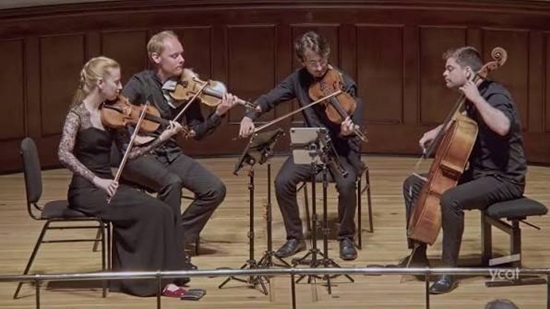
 United Kingdom Mozart and Tchaikovsky: Fibonacci Quartet (Luna De Mol, Kryštof Kohout [violins], Elliot Kempson [viola], Findlay Spence [cello]). Dora Stoutzker Hall, Royal Welsh College of Music and Drama, Cardiff, 22.10.2026. (LJ)
Mozart – String Quartet No.21 in D major, K575 (1789)
Tchaikovsky – String Quartet No.3 in E-flat minor (1876)
Now in the third year of their residency at the Royal Welsh College of Music and Drama (RWCMD), the Fibonacci Quartet were greeted with warmth and cheer when they walked out into the Dora Stoutzker Hall. Their programme juxtaposed Mozart’s Classical elegance with Tchaikovsky’s full-blown Russian Romanticism. The two pieces – Mozart’s String Quartet No.21 and Tchaikovsky’s String Quartet No.3 – were composed around one hundred years apart. Time is not the only feature that distinguishes these pieces as two vastly different works; their style could also be described as centuries apart. Mozart’s piece is known for its Classical clarity, proportionality, and levity, whereas Tchaikovsky’s is synonymous with intensity, deeply felt lamentation, and an almost symphonic scale. With such contrasting pieces, the Fibonacci Quartet demonstrated their skill for performing music across the canon. Luna De Mol, who is truly at home in the Classical era, led the quartet for the Mozart and Kryštof Kohout took over as first violinist for the Tchaikovsky, demonstrating his passion for Romantic repertoire and inherent understanding of its Slavonic roots.
Mozart’s String Quartet in D major was the first of his Prussian Quartets, referring to Mozart’s association with King Friedrich Wilhelm II of Prussia, who invited him to compose for his resident chamber ensemble. Due to the King’s talents as an amateur cellist, this quartet includes pronounced passages for the instrument. Here, the cello is not simply a foundation for the upper strings but an active participant in the exchange of musical ideas. The Fibonacci Quartet’s performance of the opening movement (Allegretto) was as close to perfection as possible. Their bowing, timing, and sense of occasion, which they created through excellently articulated and characterful conversation amongst each other, was captivating. In the third movement (Menuetto and Trio) the flow between the musicians was seamless as they deftly passed Mozart’s theme back and forth. The second movement (Andante), however, did not match the quality of the opening. At one point cellist Findlay Spence’s intonation was a fraction too sharp and the overall cohesion between players seemed slightly frayed. I also felt that they took the final movement (Allegretto) a touch too fast as speed and dynamic contrast made the movement sound slightly frenetic and over-emphasised. This said, the Fibonacci Quartet must be commended for their clarity and articulation when playing at such a fast tempo.
When introducing Tchaikovsky’s Third String Quartet, Elliot Kempson remarked that the composer managed to ‘condense large-scale symphonic sounds into a chamber piece’ which ‘hints at his ballet compositions and Russian Orthodox choral music’ (Odette’s theme from Swan Lake can be heard clearly towards the end of the piece). Kempson added that Tchaikovsky ‘uses us as a choir’ in the third movement to generate an ‘elegy-like feeling’. Indeed, Tchaikovsky wrote the work in memory of his friend, violinist Ferdinand Laub, who died in 1875. The composer’s grief can be heard in the deeply sorrowful third movement marked Andante funebre e doloroso, ma con moto.
Perhaps the most famous recording of this piece is that of the Borodin Quartet from 1979. My preference, however, is the St Petersburg String Quartet’s recording, which was released by Sony Classical in 1994. In her performance of the main theme, violinist Alla Aranovskaya combines a powerful ardentness with a more assuaging tone. This balance of expressive power with a more introspective solemnity intensifies the sense of grief whilst affording space for Tchaikovsky’s more consoling (even resolute in the final movement) themes. In this performance Kryštof Kohout’s take on the piece was con fuoco – he played with such force and intensity that he pushed the instrument to its limits. It was a performance that paired grief with tragedy over consolation.
With such a degree of risk taking, one must be prepared for more than a few bow hairs to come loose. Indeed, a performance like this can be divisive, with some audience members relishing how Kohout created intensity through a ‘heart on one’s sleeve’ performance and others preferring intensity to arise from restraint and balance. Regardless of what interpretation you may prefer, this performance demanded attention. Yes, Kohout may have taken a bit too much of a leading role, detaching himself from his fellow musicians, but his performance was so full of conviction it bordered on a virtuosity that made the performance especially memorable.
In keeping with tradition, the Fibonacci Quartet’s encore was an arrangement of pieces from the Gershwin songbook. This time, they wrote a mashup of I Got Rhythm and Fascinating Rhythm, titled, you guessed it: ‘I Got Fascinating Rhythm’. Their humour, clever arrangement, and spirited performance left audience members whistling as they left the concert hall. And, after such intensity, this was the perfect salve to soothe any lingering Tchaikovsky-induced anguish!
As the quartet’s relationship with Cardiff continues to strengthen, partly due to the RWCMD residency which gives them opportunities to teach and perform, their performances are becoming bolder. In the year that has passed since I last heard them perform (see my review here), their music making has become more daring and exciting. They are crafting a voice that is distinctly ‘Fibonacci’, which is no small feat. At this juncture, I can say that theirs is music that makes you feel alive; it is not for the fainthearted.
For readers wishing to hear the Fibonacci Quartet perform these pieces for themselves, they will be appearing at the Concertgebouw and Wigmore Hall on 10 January and 21 February next year.
Lucy Jeffery