 Germany Gaspare Spontini, La Vestale: Staatsopernchor, Staatskapelle Berlin / Carlo Rizzi (conductor). Staatsoper Unter den Linden Berlin, 26.9.2026. (AB)
Gaspare Spontini has every reason to be remembered in Berlin. From 1820 to 1841 he shaped the musical life of the Prussian court as Generalmusikdirektor (a title invented for him), while Wagner admired the monumental choral tableaux of La Vestale and later invited Spontini to Dresden. Yet the opera itself, first performed in Paris in 1807, has survived only fitfully, and its modern reputation rests partly on Maria Callas, whose performances in Luchino Visconti’s celebrated 1954 La Scala production restored the work to public consciousness.
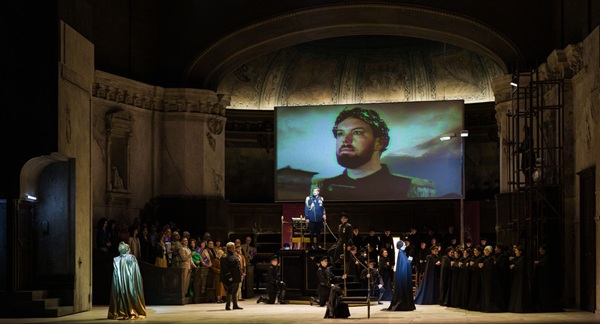
Lydia Steier’s production, first presented in Paris and now brought to the Staatsoper, seems less interested in discovering Spontini than in imposing upon him a dystopian theatrical approach that has become all too familiar. Etienne Pluss’s monumental setting suggests a fascist setup somewhere between convent, lecture theatre and state apparatus, while Katharina Schlipf’s costumes populate it with anonymous soldiers, functionaries and oppressed women. Margaret Atwood’s The Handmaid’s Tale serves as an explicit point of reference for Steier, and its world of institutionalised control over women is translated here into an even more brutal system of military and religious oppression.
Bodies hang upside down against a black wall before the action has properly begun. Women are beaten, spat upon and humiliated, flesh is stripped, weapons are constantly present, and public ritual becomes inseparable from terror. Marina Prudenskaya’s Grande Vestale presides over her maidens with almost sadistic severity, while Adrian Sâmpetrean’s high priest – clearly having an affair with the Grande Vestale – acquires the efficiency of a bureaucrat administering death.
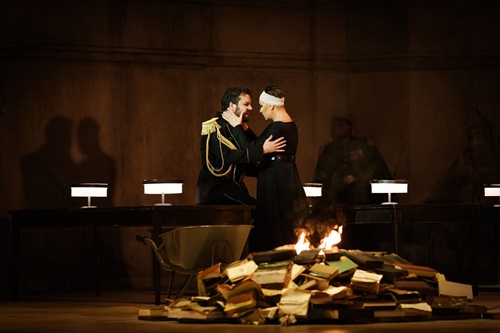
For a while the images shock, then they begin to flatten one another. Each new outrage has to exceed the last, and the result becomes surprisingly monotonous because so much happens in exactly the same register. The book-burning that replaces Vesta’s sacred flame is one of the stronger images and carries an immediate resonance in Berlin, since the Nazi book burning of 10 May 1933 took place on what is now Bebelplatz, then Opernplatz, directly beside the Staatsoper Unter den Linden, but this obvious reference is lost to the production.
This constant dystopian violence, then, is the central weakness of the evening, because Spontini’s score does not support such unremitting darkness. The ceremonial grandeur of his score can be severe, but its language also retains a Gluckian clarity and elegance while pointing towards Rossini, Meyerbeer and the later French grand opéra. Again and again, music of brightness, or of subtle and joyous intricacy accompanies scenes of grotesque brutality, and rather than creating productive friction, the contrast exposes how little Steier’s concept grows from the score itself.
The treatment of the Vestals is similarly reductive. Their historical position was shaped by patriarchal discipline and enforced chastity, yet they also possessed unusual privileges and legal independence. It is precisely this ambiguity that might have provided a more interesting starting point, whereas Steier turns them almost exclusively into victims within a totalitarian machine.
Nor does the production compensate through psychological detail. Julia and Licinius are supposedly driven by a passion powerful enough to destroy religious and political order, yet little sparks between them onstage. At emotional climaxes they are made to climb onto tables or submit to exaggerated physical intercourse, while video flashbacks attempt to supply a history of intimacy that the live performance never comes close to achieve.
Sonya Yoncheva nevertheless makes Julia the evening’s strongest argument for the opera. The role is enormous, and she possesses the scale and dramatic instinct for it. The upper register can harden, and the vibrato is at times prominent, but in the great monologues the voice opens impressively, with amplitude, flexibility and a dark, glamorous colour that recalls why this part once attracted singers of the stature of Callas in the first place.
David Butt Philip’s Licinius is less distinctive. His metallic, slightly nasal tenor is used intelligently, and he can withdraw heroic declamation into a more lyrical inwardness, yet the role never acquires the stature it needs. Siyabonga Maqungo’s Cinna makes a stronger immediate impression, while Prudenskaya remains formidable as the Grande Vestale.
Carlo Rizzi’s account with the Staatskapelle Berlin is, especially at first, surprisingly pale. The overture feels stony rather than suspended and linear, winds and brass are not always immaculate, and there are moments of uncertain coordination between pit and stage. Later the playing becomes freer and more transparent, with some particularly fine horn work, while Dani Juris’s chorus supplies much of the ceremonial weight Spontini demands and that so impressed the young Wagner. Even so, one rarely senses the stylistic confidence that might make this unfamiliar music sound inevitable rather than dutiful.
The final ballet exposes the production’s conflict with the work most clearly. Spontini writes festive, radiant music for a lieto fine, but Steier turns that happy ending completely upside down. What initially appears as a glittering pseudo-celebration, collapses into political violence when Cinna orders the soldiers to execute Licinius and Julia, together with the high priest, leaving himself among the corpses as the apparent ruler of the next dictatorship.
Spontini deserves rediscovery, and La Vestale remains a fascinating and – given its early reception history – important step in the development of 19th-century opera. This evening contains strong voices, striking images and no shortage of theatrical determination, yet despite all that activity misses Spontini’s dramatic and musical concept. As the man sitting next to me – coming from the same village as the composer – stated with determination: ‘Questo non è Spontini!’ (‘This is not Spontini!’), the world’s first Generalmusikdirektor, once again, is left waiting to be properly discovered.
Andreas Bücker
Featured Image: Spontini’s La Vestale at the Staatsoper Unter den Linden © Stephan Rabold
Production:
Director – Lydia Steier
Staging – Etienne Plus
Costumes – Katharina Schlipf
Lighting – Valerio Tiberi
Video – Etienne Guiol
Dramaturgy – Olaf A. Schmitt
Choir conductor – Dani Juris
Cast:
Julia – Sonya Yoncheva
Licinius – David Butt Philip
La Grande Vestale – Marina Prudenskaya
Cinna – Siyabonga Maqungo
The Sovereign Pontif – Adrian Sâmpetrean
A Consul – Hanseong Yun
Caro Dott. Andreas Bücker, buon giorno. Ho letto con grande interesse il Suo articolo su La Vestale a Berlino. Ha centrato pienamente gli argomenti da trattare. Mi ha fatto sorridere per la citazione in fondo. Però devo ribadire che questo non è Spontini. Speriamo che queste critiche servano per migliori allestimenti. Speriamo di rivederci per una grande Agnes von Hohenstaufen. Con stima invio cordiali saluti.
Marco Palmolella
[Translated] Dear Dr. Andreas Bücker, good morning. I read with great interest your article on The Vestal Virgins in Berlin. He fully focused on the topics to be covered. It made me smile for the quote at the bottom. But I must reiterate that this is not Spontini. We hope that these criticisms will serve for better staging. We hope to see each other again for a great Agnes von Hohenstaufen. With esteem I send cordial greetings.
Marco Palmolella
Gentile Signor Palmolella,
La ringrazio sentitamente per le Sue cortesi parole. Credo che condividiamo pienamente le stesse impressioni e sensazioni riguardo alla serata trascorsa alla Staatsoper.
Sarebbe davvero un grande piacere poterLa incontrare nuovamente in occasione di una rappresentazione di Agnes von Hohenstaufen, un’opera che non ho ancora avuto il piacere di vedere.
Con i miei più cordiali saluti e i migliori auguri da Berlino,
Andreas Bücker
Dear Mr Palmolella,
Thank you very much for your kind words. I believe we are entirely of one mind about the evening at the Staatsoper.
It would indeed be a great pleasure to meet again at a performance of Agnes von Hohenstaufen, an opera I have not yet had the pleasure of seeing.
With warm regards and best wishes from Berlin,
Andreas Bücker
Dr. Andreas Bücker, vielen Dank, herzliche Grüße. Marco Palmolella