
 United States Liszt, Bruckner: Jean-Yves Thibaudet (piano), New York Philharmonic / Rafael Payare (conductor). Wu Tsai Theater, David Geffen Hall, New York, 4.11.2026. (ES-S)
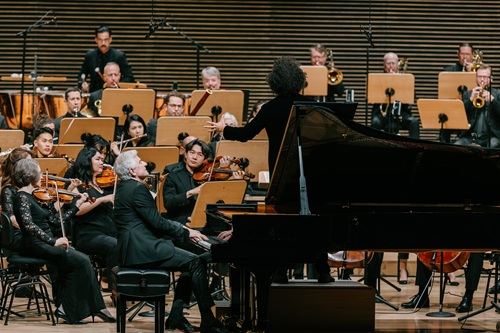
Liszt – Piano Concerto No.2, in A major, S125
Bruckner – Symphony No.9, in D minor (Ed. Nowak, 1951)
Having just been featured on the cover of Gramophone’s November issue, Venezuelan conductor Rafael Payare returned to the New York Philharmonic for a subscription series. The two Romantic works on the program – Liszt’s Second Piano Concerto and Bruckner’s Ninth Symphony – could hardly be more different: one fluid, theatrical and exuberant, the other monumental, predominantly austere and searching. Yet both rely on the development and transformation of musical ideas to sustain their larger structures.
Begun in 1839 and repeatedly revised until 1861, Liszt’s Piano Concerto No.2 took shape as he moved from a career dominated by virtuoso performance toward a greater preoccupation with symphonic composition. Its six interconnected sections form a single continuous movement, transforming a handful of themes while subordinating pianistic display to a larger musical argument.
Jean-Yves Thibaudet made a persuasive case for the concerto’s musical coherence, finding poetry in its quieter passages without sacrificing the exuberance of its more flamboyant episodes. His first phrases emerged naturally from the gentle woodwind introduction, establishing a tenderness that permeated his interpretation.
The celebrated dialogue between piano and cello (Matthew Christakos) was particularly memorable, the sensitive interplay between the two instruments lending it the intimacy of chamber music. Thibaudet’s rapid passagework was agile and assured, though some details lost definition.
Payare brought rhythmic vitality to the orchestral passages while remaining attentive to Thibaudet’s phrasing. Their collaboration was successful overall, even if there were a few moments, particularly near the conclusion, when the balance between soloist and orchestra tilted toward the latter. The final march retained its triumphant character without becoming bombastic, reflecting the commendable restraint that marked the performance as a whole.
Following Thibaudet’s solo appearance, Matías Tarnopolsky, the Philharmonic’s president and CEO, came onstage to announce that the pianist had been awarded the 2026 Avery Fisher Prize. Tarnopolsky returned after intermission with more solemn news: the evening’s performance of Bruckner’s Ninth was dedicated to the memory of Herbert Blomstedt, one of the great Bruckner interpreters of the past century, who had died earlier that day at the age of 99.
Like Liszt’s Second Piano Concerto, Bruckner’s Ninth Symphony underwent a long gestation, as did many of his other symphonies. In Bruckner’s case, however, the work remained unfinished at his death.
Payare conducted the three completed movements in Leopold Nowak’s edition. The opening Feierlich, misterioso unfolded with a convincing sense of continuity and powerful climaxes. Yet Payare did not fully capture the almost Sisyphean character of Bruckner’s music, in which each retreat demands another arduous ascent toward a summit, the struggle itself becoming as significant as its culmination. Individual phrases were not always as sharply delineated as one might have wished. Several of the Philharmonic’s principal players were absent that evening, which may also have affected the orchestra’s overall sound.
The Scherzo had rhythmic drive and an appropriately menacing character, though greater ferocity in the attacks and more differentiation between successive returns of the thematic material would have been welcome.
The Adagio was the interpretive high point, with Payare sustaining its long melodic lines while allowing the harmonic tensions to accumulate. The great dissonant climax emerged organically, without sounding like an isolated eruption. In the aftermath, he guided the music’s retreat from anguish toward the serene final pages, the quiet closing sonorities suggesting a hard-won peace rather than easy consolation. The movement’s entire architecture evoked a spiritual cathedral, fitting for a symphony Bruckner reportedly dedicated to the ‘majesty of all majesties’.
Edward Sava-Segal