
 United Kingdom Bacewicz, Rachmaninov, Rimsky-Korsakov: Benjamin Grosvenor (piano), Sinfonia of London / John Wilson (conductor). The Anvil, Basingstoke, 4.11.2026. (CK)
Bacewicz – Concerto for String Orchestra
Rachmaninov – Piano Concerto No.2
Rimsky-Korsakov – Scheherazade
It was a real pleasure to revisit The Anvil after a gap of more than 20 years: long enough to be surprised afresh by the hall’s striking acoustic properties – as soon, in fact, as the Sinfonia of London’s strings dug into the Allegro that kick-starts Grazyna Bacewicz’s Concerto for String Orchestra so bracingly. Such fullness and depth of sound!
Bacewicz is a fascinating figure. My first experience of her music was her Second Symphony, played by the BBC Symphony Orchestra under Sakari Oramo almost exactly two years ago: one might expect a concerto for strings to be lighter fare, but it shares with the symphony a neo-classical clarity and vigour and a wide range of expression.
The music’s energy and vitality, its rhythmic precision and its welcome edge of acerbity and bite were meat and drink to the marvellous players of the Sinfonia of London (many of whom probably played in the Sinfonia’s strings-only BBC Prom a couple of months ago). It is atmospheric, too: the Andante opens with drifting skeins of sound from muted violins over a musing solo cello. The effect was like watery sunshine: impressionistic, yes, but the music has muscle as well as sheen, building powerfully before fading back to the sounds of the opening.
The Vivo finale was full of sinewy, scurrying energy, and a sense of fun, too: Richard Bratby’s lively and informative programme note quoted a musicologist’s view that Bacewicz is ‘one of the few postwar composers who have succeeded in writing music that is authentically playful.’ Amen to that: performed, as here, by a crack string body in a superb acoustic, her music has irresistible élan.
There was a similar vividness to Benjamin Grosvenor’s performance of Rachmaninov’s evergreen Second Piano Concerto. Those opening chords were in no way hurried, but Grosvenor imbued them with a sense of purpose, even of menace: a mood that persisted through the strings’ rich, low-lying melody (like a river of chocolate, it has always seemed to me: here it was dark chocolate).
What followed was a forthright performance, every phrase weighted just so, yet sounding spontaneous: Grosvenor’s playing never sounded inflated or affected. The second theme seemed to swim in on the tide; and he packed all the necessary punch as the movement approached its climax. The slow movement was similarly and refreshingly unmannered: there were places where Grosvenor could perhaps have yielded a little more (there was some meltingly beautiful orchestral playing), but I admired his honest and all-of-a-piece approach. The music always sounded as if it mattered. There was feeling and excitement aplenty in the finale, with the orchestra backing him to the hilt. His generous encore – Liszt’s Petrarch Sonnet No.1, Pace non trovo – was spellbinding.
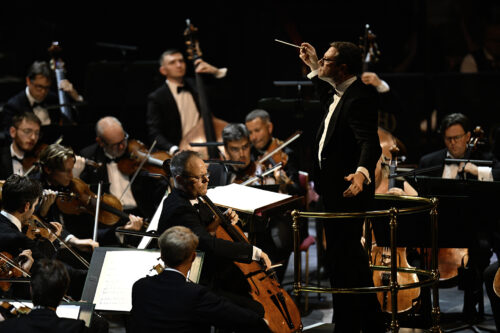
After the interval we were treated to a sumptuous performance of Rimsky-Korsakov’s Scheherazade. The Sinfonia of London is sometimes described as an orchestra of soloists, and this piece suits them supremely well: if I were to mention all the characterful and vividly taken solos this would be a long review. Pride of place must of course go to the leader, Charlie Lovell-Jones, who depicted the dangerously placed storyteller so bewitchingly, so vulnerably, so affectingly: and I cannot omit Todd Gibson-Cornish, principal bassoon, wonderfully entertaining in The Story of the Kalender Prince.
Masterminding the performance, of course, was the remarkable conductor John Wilson. His stick technique is unique: he will crouch on the podium or make sweeping gestures where they are needed, but his instructions to the players are most often communicated by a masterful flick of the wrist, a surgically precise flash of the baton. It is incredibly detailed, and the response is so instant that he seems to be inside every individual player’s head. Yet there is nothing machine-like about the result. It is mesmerising to watch.
Chris Kettle