
 United Kingdom Nørgård, Adès, Sibelius: Bertrand Chamayou (piano), London Symphony Orchestra / Thomas Adès (conductor). Barbican Hall, London, 5.11.2026. (JR)
Nørgård– Dream Play
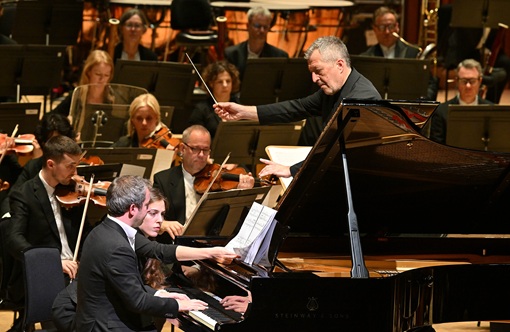
Adès – In Seven Days – for piano and orchestra
Sibelius – Symphony No.5, Op.82
Back in 1999 British conductor and composer Thomas Adès conducted the BBC Symphony Orchestra in a performance of Tributes – Album for Strings by the late Danish composer Per Nørgård. Adès has long admired the music of Nørgård, who in turn greatly admired the music of Sibelius and even corresponded with him. Those connections gave the seemingly disparate programme a genuine connection.
Dream Play (Drømmespil) was composed in 1975; it creates overlapping textures by, interweaving melodies. You can either listen to the detail or – as the composer once suggested – simply allow the sound of the whole to drift over you. While one can sense discernible musical figures, they intertwine with fluid, shifting harmonies. Adès gave a short introduction to the work, saying that modern music can be too serious, and this work, he felt, was decidedly fun, happy and even hippy!
Appropriately for Bonfire Night, the work eventually goes up in smoke. The work was charming, with an array of tingling sounds on a battery of tuned percussion six percussionists – playing on snare drum, three tenor drums, triangle, cymbals, crotales (antique cymbals), tubular bells, vibraphone, glockenspiel, celesta and xylophone – plus a dedicated piano player. There are pops, bangs and shrieks and at the very end Adès swirled one hand high above him to allow the piece to evaporate into the sky.
In Seven Days tells the Biblical story of the Creation by focussing on the elements of the Creation. Adès writes (usually) in a very approachable modern style and this work was no exception. This work dates back to 2008 and is sometimes (but not in this concert) accompanied by a video installation by Adès’ partner Tal Rosner.
The first section, Chaos – Light – Dark starts with a perpetuum mobile by the strings joined after a brass chorale by the piano racing at double speed. At times the work was extremely loud, often with a discernible Gamelan influence.
On the second day entitled Separation of the waters into sea and sky we enjoyed the tuned percussion left behind from the piece by Nørgård. The third day (Land – Grass – Trees) brought burgeoning plant life, starting with a deep bass and rising to a majestic climax. The fourth day (Stars – Sun – Moon) looked up at the stars in the shape of glittering sounds. The fifth day (Creatures of sea and sky) introduced aquatic life; the sixth day (Creatures of the land) had the piano to the fore. Finally, a section entitled Contemplation indicated that the whole process is repeated until the Earth is filled.
It was often, truth be told, hard to discern where one section started and the other finished but, despite its length (30 minutes), time raced by, such was the fascination of the innovative orchestration and Bertrand Chamayou’s virtuosic piano playing. The French pianist nurtures a constant dialogue with living composers alongside his deep affinity with the French repertoire. In this work, Chamayou had his work cut out but, with aid of a score and a page turner, he made light work of the huge technical hurdles presented by the composer. It was a tour de force and a mesmeric sonic journey. The orchestra rose to the challenge of a work where the structure was often very fluid and many players were seen visibly counting bars.
In 2022 Adès composed a work for violin and orchestra entitled Air – A homage to Sibelius, so he clearly has a deep affinity with Sibelius’s works and revers the Fifth Symphony. Adès showed his skills as a conductor, with fine control of tempi and dynamics. He knew whom to showcase in every bar, often dampening the strings to good effect. At the end of the work, the final Più presto was simply thrilling, starting with the menacing brass through to the triumphant, explosive climax and that two-note cadence bringing the work to its abrupt and unusual close, all executed with remarkable precision. Thomas Adès is now Principal Guest Conductor with the Hallé — Manchester can look forward to fine concerts under his baton.
Plaudits go to the bassoon soloist (Rachel Gough), and both the horn section and trumpets (led by Portuguese guest principal Sergio Pacheco) for the famous ‘Swan Hymn’. Adès was a bundle of energy on the podium and the orchestra was visibly energised by under his vigorous direction.
I noted that the orchestra also had a guest leader Kana Ohashi, born in Japan but raised in Australia, and now assistant concertmaster with the Leipzig Gewandhaus Orchestra.
After the musical fireworks, we made our way out to see and hear the fireworks in the sky.
John Rhodes