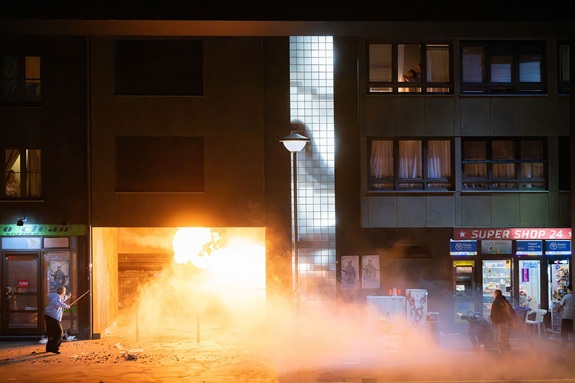
 Germany Wagner, Siegfried: Bavarian State Orchestra / Vladimir Jurowski (conductor). Nationaltheater, Munich, 4.11.2026. (AL-L)
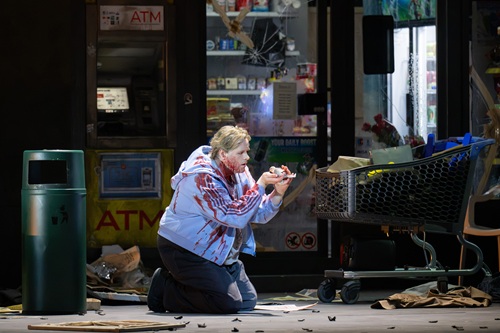
Siegfried, the third instalment of the Ring being prepared by Vladimir Jurowski and Tobias Kratzer at Bayerische Staatsoper, confirms what Das Rgeingold (click here) two seasons ago and Die Walküre (review here) last June had led us to expect.
The continuity of Kratzer’s concept is evident. Brünnhilde, whom Wotan put to sleep in a Valhalla that was none other than the Nationaltheater itself, still lies sleeping within the walls of the Staatsoper when Siegfried comes to wake her. Videos are used with the same intelligence, the touches of humour land with the same efficiency, and the direction of the singers is of a high order. Kratzer preserves the balance that was already the strength of the first two instalments: respect for the storyline, served by inventive and resolutely modern dramaturgy.
There is a certain feverishness in his conception that suits both music and text particularly well. Siegfried is an impossible brat: irascible, violent, aggressive. Poor Mime, pushed around in turn by this unmanageable foster son, by Wotan and by Alberich, finds his position increasingly untenable as the evening progresses.
The most striking aspect of the staging lies in its characterisation of the many duets that give the work its structure: Wotan and Mime in Act I, Wotan and Alberich in Act II, then Wotan facing Erda and Siegfried in Act III. Each of these confrontations has its own tension and a clearly legible balance of power. In a particularly apt touch, Alberich remains omnipresent throughout Act II, becoming the confidant to whom Siegfried relays his impressions, which gives the hero’s solitary musings an unexpected interlocutor.
The action unfolds in contemporary settings: Act I in a rather nondescript two-room flat, Act II in a seedy suburb in decidedly unsavoury company, before Act III brings us back to the Nationaltheater itself. It would be a pity to reveal all of Kratzer’s theatrical coups; the production deserves to keep its freshness.
There is, however, an overabundance of ideas. Was it necessary to bring on a militia led by Alberich twice, at the close of both the second and third acts? The device makes little sense, no more than certain moments of gratuitous violence against Erda or the little guinea pig that ends up in a microwave oven. Nor is it clear that Grane’s one-minute appearance at the very end, Wotan’s cage of ravens, or the arrival by car of police officers sent to subdue the dragon, only to end up charred, are truly needed. The same applies to splitting Siegfried between a boy of about twelve and Benjamin Bruns himself: though well-executed, the idea adds little.
In the pit, the musical standard is very high. This time Jurowski’s reading asserts a particularly strong character of its own. His Siegfried is modern. As in the two previous instalments, a wealth of imaginative detail emerges from the woodwinds, set against a dense and flamboyant orchestral sound.
As Serge Dorny, the house’s Intendant, explained to us, the cast once again includes singers in role debuts. Nicholas Brownlee is nothing short of exceptional as the Wanderer. Heralded from Das Rheingold onwards as the next great Wagnerian bass-baritone of his generation, he continues to be a revelation, placing himself in the line with George London or James Morris: vocal power, but also intelligence with respect to the text. This is a young, sharply drawn Wanderer, a world away from the resigned figure to which the role is too often confined.
Benjamin Bruns takes on Siegfried, the logical next step in a remarkable evolution. First noticed as the Steersman in Der fliegende Holländer at Bayreuth, he went on to sing David in Die Meistersinger von Nürnberg in this very house, and recently Lohengrin in Stuttgart. He is now a genuine heldentenor, with the power the heroic passages require, notably at the end of Act I, but also real care for line and text. A major achievement.
Matthias Klink is less convincing as Mime: neither a character tenor nor a heldentenor, he remains somewhat caught between the two. I am also unconvinced that entrusting the Woodbird to a soloist from the Tölzer Knabenchor was a wise decision; the role is fiendishly difficult, and both projection and intonation are problematic. Georg Nigl’s Alberich is somewhat unusual, lighter in voice than most interpreters of the part, but his way with the text and his stagecraft carry conviction. Timo Riihonen is a suitably sonorous Fafner, and Wiebke Lehmkuhl, already Erda in Das Rheingold, remains as fascinating as ever. Finally, Simone Schneider is a very solid Brünnhilde, with some fine top notes, though somewhat neutral: the singing is well shaped, but the character could be more sharply defined.
A fascinating evening, overloaded at times, and yet over five hours at the Nationaltheater that felt like five minutes. The conclusion of this Ring, with Götterdämmerung in June, is all the more eagerly awaited.
Antoine Lévy-Leboyer
Featured Image: Bayerische Staatsoper’s Siegfried © Monika Rittershaus
Cast:
Siegfried — Benjamin Bruns
Young Siegfried — Felix Fröbel
Mime — Matthias Klink
Wanderer — Nicholas Brownlee
Alberich — Georg Nigl
Fafner — Timo Riihonen
Erda — Wiebke Lehmkuhl
Brünnhilde — Simone Schneider
Woodbird — Soloist of the Tölzer Knabenchor
Production:
Director — Tobias Kratzer
Assistant director — Matthias Piro
Sets & Costumes — Rainer Sellmaier
Lighting — Michael Bauer
Video — Manuel Braun, Jonas Dahl, Janic Bebi
Dramaturgy — Bettina Bartz, Olaf Roth