 Germany Wagner, Die Walküre: Soloists, Bavarian State Orchestra / Vladimir Jurowski (conductor). Bavarian State Opera, Munich, 28.6.2026. (AL-L)
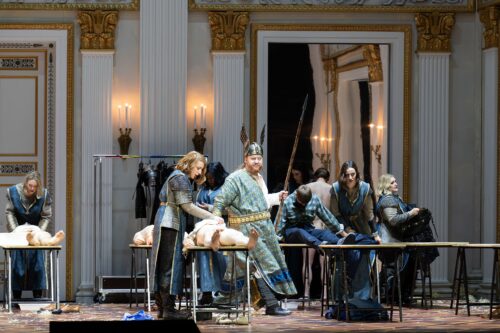
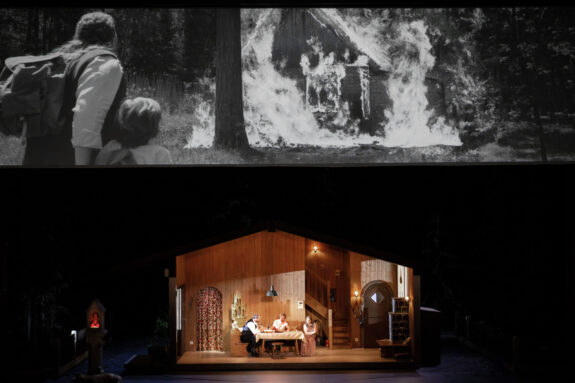
Munich Staatsoper was sold out. In the foyer before curtain up, music lovers were enthusiastically discussing Ring cycles past and present from all over the world. This production is the second instalment of a Ring cycle begun in autumn 2024 with Das Rheingold (reviewed here) and Tobias Kratzer’s team have been scrupulous about continuity. The model of the church that closed the Prologue reappears in Hunding’s living room. Loge materialises at the end of the third act in identical clothes, cigarette in hand. The inventive use of videos — already a hallmark of Rheingold — returns with at least equal effectiveness: projected images during the retrospective exchanges of Act I keep the action clear and immediate. Most spectacularly, the Ride of the Valkyries was filmed on location in the streets of Munich — the applause erupted before the music had even ended.
The dramaturgical coherence runs deeper than these cross-references. Kratzer’s gods were immature and impulsive in Das Rheingold; they remain so here, but with a crucial shift: Wotan has begun to measure the cost of his own actions and to confront his powerlessness to undo them. This is conveyed through him repeatedly but unsuccessfully attempting to slash his wrists. Kratzer could not be further from a director like Dmitri Tcherniakov, who consciously seeks to impose an alternative narrative on his source material. Every scenic idea in this production flows from a close, almost philological reading of music and text.
The first two acts are exemplary in their clarity and dramatic focus. The triangular relationship between Siegmund, Sieglinde and Hunding is handled with exceptional Personenregie: Hunding arrives by car with the carcass of a ram — a votive offering to Fricka — and Fricka and Wotan duly swear their oath on the animal’s heart. The third act is less densely inventive: Valhalla is revealed as the Nationaltheater itself, a seductive idea that nonetheless leaves the characters with less to inhabit than the richly conceived earlier tableaux.
Vladimir Jurowski conducted with the authority and commitment to inner dramatic truth that have become his hallmarks here. The woodwind chorus was again outstanding, and his attention to the score’s emotional detail — the sudden tenderness of the love music, the weight of Wotan’s Farewell — was consistently rewarding. Signs of fatigue made themselves felt in the closing stages of Act II: there were moments of imprecision in ensemble, and the brass produced occasional accidents. These were the blemishes of an arduous evening — five hours at the Nationaltheater in Munich during a heatwave — not of insufficient preparation, and the overall level remained high throughout.
Nicholas Brownlee, who announced before Act III that he was not at his best, is definitely one of the great Wagnerian bass-baritones of his generation. Even in reduced voice, the power of expression, the natural authority and the command of text were imposing. This interpretation will only deepen with further performances. Miina-Liisa Värelä was a solid and convincing Brünnhilde, the voice secure in all registers and the dramatic engagement unfailing. Ekaterina Gubanova brought exceptional textual intelligence and a formidable stage presence to Fricka. Of the twins, Irene Roberts gave Sieglinde mezzo-ish warmth and genuine expressivity; Joachim Bäckström has the notes and the projection for Siegmund, but the voice is a little pale in colour and the phrasing could be better shaped. Ain Anger projected Hunding’s menace with authority, if not always with perfect intonation.
The standing ovation was long and well-deserved. Siegfried and Götterdämmerung follow next season. Clear your diaries.
Antoine Lévy-Leboyer
Featured Image: Bavarian State Opera’s Die Walküre Act I © Monika Rittershaus
Cast:
Wotan — Nicholas Brownlee
Siegmund — Joachim Bäckström
Hunding — Ain Anger
Sieglinde — Irene Roberts
Brünnhilde — Miina-Liisa Värelä
Fricka — Ekaterina Gubanova
Helmwige — Dorothea Herbert
Gerhilde — Julie Adams
Ortlinde — Elene Gvritishvili
Waltraute — Claudia Mahnke
Siegrune — Niina Keitel
Rossweisse — Christina Bock
Grimgerde — Natalie Lewis
Schwertleite — Noa Beinart
Production:
Director — Tobias Kratzer
Stage designer & Costumes — Rainer Sellmaier
Lighting — Michael Bauer
Video — Manuel Braun, Jonas Dahl, Janic Bebi
Dramaturgy — Bettina Bartz, Olaf Roth