
 United Kingdom Prokofiev, R. Schumann, Beethoven: Boris Giltburg (piano), Bournemouth Symphony Orchestra / Mark Wigglesworth (conductor). Bristol Beacon, 5.11.2026. (CK)
Prokofiev – Symphony No.1, ‘Classical’
R. Schumann – Piano Concerto
Beethoven – Symphony No.2
With this concert, in Poole on Wednesday and repeated here at The Beacon, Mark Wigglesworth’s Beethoven Project with the Bournemouth Symphony Orchestra, Roads to Joy, reached its second stage; but I cannot report on it without first writing something about the previous weekend’s event, Beethoven: the Man, in Canford School on Saturday, and repeated at The Beacon on Sunday. I attended the Saturday event: a full afternoon, from 1.30pm until 6.30pm. An audience of 100 was originally planned for: the audience on the day was four times that number.
It was compered by BBC Radio 3’s Sarah Walker; she first introduced us to John Suchet, author and expert on all things Beethovenian, who entertained us (without notes) for almost an hour, bringing the composer to life: his harsh childhood, his difficult nature, his encroaching deafness, his hapless pursuit of women (including the Immortal Beloved, whoever she was). Samuel West read extracts from Beethoven’s letters, interleaved with fine performances of quartet movements by musicians from the Bournemouth Symphony Orchestra (Mark Derudder and Carol Paige, violins, Clement Pickering, viola and Hannah Sloane, cello), from the delightful first movement of the F major Quartet Op.18 No.1 to the sublime Heilige Dankgesang at the heart of the A minor Quartet Op.132. it was a cumulatively moving experience.
Impossible to summarise the conversation that ensued between Dame Evelyn Glennie and Sarah Walker. It did more than dwell on the nature and consequences of deafness for a musician of sensitivity and genius like Beethoven: it took me – all of us, I expect – to places I hadn’t been to before, not just in my experience of music, but in my awareness of parts of my own nature and physiology that I hadn’t even realised were there.
The afternoon ended with an extended Q & A session with John Suchet, Dame Evelyn Glennie and Mark Wigglesworth, genially chaired by Jonathan Dimbleby. It was an extraordinary day. Two more are planned: Beethoven: the Music in October 2027, and Beethoven: in Society in February 2028. Unmissable.
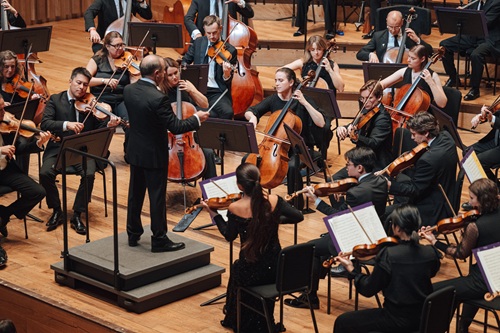
And so to the concert at Bristol Beacon. Prokofiev’s ‘Classical’ Symphony, opening the programme, was sprightly and deliciously light on its toes. The violins tiptoeing around a chortling bassoon brought smiles in the first movement; the Larghetto was played with delicacy and grace (that comical pair of bassoons still chuckling away). The brief Gavotte bid us farewell in throw-away fashion, leaving the stage with barely a puff of smoke: and although the BSO’s wind players were on sparkling form in the harum-scarum finale (those skyrocketing flutes! Perfect for Bonfire Night) it was the stylish and agile strings who stole the show. A Guardian critic, on a recent visit to Poole, described the BSO strings as ‘world-class’: easy to hear why.
Boris Giltburg is a fine pianist, and it is exciting that he is the orchestra’s Artist-in-Residence this season. He has given distinguished performances of Brahms and Prokofiev with them in recent seasons: and I have heard him give an outstanding performance of Beethoven’s Emperor Concerto with the Royal Philharmonic Orchestra, completely free of the later 19th-century Romantic accretions that this work seems to attract.
So why can I not enthuse about this performance of Schumann’s Piano Concerto? Giltburg played it beautifully, pitching its changing moods perfectly (both Florestan and Eusebius put in appearances); and there was delicacy and feeling in his interplay with the orchestra, particularly with the woodwind. His cadenza was brilliant, and he launched the finale joyfully: so surely the fault – if there was one – was mine. I can only confess that this performance engaged me only fitfully. Schumann’s orchestral writing, perhaps…
Giltburg’s encore was a different matter: Schumann’s lovely Arabeske, magically played. Perhaps it is Schumann’s solo piano music that I surrender to most willingly. When Giltburg gives a recital in Poole next March, the centrepiece of his programme will be Carnaval. I can’t wait.
No such reservations about Beethoven’s Second Symphony. The timpanist forsook his top-step station, exchanging his modern drums for a pair with proper skins and tuning taps round the sides, and his sponge-headed sticks for wooden ones; the two trumpeters switched to the longer, valveless ancestors of their usual instruments. Mark Wigglesworth, conducting from memory, raised his baton.
Bang. A solemn and rather sad chain of chords from the woodwind. Bang. Ditto from the strings. It is as memorable an opening as that of the Eroica. The main theme, when it arrived, was spring-heeled, with emphatic timpani. Dynamic direction from Wigglesworth, crisp and clean playing from the orchestra: powerful, purposeful, but feeling was there too. Elegance and beauty in the Larghetto, with much finesse from the strings: the music at times looking ahead, so it seemed, to later symphonies.
The pairs of horns and trumpets came into their own in the Scherzo (Beethoven breaking new ground: he had followed Haydn in labelling the equivalent movement in the First Symphony Menuetto). Wigglesworth kept the music buoyant; and the finale was fleet-footed, full of energy but lightly articulated, dynamic contrasts clearly pointed. It was an infectious and winning performance, and convincing proof that a slimmed-down BSO can play as stylishly as any period band. My companion used the word ‘intimate’: the music really did have the direct communicativeness of chamber music, though it also pointed ahead to an exciting future. Roads to Joy is well under way.
Chris Kettle