
 United Kingdom BBC Proms 2026 [31] – Mahler: Mahler Academy Orchestra, Philipp von Steinaecker (conductor). Royal Albert Hall, London, 11.9.2026. (AV-E)
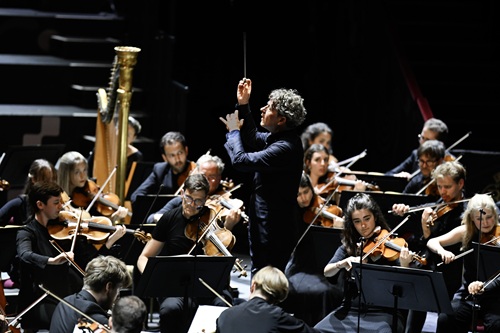
Mahler – Symphony No. 9 (1910, premiered 1912)
Philipp von Steinaecker’s Mahler Academy Orchestra is not merely another trendy ‘period-instrument’ experiment. The Originalklang (original sound) project was founded to reconstruct the orchestral sound Mahler himself knew, using an instrumentarium painstakingly modelled on the Vienna Philharmonic around 1900 and relearning the playing techniques of the fin de siècle.
The programme notes stated: ‘The Gustav Mahler Academy, today part of the Busoni-Mahler Foundation in Bolzano, was found by Claudio Abbado as a place for young musicians to learn how to become the orchestral players of the future. The international students of the Mahler Academy have worked alongside professional musicians from some of Europe’s finest ensembles’
For the performance, eight double basses were elevated at the back of the stage, while the first and second violins were seated antiphonally on opposite sides.
The Mahler Academy Orchestra was playing on original instruments to recreate the orchestral sound Mahler knew. Their collection includes wooden flutes, oboes by Hajek and Stecher, clarinets by Berthold, Heckel bassoons and Schnellar timpani. The aim was to recapture the colours and character of the period orchestra. Yet the sounds Mahler imagined in his mind must surely have transcended the rather rough and rugged instruments available in his day, as we heard this night. The hypothetical presumption of an ‘authentic Mahler sound’ can never be reduced simply to the instruments available to Mahler.
I had heard Mahler 9 approached with ‘authentic’ period-performance principles before, disastrously from Sir Roger Norrington, but never one as intriguing and interesting as this. The Originalklang approach brought finer details and instrumental colours into focus that had previously remained buried, making familiar passages sound refreshingly new – ‘newly minted’, or more aptly, ‘oldly minted’.
Waiting for the performance to begin, some of us could hear someone shouting a stream of incessant inanities from BBC Radio 3 Loggia Box 2, while sounds of ‘shhhh!’ and ‘shut up!’ were uttered toward it. The waffle turned out to be Tom Service, who delayed the concert with a long-winded ramble: ‘A bit of a pause, one of the players – they are playing gut strings these string players – one of them has had to leave the stage – a broken string, who knows but that’s the fragility and the tenderness;, everything is at stake in this performance, that is the wonderful thing that Philipp von Steinaecker has been saying about these instruments, they are fragile, they are more human than their modern counterparts and everything they are putting on the line this evening; this orchestra, is all about taking us further into the worlds of feelings of Mahler’s Ninth Symphony; that’s what this concert tonight is all about; Philippe has described how the instruments have more character, here we go, the first movement of Mahler’s Ninth Symphony.’ Meanwhile, poor old von Steinaecker was waiting patiently for Service to give it a rest.
The first movement, Andante comodo, sounded akin to Mahler being served not ‘off-the-bone’ but rather on the bone, with the flesh removed, allowing us to hear its skeletal structure. From the outset, the use of gut strings and period brass stripped away the upholstered plushness and heavy vibrato of the modern orchestra, leaving a texture that felt more in the frame than in the flesh. The ornate orchestration was laid bare, exposing the raw, bony architecture of Mahler’s writing. At times it sounded as austere as Norrington and as ascetic as Pierre Boulez, both of whom favoured an analytical rather than an emotional Mahler.
Yet this was not a failure of Philipp von Steinaecker’s conducting, which was emotionally charged, nor of the players, who were deeply expressive and responsive. Rather, the instruments themselves, with their particular timbres, seemed to produce an expressive etiolation: their restricted tonal palettes could not always supply the sensual saturation and emotional eruption demanded by Mahler. Von Steinaecker’s management of Mahler’s constantly shifting tempi was careful and assured, each change seeming to arise organically from what came before rather than being imposed upon the music. The tempi were concise and measured, allowing the emotional argument to remain remarkably cogent, with one section flowing seamlessly into the next.
At 19 minutes and 20 seconds, however, the four hard-stick timpani thuds were too prim and prissy, lacking the death blow, nailing intensity required at this crucial climax. Thus, the sheer force of the climax itself never materialised. Yet the subsequent funeral march, Wie ein Kondukt, was more convincing, the timpani death-strokes giving its grim tread a more ominous weight.
Im Tempo eines gemächlichen Ländlers. Etwas täppisch und sehr derb, came off best of all the movements. Appropriately, the lurching Ländler was autistically awkward and grotesquely gruff, with the period winds sounding roughly rustic, their angular accents giving the music an acidic authenticity. There was something deliciously unvarnished about the strings’ coarse-grained ‘soiled’ sound. However, towards the end, von Steinaecker seemed deliberately to bring the vigorous dance almost to a halt, the full orchestral momentum suddenly slackening for barely a second (which felt like an eternity) as the strings and winds slowed into the final Ländler. This daringly calculated suspension enhanced the movement’s lumpen rusticity, entirely in keeping with its unruly character.
The Rondo-Burleske. Allegro assai. Sehr trotzig, was taken at a headlong, almost reckless pace, bristling with swagger and defiance. Their anti-pleonastic playing was not always razor-clean or immaculately linear, but that was almost beside the point: this was music that needed to snarl, bite and hurl itself forward, and the players supplied plenty of bawdy energy. The deliberately dilapidated-sounding period instruments gave the sound a wiry, rough-hewn, abrasively raucous edge, with the coarse brass and caustic winds contributing to its uncouth and unruly character. If the precision occasionally frayed under the pressure, the sheer élan carried the performance through with considerable panache and plenty of spirit, if not flesh.
The Adagio. Sehr langsam und noch zurückhaltend, was taken at a broad, spacious tempo, though without ever becoming dragging or indulgent. Its character was sedately sorrowful and intimate, the reduced vibrato of the period strings giving the sound a pallid, almost bloodless quality. The result could seem somewhat scrawny, yet the absence of plushness also exposed the extraordinary delicacy of Mahler’s orchestration, while the woodwinds contributed a constantly shifting palette of timbres, not always entirely secure.
The percussion in the great climax lacked the heft required to make its emotional eruption fully overwhelming, but the subsequent gradual diminution was extraordinarily affecting, as though Mahler were already calling from beyond the grave before he had even arrived there. The final coda was the highlight of the evening and arguably the most intense, played with utter concentration. The closing bars faded into a pallid, vibrato-less fleshlessness that made the final dying sounds feel incredibly close to the bone.
It was deeply regrettable that von Steinaecker did not end with both arms held aloft, signalling that the silence should be left to linger for a few more seconds of contemplation before applauding. Instead, the silent spell was vandalised by some moronic yobo shouting ‘Bravi!’, to the dismay of much of the audience, many of whom responded with sighs and cries of disdain and derision.
Alexander Verney-Elliott