
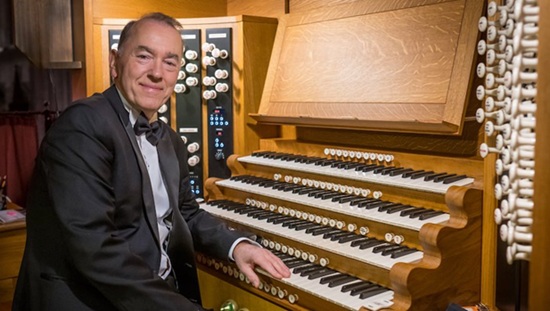
 United Kingdom Gloucester Cathedral Organ Festival – Gigout, Jongen, Saint-Saëns: Thomas Trotter (organ), BBC National Orchestra of Wales / Adrian Partington (conductor). Gloucester Cathedral, 12.9.2026. (JQ)
Eugène Gigout (arr. Ropartz) – Grande Choeur Dialogué
Joseph Jongen – Symphonie Concertante, Op.81, pour grand orgue et orchestre
Saint-Saëns – Symphony No.3 in C minor (‘Organ Symphony’)
Throughout the summer there has been an ongoing musical celebration in Gloucester Cathedral following the installation of the new organ, built by the Worcester firm of Nicholson & Co. The celebrations began with a Festal Evensong at the beginning of July, at which the new organ was dedicated, followed shortly afterwards by an inaugural recital by Wayne Marshall. The new instrument was heard to particular and varied effect during the recent Three Choirs Festival. Introducing the concert, the Dean of Gloucester referred to ‘a truly wonderful summer of music’ in the cathedral; it would be hard to disagree. Nicholson’s magnificent instrument has attracted widespread and universally favourable comment over the last couple of months. For the final event in this summer of music the distinguished British organist Thomas Trotter joined the BBC National Orchestra of Wales, conducted by Gloucester Cathedral’s Director of Music, Adrian Partington for a programme of Franco-Belgian music for organ and orchestra.
The programme had been shrewdly designed; not only did it show off many aspects of the new organ but also it offered the chance to hear two less familiar items in the first half followed by a justly popular crowd-pleasing work after the interval.
To begin, we heard Grande Choeur Dialogué by the French composer and organist, Eugène Gigout (1844-1925). The piece began life as the last of a collection of six compositions for solo organ which were published in 1881 under the collective title Pièces d’orgue. The title Grande Choeur Dialogué refers to the structure of the composition. Two manuals of the organ are set up with different stops so that playing on one manual results in significant contrast when the organist switches to the second manual. Particularly at the beginning and end of Gigout’s piece, the organist plays on alternate manuals – ‘Choeur 1’ and ‘Choeur 2’ – in almost a ‘call and answer’ fashion. A clever, effective transcription by Joseph Marie Guy-Ropartz (1864-1955) was used. Essentially, Ropartz allocated the music for ‘Choeur 2’ to the orchestra, leaving the ‘Choeur 1’ material to be played by the organ, though the distinction between the twin forces is less apparent in the middle section of the piece. Much is made of a fanfare-like motif in Gigout’s original and in the organ version the work opens with this fanfare played on ‘Choeur 1’; thus, it was entirely fitting that the first sound we heard was made – excitingly – by the new organ. Thomas Trotter deployed reeds to excellent effect both hereabouts and in the closing pages of the piece. I liked the tempo which Adrian Partington set; he allowed the majesty of the music to register but always maintained good momentum and as a result the music never seemed stodgy. Gigout’s music is joyful and celebratory and that is how it came across in this performance. I liked very much the contrasts between the orchestral timbres and those of the organ. This short piece may not be the deepest composition but the Ropartz transcription worked very well and the music made an ideally festive opener to this programme.
The Symphonie Concertante by the Belgian composer, Joseph Jongen (1873-1953) is a very interesting work and it also has a fascinating, unexpected background. Its origins lie in the unlikely setting of a large department store in downtown Philadelphia. In brief, the store was one of several owned by John Wanamaker (1838-1922) and it boasted a huge central Grand Court, which is seven storeys high. To this day, the Grand Court is home to what is claimed as the largest functioning pipe organ in the world. Wanamaker purchased the instrument in 1909 and, over two years, he had it installed in the heart of what was then a new store. So large is the space in the Grand Court that when the sales counters were temporarily removed it was perfectly feasible for the Philadelphia Orchestra to present concerts there to a paying audience. Not content with having such a large organ in the store, Wanamaker and his son and heir, Rodman Wanamaker (1863-1928) enlarged it still further. Rodman instigated a major expansion between 1924 and 1928 and he commissioned Jongen’s Symphonie Concertante, which was planned as one of the works to be performed by the Philadelphia Orchestra and their conductor Leopold Stokowski at a concert to mark the re-dedication of the organ in 1928. In fact, that concert did not take place, partly due to the sudden death of Rodman Wanamaker; it was not until 2008 that the Philadelphia Orchestra played the work in the venue for which it was designed. The Wanamaker store was subsequently acquired by Macy’s and that firm not only maintained the organ but also carried on the tradition of brief daily recitals, one of which I heard when I visited the store in 2023. Sadly, in 2025 the store was closed but the organ remains in situ; it is protected by its status as a National Historic Landmark and, I believe, remains in at least occasional use.
Jongen’s Symphonie Concertante is too little known; prior to this evening I had only heard it on CD. Whilst I was very keen to experience it live, I must admit that in advance I was slightly concerned that the resonant acoustic of Gloucester Cathedral might make it hard to hear some of the orchestral detail. However, once my ears had adjusted to the balance within the first couple of minutes, my fears proved to be groundless; my seat was situated about two-thirds of the distance down the nave yet I heard a pleasing amount of orchestral detail. That, of course, is a credit to the players of the BBC NOW but I am sure it helped greatly to have Adrian Partington on the rostrum. Not only does he have expert knowledge of the cathedral’s acoustic, but in addition I believe I am right in saying that he has played the solo part in a couple of past performances of the work so he brought an expert knowledge of the score to this performance.
The work is in four movements, and it is important to note that it is not an organ concerto; as the title suggests, it’s a score in which the organ and orchestra collaborate closely. It is true that the solo part is challenging and demands a virtuoso performer, yet often – and especially in the slow movement – the organist functions more as primus inter pares. The performance was excellent in all respects. The first movement, Allegro, molto moderato demonstrated a genuine partnership between organ and orchestra. The tempi seemed expertly chosen; there was good momentum but also, in the appropriate places, the warm romanticism of Jongen’s lyrical music was allowed to bloom. The second movement (Divertimento: Molto vivo) is an interesting construct. In essence, Jongen combines two contrasting ideas. Much of the music can best be described as perky in nature – for example, that is how the organist opens the movement, followed by the orchestra – but there are several short episodes where the mood is decidedly lyrical. It seemed to me that the performers brought out both aspects of this entertaining movement very successfully.
The slow movement Molto lento: Lento misterioso is a beautiful piece of writing. The melodic material is very fine and is bedecked in gorgeous harmonies. Jongen displays a very acute and imaginative ear for orchestral texture. Interestingly, the organ is frequently required to function just as part of the overall picture, enriching the textures in a most satisfying fashion, Trotter understood his role perfectly in this respect. Ever since I first heard this new Nicholson organ I have felt that, besides its imperious power, one of the most successful and satisfying features of the instrument is its ability to compel attention, through clarity. when it is being played softly. That characteristic was very much on show in this movement – and would be again in the slow movement of the Saint-Saëns symphony. Trotter ensured that the organ was ideally integrated and this meant that on the occasions when Jongen brings the solo instrument to the foreground, the effect was properly made. Under Partington’s guidance the BBC NOW brought out the music’s poetry; I especially admired the work of the violins and of the woodwind principals. The programme notes suggested that if Debussy had ever composed a work for organ and orchestra it might have sounded like this; tonight’s very sensitive performance gave credence to that view. Jongen concludes his Symphonie Concertante with a lively finale, Toccata (moto perpetuo): Allegro moderato. Here, as if to compensate his soloist for the relative restraint of the slow movement, Jongen gives ample opportunity for witty, athletic display. The music is exuberant and festive. Trotter rose to the occasion splendidly, as did the BBC NOW – I admired the excellent contributions of the brass section in several places.
With all due respect to the other two composers whose music was played, I think that the Symphonie Concertante offered the most interesting music on the programme. I was delighted that my first live encounter with the work was in such a fine performance. Given the infrequency with which the work is heard, at least in the UK, I suspect that many in the substantial audience would have been hearing it for the first time. It was very gratifying, therefore, that the work and performance received a most enthusiastic reception.
After the interval we were on much more familiar territory with the Third Smphony by Camille Saint-Saëns (1835-1921). In 1886, he was commissioned by the Philharmonic Society in London to write a new symphony for a concert in which he was to play a piano concerto (he played Beethoven’s Fourth piano concerto). The symphony was dedicated to the memory of Liszt, who had died in 1886, while composition of the symphony was in progress, and almost certainly Saint-Saëns included an important organ part as a homage to Liszt. It is notable, though, that the use of the organ is quite restrained; it is not involved at all in the first and third movements and it is not until the finale that the instrument is really to the fore; the composer merely described the symphony as ‘avec orgue’, though the work has long been referenced as the ‘Organ Symphony’.
The first movement (Adagio – Allegro moderato) came off very well. The members of the BBC NOW, and the woodwind in particular, articulated the ‘chattering’ material crisply, thereby ensuring that the resonant acoustic didn’t blunt that important aspect of the music. I admired the vigour of Partington’s conducting; this imparted a welcome romantic surge. The first movement flows seamlessly into the Poco adagio. Here, the performance had a genuine nobility. The BBC NOW’s strings played the big tune with great warmth, their efforts assisted by the cathedral’s resonant acoustic. From the organ loft, Thomas Trotter blended the quiet organ part perfectly; I loved the gentle but perceptible way the deep pedal sounds made their presence felt. This was a sumptuous account of the movement. If the resonant acoustic had enhanced the sound in the slow movement, there was always the risk that it would compromise the clarity of the Allegro moderato – Presto third movement; it was greatly to the credit of the orchestra and conductor that this did not happen. Partington invested the music with verve and drive, the players responding keenly to his direction.
I strongly suspect that, like me, most people in the audience had been waiting for the moment when that great C major chord announced the finale; would the sound of the full organ be as splendid as we all hoped? Trotter disappointed no one. The chord was thunderous and imposing yet not overdone; the proportions of organ versus orchestra were just right. Saint-Saëns is cunning; he doesn’t fall into the trap of immediately announcing his big tune at full blast; rather, he introduces it delicately. That restraint means that the fortissimo repetition of the tune, replete with full organ and exciting brass fanfares, can really register. So it did tonight; the restatement of the tune was resplendent, the organ majestic and sonorous. Once past this point, the performance was exciting and full of energy; Partington obtained a performance of great commitment without ever driving the music in a vulgar fashion. The closing pages were thrillingly achieved and in the closing bars Trotter voiced the majestic descending C major scale on the pedals in an ideal way; the sound was imposing without dominating everything. I strongly suspect he deployed the 32-foot Bombarde at this point. Unsurprisingly, the audience acclaimed the performance; many of them rose to their feet to applaud.
This was a splendid and varied concert. It may be the end of Gloucester Cathedral’s summer Organ Festival but, in truth, it is the end of the beginning. Nicholson & Co have built a magnificent, versatile organ which will surely serve the cathedral for decades to come. After the festival, the organ will continue to do its ‘day job’, both liturgically and in concerts. In terms of its function as a concert instrument, an exciting programme of recitals has been announced for 2026/27, so music lovers who are not regular church-goers will have plenty of opportunities to experience the new organ for themselves.
The concert was recorded for broadcast on BBC Radio 3 at a future date.
John Quinn