
 United States Various: Carlo Vistoli (countertenor), Giulio Zappa (piano). Park Avenue Armory, New York, 10.9.2026. (RP)
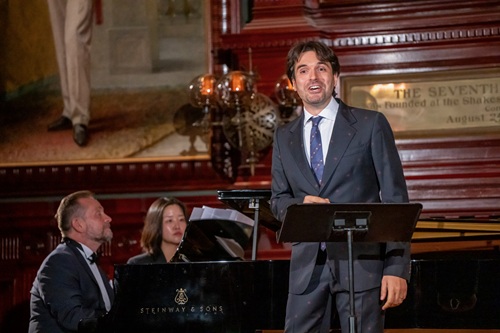
It wasn’t that long ago that a recital like the one given by countertenor Carlo Vistoli and pianist Giulio Zappa to open the Park Avenue Armory’s 2026/27 concert series was the American gold standard: Baroque songs and arias, a taste of the Classical, a turn toward the Romantic, some intimate Belle Époque exotica and, finally, something daring – a popular American song or two. That formula eventually began to seem somewhat fusty as more personal narratives became the norm. Vistoli and Zappa, however, have breathed new life into it with stunning vocalism, exceptional musicianship and exquisite taste.
This performance marked Vistoli’s North American recital debut. The Italian countertenor has built a career spanning opera, concert and recital. His participation in William Christie’s 2015 Le Jardin des Voix was particularly formative, and he has continued to collaborate with Christie while establishing himself as a leading interpreter of Baroque repertoire. His career has taken him to major opera houses and festivals on both sides of the Atlantic, in roles ranging from Baroque heroes to later repertoire.
Zappa, too, was new to New York audiences. An internationally active pianist, vocal coach and répétiteur, he has worked with major opera houses and festivals including La Scala, the Teatro Real, the Rossini Opera Festival and the Wiener Staatsoper. His long list of collaborators includes singers ranging from Luciano Pavarotti and Mariella Devia to Juan Diego Flórez and Lawrence Brownlee.
While it is no injustice to describe Vistoli as a countertenor, he transcends the type. The overall beauty and evenness of his voice throughout the range, from guttural chest tones to a luminous upper register, render classification almost superfluous. Couple that with his long, spinning legato lines and agile, airy ornamentation, and the countertenor designation begins to seem almost beside the point.
The recital opened with two of Britten’s arrangements of Purcell songs, ‘Music for a While’ and ‘Sweeter than Roses’. His attentiveness to text was evident from the start, with his vivid enunciation of the repeated ‘drop’ in Dryden’s description of the snakes descending from Alecto’s head. His word painting in the latter was equally vivid, finding colors to suggest everything from a cool evening breeze to the magic of victorious love. The Handel arias, especially ‘Care selve’, were the epitome of stately elegance, while ‘Where’er you walk’ was marked by ornamentation so light and transparent that it seemed to float in midair.
Vistoli brought controlled dynamics and emotional restraint to an intimate expression of grief in Beethoven’s ‘In questa tomba oscura’. An even greater display of his dramatic abilities came in Schubert’s ‘Der Tod und das Mädchen’. Zappa instantly established the mood with the precision and intensity of the stark, insistent rhythm in the low register, evoking the ominous presence of Death before Vistoli sang a note. While the Maiden’s pleas to be spared were harrowing, Vistoli made Death’s embrace even more chilling through vocal color and penetrating low notes. Also in this vein was Rossini’s ‘La légende de Marguerite’ in which Vistoli exchanged Rossinian bravura for a darker, more introspective lyricism, shaping the song’s long-breathed phrases with exquisite control and finely graded vocal colors.
Vistoli and Zappa clearly delight in exploring cultural crosscurrents, and three songs from Reynaldo Hahn’s Venezia, a cycle of six songs in Venetian dialect, were especially intriguing choices. These light-hearted songs allowed Zappa to summon the movement of a gondola and the strumming of a serenade. Vistoli’s wordless ‘La barcheta’ was gorgeous; he combined suavity and innocence in ‘La biondina in gondoleta’ while richer tones in ‘Che pecà!’ suggested the wisdom brought by experience in matters of the heart. This was Vistoli at his most carefree and charming.
Zappa’s artistry took center stage in a pair of solo piano works that mirrored the recital’s vocal intimacy. He brought a delightful blend of domestic warmth and wit to Rossini’s ‘Une caresse à ma femme’, a tender homage to his second wife from Péchés de vieillesse. This was paired with Respighi’s Valse caressante from Sei pezzi per pianoforte in the second half, where Zappa navigated shifting accents and French salon elegance with a crisp, floating grace that made the waltz both caress the ear and capture the heart.
Whether by design or chance, the spirit of Marilyn Horne, now 92, hovered over the recital. The trailblazing mezzo-soprano was a force in the revival of Baroque opera, championing roles that Vistoli now claims for his own. He is also following in Horne’s footsteps by expanding the perceived territory of singers who perform roles originally written for different voice types.
Horne championed the songs of Stephen Foster, the 19th-century composer often called ‘the father of American music’, including ‘Jeanie with the Light Brown Hair’. Vistoli instilled its simple melody with a wistful tenderness. The final number was ‘Somewhere’ from Bernstein’s West Side Story which Vistoli dedicated to those who died in the 11 September attacks. Horne famously recorded the soaring solo in Bernstein’s own 1985 recording of his groundbreaking musical. Vistoli turned this anthem of hope into a searing plea for the elusive dream of freedom to live and love.
Vistoli and Zappa rewarded the audience with stellar encores by Handel, Rossini and Gluck. If his performances in the recital program were excellent, these arias were a notch higher, showcasing superb command of his voice and profound emotional honesty. ‘Di tanti palpiti’ from Rossini’s Tancredi was arguably the finest of the three. Its demanding high tessitura seemed effortless while Vistoli’s poise lent the aria elegance, rhythmic precision and emotional warmth.
The final encore was ‘Ninna Nanna romagnola’, a Romagnola lullaby set to music by Francesco Balilla Pratella. Its deceptively simple rocking melody tells the heartbreaking story of a mother keeping vigil over her dying child. Vistoli lavished the simple melody with affection and such a panoply of vocal colors that the lullaby became not merely heartbreaking but profoundly human.
Rick Perdian
Purcell – ‘Music for a While’, ‘Sweeter than Roses’ (arr. Britten)
Handel – ‘Care selve’ from Atalanta; ‘Where’er you walk’ from Semele
Rossini – ‘Une caresse à ma femme’ from Péchés de vieillesse, Vol. IV; ‘La légende de Marguerite’ from Péchés de vieillesse, Volume II: Album français
Mozart – ‘Dans un bois solitaire et sombre’, K308; ‘Ridente la calma’, K152
Beethoven – ‘In questa tomba oscura’, WoO133
Schubert – ‘Der Tod und das Mädchen’, D531; ‘Ständchen’ from Der Schwanengesang, D957
Bellini – ‘Vaga luna che inargenti’
Donizetti – ‘Me voglio fa’ ‘na casa’
Respighi – Valse caressante from Sei pezzi per pianoforte
Hahn – ‘La barcheta’, ‘La biondina in gondoleta’, ‘Che pecà!’ from Venezia
Stephen Foster – ‘Jeanie with the Light Brown Hair’
Bernstein – ‘Somewhere’ from West Side Story’
Encores: Handel – ‘Verdi prati, selve amene’ from Alcina; Rossini – ‘Di tanti palpiti’ from Tancredi; Gluck – ‘Che farò senza Euridice?’ from Orfeo ed Euridice; Traditional – ‘Ninna Nanna romagnola’ (arr. Francesco Balilla Pratella)
I wish I had been able to attend this concert. This is one of the most beautifully written reviews it has been my privilege to read. Yes, bravo to Carlo Vistoli and to Giulio Zappa. But bravo as well to Rick Perdian who wrote so beautifully about this recital, that upon reading it, I felt as though I was present in the audience!
Intens genietend van de wonderschone stem van Carlo Vistoli, ben ik Rick Perdian zeer dankbaar voor zijn bijzondere analyse van dit recital.
[Translation] While thoroughly enjoying the magnificent voice of Carlo Vistoli, I am deeply grateful to Rick Perdian for his remarkable analysis of this recital.