A look back at four Verbier Festival 2026 days
27–30.7.2026 – Bruce Liu; Thomas Quasthoff and Kirill Gerstein; Evgeny Kissin and András Schiff; Mikhaïl Pletnev, Dmitry Shishkin, Daniel Lozakovich and the Verbier Festival Chamber Orchestra; Alexandre Kantorow; Mikhaïl Pletnev, Gianandrea Noseda and the Verbier Festival Orchestra. Église de Verbier and Salle des Combins, Verbier. (DN)
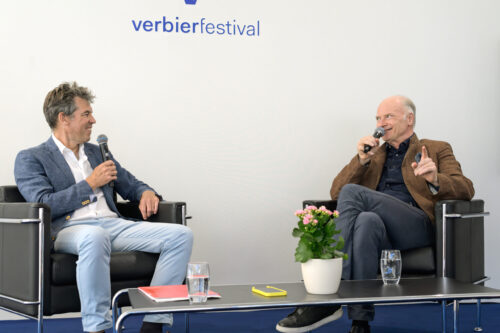
Verbier’s altitude is part of the practical experience of the festival, not just its scenery. The village lies across steep Valais slopes and getting from one concert to another means walking uphill, finding the right bus or using mountain transport. The two main venues intensify that contrast. In the Église de Verbier, the audience sits close enough to register small changes of expression, hesitation and physical restraint. Salle des Combins opens everything out: the sightlines are wider, the ensembles larger and the relationships between musicians more public.
Gianandrea Noseda’s talk on 27 July gave the final concert an unusually clear prelude. He resisted the familiar label ‘Tragic’ for Mahler’s Sixth Symphony and described Mahler’s Fifth as horizontal, the Sixth as vertical and the Seventh as spiral. The distinction was memorable because it was practical rather than decorative. Three evenings later, the Sixth did indeed seem to build in blocks, with pressure accumulating upward through the orchestra before breaking or collapsing.
Bruce Liu opened the concert sequence on 28 July in a full Église. His programme — Ligeti, Bach, Beethoven, Chopin, Ravel, Mompou, Albéniz and Liszt — looked sprawling on paper, but the recital did not feel like a parade of styles. Liu held it together through control. Playfulness could turn quickly towards melancholy; force could recede into something more inward. In the close acoustic of the church, any exaggeration would have been obvious. His contained stage presence made the contrasts sharper rather than smaller, and the repeated returns during the applause confirmed how strongly the audience had followed him.
Thomas Quasthoff and Kirill Gerstein changed the atmosphere later that afternoon in Viktor Ullmann’s The Love and Death of Cornet Christopher Rilke. Quasthoff remained seated and read the text with gravity, but without forcing it into theatre. Gerstein was never merely an accompanist. The piano interrupted the narration, extended it and sometimes took over after the voice stopped. Their partnership depended on timing and alternation. Several endings left the audience uncertain for a moment about when to applaud; that hesitation suited a work in which the final stillness belonged to both performers.
At Salle des Combins, Evgeny Kissin and András Schiff made the idea of changing leadership visible. Kissin was the more forceful and outwardly expressive presence; Schiff was more restrained and structural. In Mozart, Kissin often seemed to set the direction while Schiff supported and steadied it. After they changed places for Robert Schumann, the balance shifted. In the second half, especially in Smetana and Dvořák, Schiff’s structural command became more prominent while Kissin supplied weight and intensity.
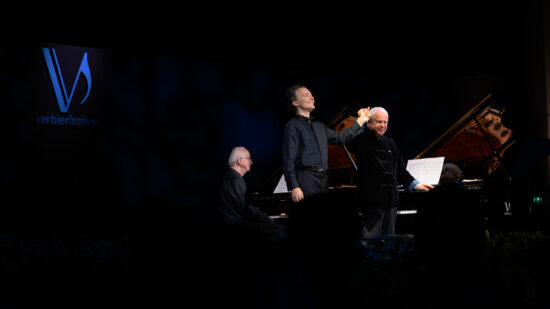
The best moments were not those in which one pianist dominated. They came through exchanged looks, coordinated entries and small adjustments of timing. The two-piano works preserved their separate identities; the piano-four-hands pieces brought them into much closer physical and interpretative proximity. After several encores and sustained applause, the lasting impression was of two very different musicians listening closely enough to keep changing the terms of their partnership.
The following evening belonged first to the Verbier Festival Chamber Orchestra, which was marking its twentieth anniversary. That history prevented the ensemble from appearing as a background for Mikhaïl Pletnev, Dmitry Shishkin and Daniel Lozakovich. The orchestra had its own continuity, and its members played with the combination of energy and discipline expected from musicians who know one another’s habits as well as the repertory.
Pletnev rarely wasted motion on the podium. A pointed indication, a sudden lift of the left hand, a brief fist or a gesture towards one section could be more decisive than a continuous display of conducting. In Czerny, the VFCO moved easily between smooth momentum, playfulness and greater force, while Pletnev kept the structure firm. During the applause he repeatedly turned attention away from himself, acknowledging the concertmaster, individual players and sections of the orchestra.
Dmitry Shishkin then played Pletnev’s orchestral arrangement of Schubert’s Wanderer Fantasy. The arrangement broadened Schubert’s tightly concentrated piano writing into something closer to a symphonic argument, and that scale did not always favour the soloist. Shishkin played with refinement and became more animated as the work developed, but at times the orchestra was simply too strong and the piano line lost definition. His solo encore changed the balance immediately. Alone, he sounded more intimate and more clearly himself.
Daniel Lozakovich’s performance of Pletnev’s arrangement of Robert Schumann’s Violin Concerto achieved a better equilibrium. He began in a controlled, inward manner and allowed the expressive pressure to grow. There were still passages in which the violin blended closely with the orchestra, occasionally to the point of losing its edge, but this could also suit Schumann’s refusal of the usual heroic soloist-versus-orchestra model. Lozakovich’s strongest moments came later, when restraint opened into urgency. The finale released more energy; the encore returned to a darker and more solitary mood.
The Église was packed for Alexandre Kantorow on the morning of 30 July and his recital was the most physically absorbed solo performance of the four days. His head was often lowered, his hair falling across his face; at moments the tension registered in small tremors or gestures that continued after a phrase had ended. Yet the performance was not built on physical display. Its force came from the repeated movement between containment and release.
Across Bach-Liszt, Medtner, Chopin, Alkan, Scriabin and Beethoven, the recital passed through dark, urgent and more hopeful states. After the interval, mourning could give way to lightness, rhythmic drive to suspended stillness, and force to playfulness. At times the intensity threatened to become too continuous, but Kantorow restored proportion by reducing the sound and allowing slower passages to settle. The applause was among the strongest I heard at the festival. He returned several times, often placing a hand on his chest, before giving an encore.
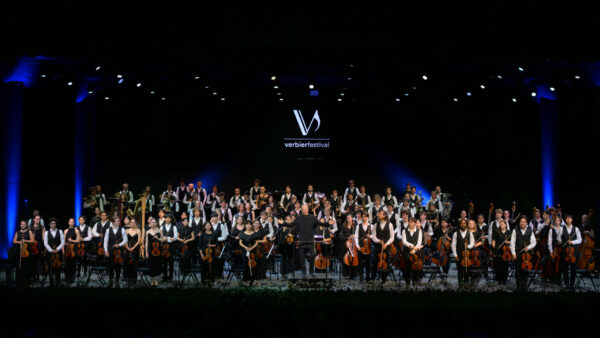
That evening, the Verbier Festival Orchestra was introduced through the 26 nationalities represented by its members. Musicians stood in turn, briefly turning the orchestra into a map of international training and mobility. Pletnev then returned in another role, as soloist in his orchestration of Chopin’s Piano Concerto No.2. At the piano he remained inward and attentive, often listening closely during the orchestral passages instead of seeking constant visual prominence.
His restraint did not diminish his authority. The strongest feature of the concerto was the balance between piano and orchestra: Pletnev’s orchestration gave the work a fuller, more symphonic body while keeping the solo line clear. Noseda supported that balance without making the concerto about himself. The playful finale was the most successful part, releasing some of the reserve of the earlier movements without sacrificing refinement. Their acknowledgement afterwards made the contrast between them plain — Pletnev contained, Noseda physically generous, the standing VFO completing the picture.
After the interval, Mahler’s Sixth realised the vertical architecture Noseda had described three days earlier. The opening march had a hard, collective profile. Noseda looked immersed in the score rather than merely demonstrative, and his gestures changed with the music: sharply directive in the marching and climactic passages, restrained when the sound narrowed, and fluid when the orchestra entered a longer flow. His abrupt left-hand lifts were especially distinctive, redirecting the ensemble with little warning.
The VFO responded with discipline and considerable force. The darker and more playful material of the Scherzo had real depth, while the softer passages made the returns of weight more severe. The three hammer blows registered as part of the symphony’s accumulating pressure rather than as isolated effects. Just as important were the transitions into stillness, when the orchestral sound thinned and sadness or hesitation interrupted the forward drive.
The standing ovation followed the largest and most physically demanding performance of the four days, but Mahler did not make the earlier intimacy seem small. The same qualities had been present throughout the festival: listening, restraint, changing authority and the difficulty of preserving an individual voice inside a partnership or an orchestra. From the Église to Salle des Combins, Verbier was most convincing when those tensions remained audible rather than being smoothed away.
Diana Nikolova
For more information about the Verbier Festival click here.
Featured Image: Gianandrea Noseda stands before the full Verbier Festival Orchestra during the final applause after Mahler’s Sixth Symphony at Salle des Combins on 30 July 2026 © Diana Nikolova