 United States Aspen Music Festival 2026 [5]: Harris Concert Hall, Klein Music Tent, Aspen Meadows Grounds, Aspen. (HS)
27.7.2026, Recital: Jean-Yves Thibaudet (piano). Harris Concert Hall
Debussy – Préludes, Book I & Book II
Encores: Villa-Lobos – ‘O Polichinelo’ from A próle do bebê (Book I)
Elgar (arr. Aldo Ciccolini) – Salut d’Amour
Debussy’s 24 Préludes, published in 1910 and 1913, are really a series of amazingly disparate mini-tone poems, each with an explanatory title. French pianist Jean-Yves Thibaudet has been a particularly distinctive advocate for these popular works and recorded them brilliantly in 1996. Since then his interpretation has only deepened as his traversal here of the works demonstrated.
Thibaudet’s miraculous command of pianistic color was in full bloom. He found ways to make high tinklings sparkle alluringly and big chords resound without overweighing. The fluidity of his passagework and the overall mood he achieved to distinguish each Prélude drew the audience’s rapt attention through the 90 minutes. Picking a favorite is a fool’s errand, but in general all these aspects came into sharper focus in Book II where Debussy’s writing expands into a greater sense of freedom.
Two encores struck out in different directions. The bouncy ‘O Polichinelo’ by Villa-Lobos achieved a different approach to rhythm from Debussy’s, and the gorgeous curves of Elgar’s Salut d’amour put a velvet cap on the recital in Ciccolini’s beautifully articulated arrangement.
28.7.2026, Recital: Angel Stanislav Wang (piano). Harris Concert Hall
Granados – ‘Quejas, o la maja y el ruiseñor’ from Goyescas
Liszt – Piano Sonata in B minor
Debussy – Estampes
Stravinsky – Three Movements from Petrushka
Encore: Debussy – La sérénade interrompue from Préludes, Book I
Debussy’s Estampes predates the Préludes by seven years, but as mini-tone poems they are vivid. Still in his early 20s, the Los Angeles-born Angel Stanislav Wang displayed his own approach to Debussy and pianism in a stunning recital one day after Thibaudet’s.
Most impressively, he coaxed supple textures, endearing legatos and an amazing range of moods from works by Debussy, Stravinsky, Granados and Liszt. That delicacy made the program opener, Granados’s brief ‘Quejas, o la maja y el ruiseñor’, a jewel of subtle rhythms and haunting melody.
Liszt’s Piano Sonata in B minor was thrilling, with hesitation at first, climaxing with enormous power. If all those peaks tended to reach the same volume, the polish and sensitivity of the quieter moments made it all the more eye-opening.
Wang seemed to hesitate before an encore, but his interpretation of La sérénade interrompue, pointedly one of the Debussy Préludes, felt like a breeze.
29.7.2026, Recital: Yuja Wang (piano), People of Earth: Gabriel Globus-Hoenich (percussion and leader), Ahmed Alon (piano, synth), Paul Rios, Jesus Ricardo (trumpet and vocals), Rubén Rengel (violin and vocals), Ivan Llanes (percussion and vocals). Harris Concert Hall
Bernstein – ‘Mambo’ from West Side Story
Lecuona – ‘Gitenarias’
Camila Cabello – ‘Havana’
Ahmed Alom – ‘Sugar Rush’, ‘Displaced Étude No.1’, ‘La Diáspora’
Paul Rios – ‘Boléro Love’
Márquez – Danzón No.2
Alain Perez – ‘Enséñale a quererte’
Encore: Tony Pabon, Manny Rodriguez – ‘I Like It Like That’
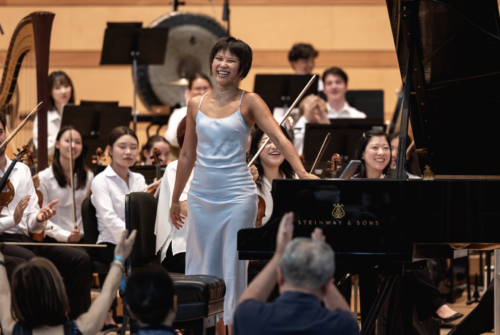
As she has proven many times with encores that venture into musical genres other than pure classical, Yuja Wang can make a piano sing in any language. The New York-based multi-Latin/jazz ensemble People of Earth may not be the first thing that comes to mind for an Aspen Music Festival recital, but it brought a capacity audience in Harris Concert Hall Wednesday to its feet — to dance the cha-cha with a funky encore.
The ensemble comprised two percussionists, two trumpets, a violinist and their own pianist, Ahmed Alon, who held his own in several four-hand duets with Wang. Of course, the music was rooted in his own Cuban and Puerto Rican genres, including pieces he composed. Wang’s virtuosic pianism fit with the rhythmic music, comping solos and blazing into pianistic flurries that could serve as the Latin equivalent of cadenzas.
Among big pieces such as Alom’s ‘La Diáspora’, which careened through a catalog of dance forms, I preferred the quieter songs. One was Márquez’s Danzón No.2, which Wang often plays as an encore, this time with a full band joining in. Another was a gentle arrangement of ‘Havana’ by Camila Cabello.
30.7.2026, Caroline Shaw’s Brush: Aspen Festival Ensemble / Teddy Abrams (conductor), Aspen Meadows Grounds, Klein Music Tent
On Thursday, Caroline Shaw’s mellow Brush refreshed me after a difficult day. Just being in Nature was a blessing, and Shaw’s slow-moving, sonorous sounds cleared my head and boosted my spirits. The music spread along a path through mountain sage and a burbling stretch of the Roaring Fork River. Single or small groups of musicians played bits from the 20-minute piece at various stations. It all came together in the music tent, where the audience could drift in and out as Teddy Abrams conducted.
31.7.2026, Sarah Kirkland Snider, Hildegard: Soloists of Aspen Opera Theater and VocalARTS, Aspen Contemporary Ensemble / Timothy Weiss (conductor). Harris Concert Hall
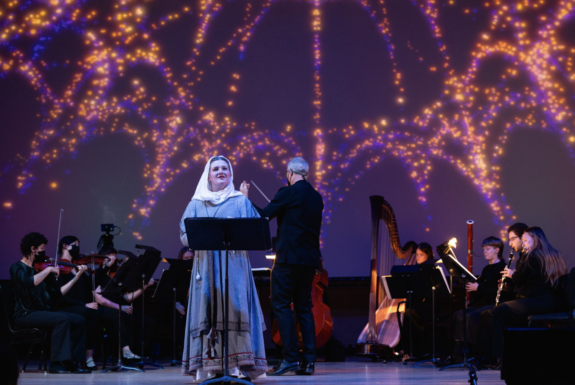
Hildegard von Bingen’s music, though written nine centuries ago, reaches us today with celestial beauty. In her opera on Hildegard’s story, Sarah Kirkland Snider expands on that with one of the most gorgeous scores I have ever heard. The music, and a clear-eyed account of a big inflection point in Hildegard’s life, captivated a rapt audience Friday in Harris Hall.
Snider’s musical means are simple. A string quintet, harp, flute, clarinet and bassoon interwound seamlessly with a cast of sublime singers. Aspen Contemporary Ensemble director Timothy Weiss conducted what must be the most beautiful music he has led in Aspen, maintaining its richness. Deborah Johnson’s projections, often suggesting the 12th-century abbess’s visions, also helped set scenes in this 2-hour 20-minute concert version of Snider’s 2025 score and libretto.
I lack the space to describe the opera’s insights into what Hildegard overcame to survive and become the figure we know, but the music’s serenity and ecstasy tell us what we need to know. Without a piano or doubled instruments to create more sound, the score relies on the sonorities of blended instruments – here flute and clarinet, there double bass and bassoon – that combine with glorious voices.
In the title role soprano Carolina Sullivan soared on long melodic lines and soprano Antonia Cáceres as Richardis, Hildegard’s novice and complicated love interest, fit perfectly with her in tone and vocal suppleness. The rest, all distinctive, reached similar levels in smaller roles
Production:
Director – Elkhanah Pulitzer
Revival director – Zoe Lesser
Costumes – Molly Irelan
Projections – Deborah Johnson
Lighting – Brooke Leinbaugh
Cast:
Hildegard von Bingen – Carolina Sullivan
Richardis von Stade – Antonia Cáceres
Gerta – Georgia Belmont
Clementia – Georgia Jacobson Wolfe
Volmar – Brett Michael Hunter
Mechtild – Yilun Wang
Abbott Cuno – Jason Hwang
1.8.2026, Barber, Lang: Yuja Wang (piano), Fleur Barron (mezzo-soprano), Davóne Tines (baritone), Kantorei (chorus director: Joel M. Rinsema). Aspen Chamber Symphony / Teddy Abrams (conductor). Klein Music Tent
Barber – Piano Concerto
David Lang – the wealth of nations (AMF co-commission)
At Saturday’s Chamber Symphony program, Barber’s concerto with Yuja Wang was a barnburner. Conductor Teddy Abrams kept the concerto moving and got the orchestra to mesh well with the soloist, especially in the lovely slow movement when flutist Demarre McGill entwined his solo with Wang’s seamlessly.
The encore was jaw-dropping. In a season of inventively delicious piano encores from star players, Wang’s semi-improvised 8-minute foray stands at the top. In Philip Glass’s moody Etude No.6 I heard overtones and resonances I never sensed before. She ended with a transcription of Art Tatum’s fiendishly difficult solo on ‘Tiger Rag’ which swung and dazzled as if Tatum himself was playing. In between she improvised a 2-minute bridge that centered on a tune by Shostakovich.
After intermission, the wealth of nations, composer David Lang’s 75-minute oratorio inspired by Adam Smith’s seminal treatise on economics, was a whole different thing. A steady stream of attendees walked out even though there were no spiky harmonies to rebel against. Lang’s repetitively same-shaped style may have been at fault. Or maybe its message riled up some in the audience, focusing on how our economic system favors the rich and disadvantages so many.
Making the first half-hour a lengthy economics lesson didn’t help and few of the movements rose to a musical level that was as gripping as the idea. Mezzo-soprano Fleur Barron, baritone Davóne Tines and the chorus, Kantorei, sang with conviction, precision and beauty. The good parts were hobbled by dull repetition.
2.8.2026, Various: Jean-Yves Thibaudet (piano), Aspen Festival Orchestra / Robert Spano (conductor). Klein Music Tent
Schoenberg – Variations for Orchestra
Stravinsky – Symphony in Three Movements
Gershwin – Concerto in F
Encore: Brahms – Intermezzo in A major
Sunday’s Festival Orchestra program began with incoherence in Schoenberg’s atonal Variations for Orchestra, turned to the spiky neo-classicism of Stravinsky’s Symphony in Three Movements that never quite jelled and then righted the ship with Gershwin’s Concerto in F and its elevated jazz. Soloist Jean-Yves Thibaudet caught the theatrical swing despite being occasionally submerged by the orchestra.
Brahms’s Intermezzo in A major made little sense as an encore, but Thibaudet played it with grace.
Harvey Steiman
Featured Image: Soprano Carolina Sulllivan in the title role in Sarah Kirkland Snider’s Hildegard © Blake Nelson