 United Kingdom BBC Proms 2026 [29] – Schumann: Isabelle Faust (violin), Freiburg Baroque Orchestra / Sir Simon Rattle (conductor), Royal Albert Hall, London 7.9.2026. (JR)
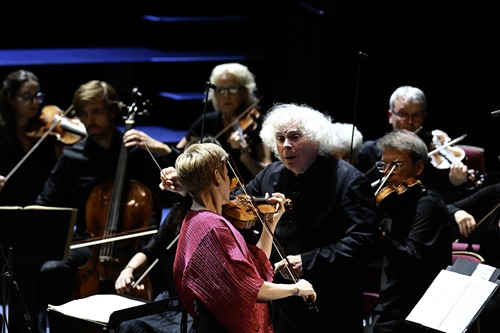
Schumann – Genoveva – Overture; Violin Concerto; Symphony No.2
The esteemed Freiburg Baroque Orchestra are no strangers to the BBC Proms, though their last visit was over ten years ago: this was, however, their first appearance in London under Sir Simon Rattle, who has formed a close relationship with the orchestra. This concert marked the end of their tour with the same soloist and a programme including some Wagner, taking in Bayreuth, Lucerne, Berlin, Bremen and Ravello, a small town on the Amalfi coast where Wagner found inspiration for Parsifal.
Schumann only wrote one opera, Genoveva, and it was by all accounts not a success. It now hardly ever gets performed in Britain (Garsington Opera and Opera North did it in 2000). The dramatic overture, however, written (unusually) before Schumann composed the opera, is well-regarded and a regular concert-opener. Although the introduction is moody, the overture is tuneful and finally bursts into a glorious D major resolution. Even the renowned critic Eduard Hanslick liked it. Conducting without a score, Rattle was full of energy, and the orchestra played with verve. It took a while for the ears to get accustomed to the sound of the orchestra’s period instruments, which sounded rather muted in the difficult acoustics of the Royal Albert Hall. The woodwind sound is less refined, the brass more raucous – but it is undeniably the sound which Schumann was accustomed to.
Isabelle Faust is a champion of Schumann’s Violin Concerto, which has a troubled history. The famed violinist Joseph Joachim played the concerto in rehearsal but not in public and felt it showed signs of the composer’s exhaustion: indeed, Schumann attempted suicide a year later by jumping off a bridge into the River Rhine and was committed to a mental asylum in Bonn where he died two years later, aged just 46. Joachim recommended the concerto should not be published for 100 years, a view shared by his co-executors, his wife Clara and Brahms. However, it was resurrected by Joachim’s great-nieces in 1933, and the Nazis used it to replace Mendelssohn’s concerto during the Third Reich.
The work is now played at quicker speeds but it still is an acquired taste. The beautiful slow second movement is probably the most beguiling, and Faust’s reading was intensely lyrical and intimate; it led without a break into the final lively movement which places demands on the soloist, lightning fingerwork required. Faust has played this concerto all round the world and recorded it, so I was surprised to see she used a score, though did not seem to look at it very often. Needless to say, Faust was on top of the work and its technical difficulties appeared to be easily overcome. We relished Faust’s virtuosic prowess, and the mellow tone of her instrument, a 1704 Stradivarius known as ‘The Sleeping Beauty’, a name which some might well apply to the concerto itself. By way of an encore, Faust treated to us a delicate baroque gem, the Adagio in D-minor by Karl-Friedrich Abel (a contemporary of J.C. Bach). This would have been almost inaudible on the radio but tingled the senses in the hall.
As Stephen Johnson in the Proms programme writes: ‘Of Schumann’s four numbered symphonies, the Second is the one has most polarised opinion’. Some critics found it repetitive and laborious, but Rattle’s interpretation dispelled any doubts; the three quicker movements were full of effervescent vim, and the orchestra’s strings thrilled us with their energy, accuracy and bright sound. In between a heartfelt Adagio espressivo gave us respite before the scampering strings raced in a long coda to the symphony’s fine conclusion.
John Rhodes
Faust was largely inaudible in the RAH, a point none of the reviews has picked up on.