Gloucester Cathedral gets its voice back
In 2025 I reviewed for MusicWeb International a recording of organ music by Jehan Alain and Maurice Duruflé which the British organist, Matthew Martin had recorded on the organ of Buckfast Abbey. I read in the booklet a phrase that resonated with me: Martin referred to the organ as ‘the voice of the building’. Shortly afterwards, by coincidence, I heard the Very Rev. Andrew Zihni, the Dean of Gloucester, voice similar sentiments when he spoke at the carol concert in the cathedral on Boxing Day 2025 when he said of the organ: ‘When it sings, the Cathedral breathes’. You could say, then, that Gloucester Cathedral lost its voice some four years ago when the organ, which everyone knew was in need of a complete overhaul, effectively stopped working rather suddenly. It was soon evident that the instrument would require much more than an overhaul and the bold decision was made to replace the organ entirely with a new instrument. Since then, the Cathedral has been using an electronic console connected to Hauptwerk sampling software. The console is the property of Mr. Paul Vaughan, and was always used by the late Carlo Curley as his recital instrument when playing in the U.K. However, though reasonably effective, this solution has been a stopgap; the installation of a brand-new organ has been anticipated with increasing eagerness.
There is evidence of organs in Gloucester Cathedral before the Restoration, but the instrument built by Thomas Harris in 1666 is the origin of the cathedral’s modern-day organ. The instrument was restored and expanded by the celebrated organ builder, ‘Father’ Henry Willis in 1847; I learned from the Cathedral website that Willis referred to the work he carried out in 1847 as ‘my stepping stone to fame’. Willis did further work on the Gloucester organ in 1888/89. Another rebuild was undertaken by Harrison & Harrison in 1920. A fundamental re-design was carried out in 1971 by Hill, Norman & Beard. That was during the time that John Sanders was Organist of the cathedral; the consultant on the project was Ralph Downes. Yet more work was undertaken in 1999 by the Worcester firm of Nicholson & Co – I remember attending the inauguration recital which was given by John Sanders’s successor, David Briggs in January 2000. Nicholsons carried out further work in 2010 in which Adrian Partington, the current Director of Music, was closely involved. It is Nicholsons who successfully tendered for the commission to build the new organ.
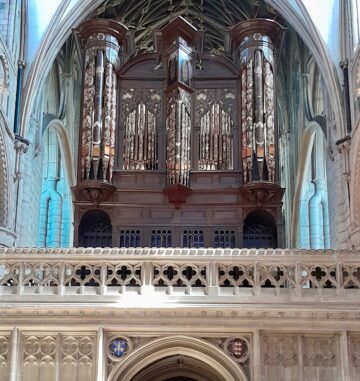
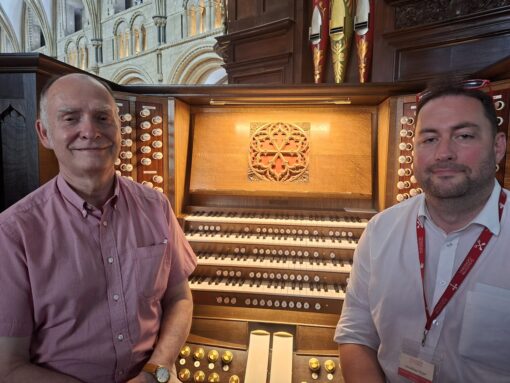
The four-year project is now complete. Visitors to the cathedral may notice little outward sign of change because a key aim of the project has been the retention of the imposing, ornate seventeenth-century organ case which sits proudly on the top of the organ screen That retention was essential because the case is the only complete seventeenth-century double organ case surviving in this country. The case has been completely – and very sympathetically – restored. Superficially, then, little seems to have changed, but up in the organ loft and inside the organ itself there has been massive change. It is a rare event for a new organ to be installed in a British cathedral so I was keen to learn at first hand exactly what’s been going on. No one is better placed to tell me than Adrian Partington the cathedral’s Director of Music since 2008, and the Assistant Director of Music, Jonathan Hope, who has been in post since 2014. I went along to Gloucester Cathedral to meet them and to find out more. The date for our meeting was propitious; it came right in the midst of the UK’s June heatwave and it was a blessed relief to go from the brutal heat into the cool of the cathedral.
Before our conversation began, I had the opportunity for a few words with James Atherton, Nicholsons’s Head Voicer. James has been intimately involved in the project since its inception. When I asked him about the opportunity that this project represented for Nicholsons, he gave me two answers. For the firm, of course, it’s a major and prestigious contract; even for leading firms like Nicholsons, the chance to design, build and install a new organ in a UK cathedral does not present itself very often. In addition, though, James feels very excited on a personal level; he sang in the cathedral choir as a tenor lay clerk for seven years and, in addition, he looked after the old Gloucester organ for some 17 years. So, he regards himself as being very heavily invested in the project. Understandably, his enthusiasm for the job and his pride in the finished instrument were palpable.
To start the conversation, I invited Adrian Partington to describe the significance of the installation of the new organ. He told me that ‘it’s a really good time for Jonathan and I to be in office in Gloucester Cathedral because cathedrals generally only get new organs every 50 years or so’. As he reminded me, ‘Gloucester hasn’t had a new organ since 1971, so it has waited a very long time. So, where it lies in history is of significance but aside from that this is clearly already going to be known as one of the leading instruments of its type in the country. It’s been specially designed for the building; furthermore, it’s been specially designed for [the building’s] three functions, and what it replaced really didn’t fulfil any of them.’ I asked Adrian to expand on the three functions which the Gloucester organ has to fulfil. ‘It’s going to be a flashy recital instrument. It’s going to be able to accompany two sorts of services: it’s got the right colours for intimate Evensong in the Quire but also – and what the last organ lacked almost completely – it’s got the body and sonority to support a full Nave. And finally, we mustn’t forget this, because it’s an important part of our culture in Gloucester Cathedral, it’s going to be able to cut through a full orchestra in Mahler’s Second Symphony, or whatever. So, those are its three functions. It’s been carefully designed; and as Jonathan will tell you even more clearly than me, we have been in consultation practically daily with the organ builders – Jonathan again more than me – and we’ve been able to tell them exactly what we want. Consequently, it has been very much designed by the people who will be playing it week in, week out.’ Adrian went on to comment that ‘the chief designer, the man whose conception it is, James Atherton, knows this building. He knew the last organ; he’s looked after instruments in this building for a very long time. In addition, he was a lay clerk here. So, he knows what the organ should be doing.’ Adrian also referenced the important role played by Paul Hale as the consultant to the project. Hale’s role has been to act as project manager, and he is well qualified for the task. I was interested to learn that he has overseen the reconstruction or rebuilding of some very significant instruments like the organ in Salisbury Cathedral. Over the last few years, Adrian told me, Paul Hale has made regular trips to the organ builders ‘just to make sure that they are getting on with it, basically; and that this very expensive project is kept within budget’.
Though both Adrian and Jonathan regularly play the cathedral organ, it is Jonathan who most frequently plays for services while Adrian directs the choir. So, I asked Jonathan what it had been like playing for services for the last four years without the resources of a full pipe organ. His one-word answer – ‘dire’ – was delivered with feeling! He went on to say ‘We’ve made the best of what we’ve had to, I think. But, in a building this size, we have an acoustic that is twice, perhaps even three times, the size of the acoustic of another cathedral of this size. Sound does travel, but, crucially, real sound travels. And we found this quite early on when they started installing this instrument, I blew through one flute pipe and then I played a chord on full organ on the digital organ and the one flute pipe created more acoustic than the digital organ going flat out. So that was a gauge of how much the building interacts with the sound or chooses not to, depending on what it is’.
In a way, Jonathan had anticipated my next question: he and Adrian will obviously notice a huge difference when playing the new organ, but what about the person in the pew, as it were; what will the general public notice? Jonathan told me that the new instrument’s spatial presence permeates pretty much every corner of the cathedral. At this point, Adrian interjected to point out ‘this is not to do with volume; it’s to do with the displacement of air.’ He referenced Saint-Saëns Third Symphony, which is to be performed in the cathedral in the autumn, and the different ways in which the organ will be able to make an impact; ‘not just the great big C major chords at the start of the finale, but also the soft low pedals at the start of the slow movement; the latter needs to register, and this organ will do just that’. At the time of our conversation, the organ had been in use for all the services on the preceding Sunday and for a few weekday services of Evensong. Jonathan admitted that ‘I’ve already been told that it’s too loud after a week of playing it. But probably that’s partly because I’m having a bit of fun in the first week, and people have got used to the limitations of a digital instrument for four and a half years’. I suggested to him that one of the most interesting things will be the impact that the organ has when he is quietly accompanying the chanting of the Psalms: ‘Well, we’ve already heard that, and it’s delicious’. I was fascinated to hear from Adrian the almost instantaneous effect the organ has had on the choir. ‘The choir has already been lifted. I mean, for four years they haven’t had a proper accompaniment. Jonathan’s a genius at what he does, but no genius can make one of these synthetic instruments sound in a way that properly supports a professional choir. And Sunday morning, particularly in the nave, I suddenly thought: Yes, I feel comfortable. And even the little children were singing out again. It’s been very, very tough’. Jonathan added an interesting observation based on listening back to the live stream from the previous Sunday’s Eucharist: ‘for the last four and a half years, I’ve had to basically use full organ in the hymns on the digital instrument. But with the new organ, I was using probably half, maybe two-thirds, at most of the instrument in the hymns. And if you listen to the livestream, the congregation were bang in time. Just the sound is getting to them’.
The references to things that were lacking on the old organ was the ideal cue for me to explore the question of the previous instrument. I have lived in Gloucester for nearly forty years and I have heard it said by several people over the years that the 1971 re-design resulted in an instrument which was a concert organ rather than one suited to liturgical use. This has long puzzled me since, surely, the primary function of any church organ is its contribution to liturgical music. Adrian’s explanation was fascinating. He told me that ‘the organ that this new one has replaced was designed specifically for concert use. It was pretty good, within its limitations, for playing the repertoire of 18th-century North German music, but beyond that it really didn’t do French music very well and it didn’t do English music very well because it didn’t have the right sounds. And it’s the English music that concerns me most because it didn’t have the right sounds.’ He went on to tell me about the crucial involvement of Ralph Downes (1904-1993) in the design of the old organ. I knew that Downes was a distinguished organist and he was involved in the design of a number of organs, most notably the one which was installed when the Royal Festival Hall was built. However, Downes was principally a recitalist and, from what Adrian told me, this strongly influenced his work for Gloucester Cathedral. As Adrian explained, ‘Downes had no interest whatsoever in the instrument as an accompanying organ. So, there’s a huge amount of repertoire from Purcell via Stanford and Elgar into the 20th century, which he just didn’t allow for. He was just a recitalist, but more than that, a kind of academic, and a teacher. And he had these principles, I understand why the Dean and Chapter decided to engage him: they wanted something new; they wanted something fresh; they wanted something of its age. And we have judged it as a product of its age; and like most things from the 1970s, it’s really not very good. So, to be a bit more specific, there’s lots of colours and sounds that composers specify – such as in Stanford in A or in his anthem For lo, I raise up – but we could never do it properly. So, the Chapter were in agreement with us that whilst of course the cathedral’s organ has got to be a spectacular recital instrument, it really needed to be rethought so that it fulfilled its primary function, which was to accompany the cathedral choir.’
Adrian’s reference to the support which the Chapter gave to this vision reminded me of something else that I heard Dean Andrew Zihni say last Boxing Day when he referred to the new organ project as ‘a once-in-a-lifetime investment in the musical heartbeat of this building’. To make this happen, the cathedral has had to raise an awful lot of money; this has been done through the In Tune Appeal. However, that appeal has been about much more than raising money for a new organ; there has been a much wider and deeper purpose and I asked Adrian to tell me more about this. ‘Although the driver for having a music appeal was, of course, to pay for the organ, which is jolly expensive, the chapter wisely decided that while we’re raising money for an organ, we may as well raise money for other things as well. And it’s all come under the umbrella heading. of In Tune. And the money that is being raised – and I’d like to say that we’re still raising, though; it hasn’t just finished – is going to support musical activities of one kind or another for everybody. Everyone who wishes to come and make music in the cathedral can do so. So, the smaller subheadings of the In Tune campaign are the organ and the choirs. Jonathan looks after the organ part of the In Tune campaign, and we’ve called it the Organ Academy, which Jonathan should talk about’.
Jonathan outlined that the Organ Academy has got two strands: events and education. ‘On one side there will the organ concert series. Now that we have the new instrument available to us, it will be significantly expanded’. Jonathan also told me about the plans for educational activities. Big morning or afternoon events for school children are envisaged. ‘For example, in October, we’re going to have a Meet the Organ event where we fill the nave with primary school children. Someone will be compère downstairs and one of us will play things up here in the organ loft. It will be just a general introduction to the organ for as many children as we can fit into the cathedral safely. We’re also going to have things that are more geared towards current organ students. We’re going to kick one off in the spring of 2027 with repertoire of organ music from Gloucestershire, just to introduce everyone to what this county has produced in terms of organ repertoire: Howells, Vaughan Williams, Wesley’. Just as importantly, Jonathan says that the intention is to form partnerships with churches and schools in the Gloucester diocese; he will keep in touch with them and help in whatever ways are possible. In the next two or three years it is hoped to establish some hubs at various churches around the county, so people don’t have to necessarily travel all the way to Gloucester to have tuition or attend workshops; they can do it in their parts of the county. He made it clear that the firm intention is to involve organists of all ages and abilities, some of whom may never have had the opportunity for an organ lesson.
The Organ Academy isn’t the whole story, though. The Choral Academy is the responsibility of Nia Llewelyn Jones, the cathedral’s Assistant Director of Music (Choral). I invited Adrian to expand on the plans. ‘Like the organ academy, the phrase choral academy encompasses a massive amount of activity. It includes, as a matter of fact, our choral activity now: we already have a junior choir, middle choir, a youth choir, a community choir; they’ve all got different names. We are trying to encourage anybody who wants to sing to be able to come and sing here. So, lots and lots of events of different kinds. And it is our boast that you can sing in Gloucester Cathedral from the age of six months without an upper limit. And just as Jonathan’s coordinating all the organ stuff, Nia is coordinating all the choral activities. We’re going into primary schools; we’re going into secondary schools. They’re just organizing things so that anybody can get the benefit of just making music in this fantastic place. And, with luck, Nia’s work will lay the foundations for a few future choristers.’
The new organ will be formally unveiled to the public at a service of Festal Evensong on Sunday 5 July, which will include the first performance of a new anthem, commissioned from David Bednall. Thereafter, the musical celebrations will continue throughout the summer. There is to be a celebrity organ recital by Wayne Marshall on 18 July. Marshall will also give a masterclass on improvisation the following day. What will be, in effect, a summer-long festival will end with a Gala Concert on Friday 12 September at which Adrian will conduct the BBC National Orchestra of Wales and Thomas Trotter will put the organ through its paces. In between, it is Gloucester’s turn to host the Three Choirs Festival at the end of July at which the organ will be shown off at several major concerts and at the daily services of Choral Evensong. I asked Adrian and Jonathan to tell me more about these events.
Wayne Marshall’s recital has been cleverly designed to show the audience exactly what the new organ can do – in all sorts of ways; he has even included two favourite hymns so that the audience can experience what it is like to sing hymns accompanied by the new organ. He will also play Bach’s celebrated Toccata and Fugue in D minor. Also on the programme will be Healey Willan’s Introduction, Passacaglia and Fugue, which, Jonathan assured me ‘will be a real showpiece for every single sound on this organ, including the new tuba’. The audience will also hear an exciting Toccata and Fugue by the Canadian composer, Andrew Ager (b.1962). Jonathan describes Ager’s work as ‘a fusion of jazz and a sort of homage to the famous [Bach] Toccata and Fugue at the same time. It’s a really intriguing piece’. Right at the end of the summer the distinguished British organist, Thomas Trotter, will showcase the organ during a concert in which Adrian is to conduct the BBC National Orchestra of Wales. Adrian is keenly anticipating Trotter’s appearance. He describes him as ‘very exciting in a different way [to Wayne Marshall]; very clear, very organised, very tasteful, but, like Marshall, just wonderful to listen to’. There will be three works in the programme, all of them involving the organ. To start with, there’s Eugène Gigout’s Grande Choeur Dialogué in the arrangement for organ and orchestra by Joseph Marie Guy-Ropartz. Then something of a rarity, at least in the UK: the Symphonie Concertante by Joseph Jongen, which Adrian says is basically an organ concerto. Finally, the ever-popular Third Symphony by Saint-Saëns.
These two concerts come at the start and end of what will be a summer musical feast at Gloucester Cathedral. The ‘meat in the sandwich’ will be the Three Choirs Festival, which runs from 25 July to 1 August. Unsurprisingly, the new organ will be featured prominently. Adrian says that the principal evening concert which showcases the organ, is going to feature the American virtuoso Katelyn Emerson, who is currently based in Cambridge. She will be playing the marvellous Concerto by Poulenc. Later in the same evening she’ll take part in Janáček’ s Glagolitic Mass, which includes a spectacular organ part. The prospect of hearing this stunningly original masterpiece in Gloucester Cathedral is most exciting (27 July). I am equally intrigued, though, by the opportunity to hear the young French organist Thomas Ospital in recital (30 July). At the launch event for the festival a few months ago, I heard Adrian describe Ospital as ‘dazzling’. Jonathan is just as enthusiastic. He reminded me that the programme will include Marcel Dupré’s Symphonie-Passion (‘a great piece’) and Ospital’s own transcription of Ravel’s orchestral suite, Le tombeau de Couperin. But what really has Jonathan on the edge of his seat is the thought of hearing Ospital play an improvisation on a submitted theme. Jonathan regards Ospital as ‘currently the best improviser alive at the moment on the organ’. He urged me to look on YouTube where there are several examples of Ospital’s improvisatory skills. Adrian has deputed Jonathan to come up with the theme on which the improvisation is to be based: no pressure, there, then!
My conversation with Adrian and Jonathan left me in no doubt that the installation of the new organ marks the start of an exciting new era for Gloucester Cathedral and its music. It is equally clear that, through the In Tune project, the organ is going to be the centrepiece of a terrific amount of outreach work to expand and enrich not just the cathedral’s music but also the musical life of the city and diocese of Gloucester. With the new organ, the cathedral has indeed got its voice back, and that voice is going to be heard well outside the walls of the building.
You can find out much more about the work that Nicholson & Co Ltd have accomplished in building the new organ and view a full specification of the instrument on the company’s website by clicking here.
John Quinn
Featured Image: The restored 1666 organ case in Gloucester Cathedral
I wasn’t able to hear the new organ in action when I conducted my interview with Adrian Partington and Jonathan Hope. However, I’ve now heard it in all its splendour at the Festal Evensong on 5 July at which the organ was formally dedicated.
It is a most impressive instrument. As I expected, there’s all the power you could wish for when the organ is in full cry. However, what impresses just as much is the definition when the dynamics are soft. That latter point was very well illustrated when Jonathan Hope played the fourth movement, Cantabile, from Vierne’s Second Organ Symphony before the service began. In the concluding voluntary, Howells’s Rhapsody No.4, Op.17, Hope really exploited the contrasts and wide range of colours available in the new organ. The instrument also provided stirring accompaniment to three well-chosen hymns, really encouraging the large congregation to sing out.
It’s a magnificent instrument, well worth waiting four years to hear.