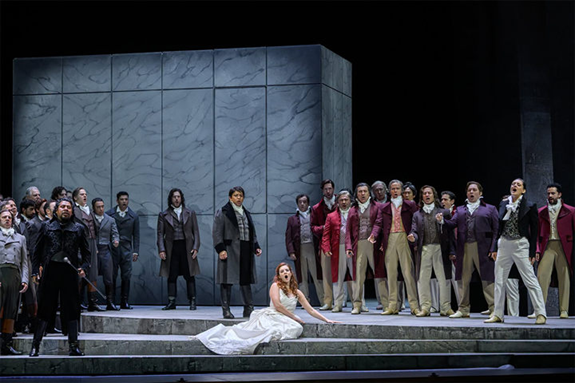
 Spain Bellini, I Capuleti e i Montecchi: Soloists, Gran Teatro del Liceu Coro and Orquesta Sinfónica / Riccardo Frizza (conductor). Teatre Liceu, Barcelona, 2.11.2026. (JMI)
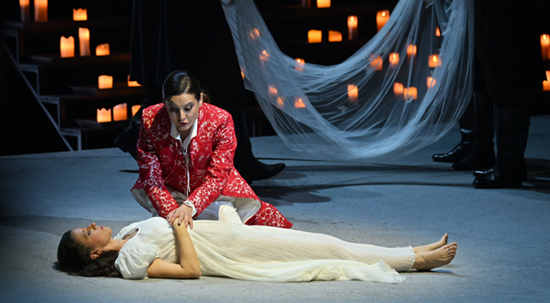
The music of Vincenzo Bellini has returned to Barcelona with the story of Romeo and Juliet which was last performed here in 2016. Back then, the expectation was centered on the role of Romeo – Elīna Garanča had been announced for the part but she canceled and was replaced by Joyce DiDonato, both of whom are, needless to say, exceptional stars. This time, the big interest was Juliet, portrayed by American soprano Lisette Oropesa. Just as Romeo was the standout of the previous production, the same can be said for Juliet in this one. I will simply add that she was the only aspect of the performance that was truly worthwhile.
I must confess that productions of this opera hold little interest for me; in fact, I do not mind if it is offered in concert version. Nowadays, stage directors feel compelled to impose their own personal vision, and it is rare to leave the theater feeling satisfied with what one has seen – especially in Bellini’s operas where the focus should remain entirely on the music and the singing.
For this performance, Barcelona’s Liceu had originally scheduled Adrian Noble’s production – imported from La Scala in Milan – but it was replaced by a Opéra Royal de Wallonie-Liège production directed by Allex Aguilera which premiered there two years ago. The action has been relocated to the time where the opera was composed and the stage is minimalist: two large side walls and a rotating central cube that moves between interior and exterior scenes, depending on whether the cube’s open or closed side is facing the audience. This cube disappears for the final scene at Juliet’s tomb. The production is uninspired and monotonous and, worst of all, there is a lack of stage direction during the various crowd scenes where the chorus actually appears to be performing as if they were in a concert!
Once again, the musical direction was in the hands of Riccardo Frizza – the same conductor who led the opera’s performances here in 2016 and in Bilbao in 2007. While one might not call his conducting extraordinary, it was certainly a solid effort: he handled the work well and was careful to support the soloists’ voices. The Liceu Symphony Orchestra was good with the exception of the prelude. The Liceu Chorus also delivered a strong performance.
All eyes were on Lisette Oropesa, whose performance was brilliant from start to finish. She possesses a high-quality voice and sang magnificently, delivering some exquisite pianissimos. She is a superb Giulietta – and a truly great soprano – whom audiences will be able to enjoy for many years to come.
The role of Romeo was sung by Italian mezzo-soprano Raffaella Lupinacci whose performance fell a few steps below that of Giulietta. While her voice is attractive, her singing lacks a distinct personality. Furthermore, her lower register was rather weak.
Tebaldo was Peruvian Iván Ayón Rivas. He once again offered his light tenor voice which is at its best in the higher register; I find his middle register rather unconvincing. Marko Mimica was adequate as Lorenzo while Alejandro López as Capellio was disappointing.
José M. Irurzun
Featured Image: Teatre Liceu’s I Capuleti e i Montecchi © A. Bofill
Production:
Director and Sets – Allex Aguilera
Costumes – Françoise Raybaud
Lighting – Luis Perdiguero
Video – Arnaud Pottier
Chorus director – Pablo Assante
Cast:
Giulietta – Lisette Oropesa
Romeo – Raffaella Lupinacci
Tebaldo – Iván Ayón Rivas
Lorenzo – Marko Mimica
Capellio – Alejandro López