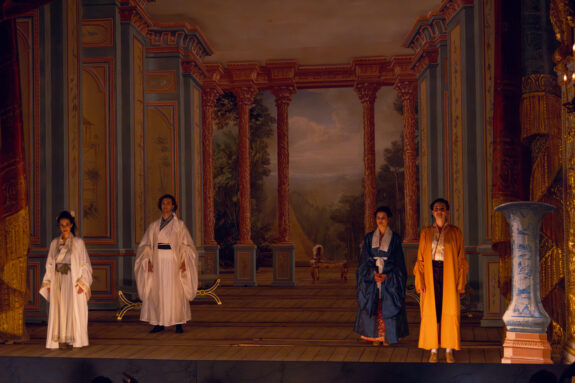
 France Gluck, Le cinesi: Soloists, Orchestre de l’Opéra Royal du Château de Versailles / Andrés Gabetta (conductor). Théâtre de la Reine, Opéra Royal de Versailles, Versailles, 28.6.2026. (RP)
There are wonderful nights at the opera, and then there are truly sublime ones. Opéra Royal de Versailles’s production of Gluck’s Le cinesi belonged firmly in the latter category. It formed the centerpiece of an unforgettable evening at the Petit Trianon, beginning with champagne and ending beneath a sky illuminated by fireworks.
After receiving the Petit Trianon from Louis XVI in 1774, Marie Antoinette transformed it into her private retreat, remodeling the gardens in the fashionable English style with Anglo-Chinese elements. Four years later, she completed the vision by commissioning the Théâtre de la Reine, creating an intimate venue for private theatrical performances and musical entertainments. She herself sang and acted in light-hearted productions, including the role of Colette in Le Devin du village, Jean-Jacques Rousseau’s comic opera.
Sheltered from the rigid protocol of the official court, the Queen’s private domain offered an unusual degree of artistic freedom. She and her close circle performed plays by Pierre Beaumarchais at a time when The Marriage of Figaro remained barred from public performance because of its perceived criticism of aristocratic privilege. Such license attracted controversy and, together with the perceived frivolity and expense of these private entertainments, drew increasing scrutiny as France’s financial crisis deepened. In 1785, Marie Antoinette, bending to public opinion, gave her final theatrical performance at the theater, appearing as Rosine in The Barber of Seville, purportedly before Beaumarchais himself.
The stark stone exterior of the Théâtre de la Reine belies the jewel-box interior, where cream, blue and gilt decorate an auditorium seating around 250, complete with an orchestra pit for about twenty musicians. Built on a modest budget, the theater relied on sculpted plaster ornament and faux-marble paneling to achieve its air of elegance. The ceiling painting is a 19th-century copy of Jean-Jacques Lagrenée’s now lost depiction of Apollo surrounded by the Graces and Muses. Ironically, this economy proved to be the theater’s salvation. During the sale of royal properties after the French Revolution, it escaped dismantling because its relatively plain construction offered little salvage value.
The Théâtre de la Reine remains remarkably intact and is one of the few 18th-century theaters in the world with its original, fully functioning, hand-operated stage machinery. This ingenious system enables seamless scene changes and spectacular effects without modern technology. The original deus ex machina remains operational, allowing painted scenery to glide into place, borders to descend and mechanical clouds carrying actors portraying gods and mythological figures to be lowered from above. Beneath the stage, a network of traps enables performers and props to appear suddenly or vanish through the floor.
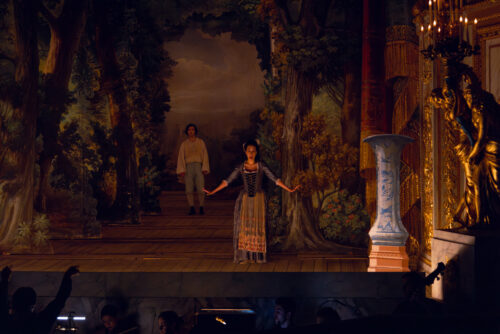
Although the theater’s stage machinery survived, its original scenery did not. In 1835, Louis Philippe, King of the French from 1830 to 1848, began converting the Château and its grounds into a museum dedicated to the history of France. As part of the theater’s restoration, he commissioned new scenery to replace the lost originals. While not contemporary with the theater itself, they remain an important record of 19th-century stage design.
Gluck’s Le cinesi is an azione teatrale, a genre of short dramatic works typically performed in royal residences or court theaters, and Metastasio’s libretto is an example of 18th-century Chinoiserie – European artistic fashion that imagined and stylized Chinese culture rather than depicting it authentically. Gluck was not the first to compose an opera using Metastasio’s libretto, as Antonio Caldara and Nicolò Conforto did so before him. They reworked the libretto at the request of the famed castrato Farinelli. Entitled La festa cinese, Conforto’s opera was performed to celebrate the name day of King Ferdinand VI of Spain in 1751.
The breezy story features three young Chinese women – Lisinga, Sivene and Tangia – passing the time in a secluded palace, lamenting the monotony of their lives. Silango arrives, fresh from his travels in Europe and eager to reunite with his beloved Sivene. The women are shocked to find him in their quarters where men are forbidden. While concealing him, they perform two scenes from Greek mythology, followed by a sketch in which Tangia parodies a vain, self-important youth – a clear spoof of Silango who has just returned from foreign travels.
In Le cinesi, Gluck gently parodies contemporary operatic conventions inherent in Metastasio’s libretto through arias for the three female characters ranging from the idyllic to the dramatic and ending with comedy. His version premiered on 24 September 1754 in Vienna in the presence of the Empress Maria Theresa, mother of Marie Antoinette. As a young archduchess, Maria Theresa had performed in the premiere of Caldara’s version in Vienna in 1735.
Historically informed musical performance has become familiar to early-opera audiences, but comparable fidelity to scenery and stagecraft remains rare. Opéra Royal is in a privileged position to strive for and achieve a remarkable level of historical accuracy in the visual elements. Director Charles Di Meglio combined Louis Philippe-era forest scenes with a recreation of the 1774 production of André Grétry’s Zémire et Azor at the Palace of Fontainebleau, a hunting lodge and autumn residence for many French monarchs. The re-created décor includes a salon in blue and pink tones, framed by two large Chinese landscapes. Cut-outs of large Qing-dynasty blue-and-white porcelain vases flank the stage and also appear in alcoves on either side.
Past and present converged when the stage elevator was used to raise a statue of the Qianlong Emperor, a great patron of the arts whose life encompassed nearly the entire eighteenth century. It is a reproduction of a rare 18th-century bisque porcelain figure entitled ‘L’Empereur de Chine’ produced by the renowned Manufacture de Sèvres circa 1776–1785. Marie Antoinette was one of the first buyers of the figure which was dispersed after the Revolution. In 2024, the Château de Versailles bought one of the rare figures at auction for its collection.
Andrés Gabetta led a fine young cast and the musicians of the Opéra Royal de Versailles in a delightful, delicately finessed performance. The Orchestre de l’Opéra Royal du Château de Versailles infused Gluck’s melodies with élan, with especially fine playing from the oboes and horns. Harpsichordist Simon Kalinowski’s stylish accompaniments were enriched with generous use of the lute stop, and he also doubled on the flute, playing Gluck’s melodies with equal panache. Sight unseen, percussionist Jean-Christophe Cassagnes brightened the evening with the tingle of a triangle and the shake of the tambourine.
Sarah Charles brought grace and vocal refinement to Sivene, the object of Silango’s affections. She was the picture of innocence, while Abel Zamora’s Silango returned from Europe charming, worldly and smug. Charles’s silvery soprano spun effortless coloratura and long lyrical lines, intertwining beautifully with Zamora’s bright lyric tenor in music that gently parodies the sentimental pastoral style while remaining genuinely touching.
As Lisinga, Sivene’s sister, Juliette Mey delivered her usual tour de force performance as Andromache, the widow of Hector in the Iliad. It was a scene as grand as opera seria, the genre which inspired it. Mey was riveting dramatically and vocally thrilling as she gave voice to Lisinga’s grief and fears after the fall of Troy. To Flore Royer as Tangia fell the comic relief, mocking Silango’s dandified European mannerisms and making sharp-witted asides about his blooming romance with Sivene. Royer’s comic timing was as finely tuned as her alluring lyric voice.
Performances at the Théâtre de la Reine remain exceptionally rare because of the building’s fragility and historical significance. Next year’s sole offering will be Johann Adolf Hasse’s youthful opera Marc-Antoine & Cléopâtre on 3 and 4 July 2027. Those seeking a grander spectacle should consider the annual gala of the Association des Amis de l’Opéra Royal (ADOR), held this year on 3 October 2026 in the Château itself, with fireworks viewed from the Hall of Mirrors.
Rick Perdian
Featured Image: Sarah Charles (Sivene), Abel Zamora (Silango), Juliette Mey (Lisinga) and Flore Royer (Tangia ) © CVS/Baptiste Lacaze
Cast:
Sivene – Sarah Charles
Tangia – Flore Royer
Lisinga – Juliette Mey
Silango – Abel Zamora
Production:
Director – Charles Di Meglio
Scenery & Accessories – Gabriel Bouchayer, Lyes Ouzeri, Pascal Mascoli
Lighting – Charles-Édouard Soudan