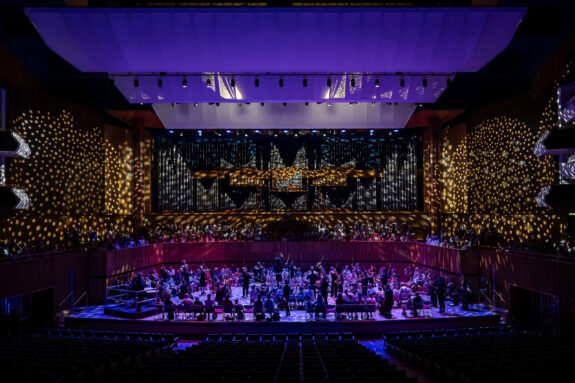
 United Kingdom Mozart: Aurora Orchestra / Nicholas Collon (conductor and presenter). Royal Festival Hall, London, 27.6.2026. (CSa)
Mozart – Symphony No.41 in C major ‘Jupiter’, K551
The charismatic conductor Nicholas Collon and his Aurora players passionately believe that orchestral music is for everyone, and that the key to engaging new audiences, particularly children and those new to the classical repertoire lies not in dumbed-down, play-it-safe programming but in imaginative and innovative presentation. Anyone who has previously encountered one of their By Heart performances of Stravinsky’s Rite of Spring or Firebird or witnessed a BBC Proms performance of Shostakovich’s searing Fifth Symphony or Beethoven’s mighty Ninth will know these concerts are anything but conventional.
The Aurora trademark formula has become unmistakable. By combining storytelling, musical demonstration and a memorised score, a complete work is transformed from what might seem to be an intimidating masterpiece into an absorbing shared experience. The Southbank realisation of Mozart’s last and greatest symphony, No.41 in C major, nicknamed ‘Jupiter’, was no exception. In an immersive presentation geared to audiences (8 years-old and upwards) Collon unpacked, deconstructed and reassembled Mozart’s masterpiece with dry humour, razor-sharp analysis and lightly worn erudition. His colourful seminar was equally matched and by exceptionally bright, engagingly fresh and dynamic playing – musicianship of the highest order.
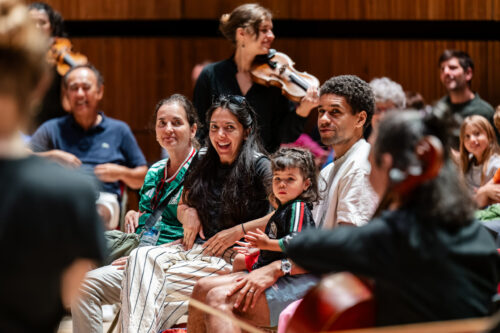
The audience, seated on the platform or raked steeply in the choir stalls, were placed at the heart of this By Heart production as 30 or so musicians deftly conducted by Collon, moved around and amongst them. There were no music stands cluttering the platform; chairs or stools were provided only for those musicians whose instruments required them to be seated.
Starting with a little contextual history, Collon explained how, in the summer of 1788, Mozart’s acute financial hardship coincided with one of his greatest bursts of creativity: Symphonies No.39 in E-flat major, No.40 in G minor and No.41 ‘Jupiter’ were all composed within a period of 6 weeks, in the vain hope of a profitable subscription concert series. Sadly for Mozart that never happened, but fortunately the world was bequeathed with three masterpieces which are widely considered to be amongst the crowning glories of the symphonic repertoire. As Collon went on to demonstrate, the contrast between Mozart’s dire personal circumstances at the time of writing and the dazzling optimism of this late work could not have been greater.
After the introduction, Collon, baton in hand, propelled the first movement Allegro vivace forward, eliciting a regal blaze of trumpets and timpani, strikingly juxtaposed with some exceptionally graceful singing from the strings. A small group of winds (flutes, oboes and bassoons positioned immediately next to my eight-year-old grandson) entered in a delightful exchange with the other sections of the orchestra, while sonorous French horns added their velvety voices from the choir stalls above.
The serene slow movement, as Collon explained, was a Sarabande marked Andante cantabile – ‘full of lyrical questions and affirmative answers’. If the melodies were suggestive of operatic dialogue, then the Menuetto became a fully-fledged opera which Collon evocatively entitled ‘The Mansion’. Set in the grounds of an imaginary aristocratic country estate, audience members were invited to act out the various characters. There were ready volunteers for the roles of the toiling gardener, the clumsy butler and the swaggering nobleman, all of whom brought the three distinct themes of the third movement dramatically to life.
‘Like the symphonies of Beethoven, Mahler and Shostakovich’ observed Collon, ‘Mozart transfers the weight and importance of his work to the final movement whose five musical themes when played together are an intricate jigsaw’. At this point the audience, serenaded by newly positioned groups of players, was split into five sections and directed to adopt and sing a theme to words gleefully suggested by Collon. The orchestra in an exhilarating conclusion, then wove the movement’s intricate contrapuntal writing into a glorious tapestry of musical colour.
Hearing a performance from within and with constantly changing musical groupings was both a fascinating and privileged experience. From this unusual perspective, one might have expected the sound to become fragmented or the instrumental balance to be lost. Instead, the opposite proved true: the structural integrity of the symphony remained perfectly intact. Collon’s great skills were not confined to an insightful presentation which opened the locked door of classical music to young and old alike. They also enabled us to hear the instrumental lines with exceptional clarity, while ensuring that Mozart’s carefully crafted architecture was fully preserved.
Chris Sallon
Featured Image: Aurora Orchestra’s Mozart ‘Jupiter’ By Heart © Julian Guidera