Aldeburgh Festival – 12-28 June 2026
The 77th Aldeburgh Festival offered a wide variety of repertoire, including several new and recent works of great interest. My experience of this year’s events featured memorable performances given in the Britten Studio and in the Concert Hall at Snape Maltings.
An afternoon recital by the Maxwell Quartet in the Britten Studio on 15 June began with a lively account of Prokofiev’s String Quartet No.2 in F (1941), in which the robust rhythms of the opening movement’s folk-like main themes were crisply articulated, the wistfully lyrical central Adagio unfolded with ease and the dance-like ideas of the exhilarating finale were resolute and compelling. All four players combined sophistication with an invigorating freshness in their approach to the material.
Brahms’s String Quartet No.2 in A minor (1873) received a considered and finely detailed reading. The outer movements’ narratives were set out cogently, with delicacy as well as purpose, there was a spare intimacy to the opening of the Andante and the refined Quasi minuetto contained a satisfyingly spirited trio section. The overriding impression was one of bracing clarity, with lean textures and a gripping narrative drive.
After the interval, the Maxwell Quartet gave the first UK performance of Eleanor Alberga’s String Quartet No.4 (2026), a substantial, closely argued, 35-minute work which the ensemble had commissioned and premiered in Amsterdam. The vivacious opening movement counterpoised bold, long-limbed thematic material with gently accented rhythmic sequences. An intricately plotted passage involving rapidly alternating pizzicato and bowed notes for all four players was exhilarating. By contrast, the second movement was poised and introspective, though not without tension. The mercurial central scherzo was a delight, with subtle shifts in metre and dynamics, a wide expressive range and rich interplay between the four instruments. Marked ‘Sliding’, the fourth movement was a spaciously conceived and profoundly eloquent statement. Beginning with a quiet, recitative-like cello solo, it expanded into paragraphs of finely wrought counterpoint. Predominantly hushed and distanced, as if dimly recalling events now long past, it also embraced more impassioned material. Enigmatic and affecting, this slow movement was the heart and soul of the piece, chamber music at its most intimate and boundless. The finale was jubilant and restorative, its initially smoothly flowing lines becoming punchier and more ecstatic as the movement proceeded. Previously heard material was recalled, bringing a satisfyingly cyclical quality to a variegated and highly individual score. The Maxwells had this music well under their fingers, giving them the freedom to interpret it with intuition and invention. Eleanor Alberga’s String Quartet No.4 made its UK debut to warm and rapturous applause, the festivalgoers spontaneously expressing their appreciation for a consummate performance of a rewarding and gloriously uplifting addition to the genre.
The next morning’s recital in the Britten Studio consisted of four variously scored works all featuring the German-French cellist Nicholas Altstaedt. The first item on the programme was the UK premiere of Tom Coult’s Craftsmen and Clowns, for solo cello (2026). With a droll title taken from a pair of character types found in sitcoms, the piece granted moments of fun and interpretative freedom. The purposeful opening movement was sufficiently flexible to take in harmonics, sequences with glassy, wispy effects and passages played with the bow tip bouncing off the bridge of the instrument. Altstaedt took these expressive effects in his stride, giving them an improvisatory freshness, without disrupting the overriding musical narrative. The central Giocoso began playfully, sprinkled with airy grace notes, before a more rhythmically free episode led to a spirited and assured closing section. The Quasi passacaglia finale deftly incorporated pizzicatos, ricochet bowing effects and passages where the player tapped the body of the instrument. These technical challenges were impressively subsumed into an interpretation of cogency, wit and elegance. Unfolding with the relaxed appeal of an accomplished storyteller, Craftsmen and Clowns made an enticing curtain-raiser.
Soprano Anna-Lena Elbert then joined Nicholas Altstaedt for a delicately radiant account of Harrison Birtwistle’s 9 Settings of Lorine Niedecker (1990-2000). Ryan Wigglesworth was the pianist in a bright and probing rendering of Britten’s Cello Sonata (1961), before violinist Benjamin Marquis Gilmore and the other three musicians closed the concert with an intensely committed performance of Shostakovich’s dark-hued Seven Romances on Poems by Alexander Blok, for soprano, violin, cello and piano (1967). This thoughtfully compiled and superbly executed programme elicited a very favourable response from an attentive and highly receptive audience.
On 19 June, a late-afternoon event in the Britten Studio saw the staging of the world premiere of Chronicle, for twelve unaccompanied voices (2026) by composers Alex Ho and Rockey Sun Keting, given by the vocal ensemble SANSARA, conducted by their artistic director Tom Herring. Featuring surtitles, discrete lighting and unobtrusive electronic effects, the performance placed an emphasis on the singers. The work took the form of settings of a libretto by Yilin Wang translating six women poets across a millennium of Chinese history. Themes of war, exile, love and loss recurred in these concise and often highly emotive texts. The musical treatments varied from gently lyrical polyphony to powerful, chant-like unisons, with several solos and various vocal groupings creating diversity and subtlety in the settings. The fluency and understated nature of much of the writing served to highlight the powerful texts, while also giving the hour-long piece a cumulative charge, inexorably drawing the listener in to its distinctive and captivating soundscape.
SANSARA’s reflective and affecting presentation contrasted strongly with the BBC National Orchestra of Wales and conductor Kevin John Edusei’s vigorous, high-powered concert held later the same day in Snape Malting’s Concert Hall. They began on exhilarating form with a lucid and marvellously precise traversal of John Adams’s Short Ride in a Fast Machine (1986) in which instrumental details were awarded sufficient time and space to make their mark.
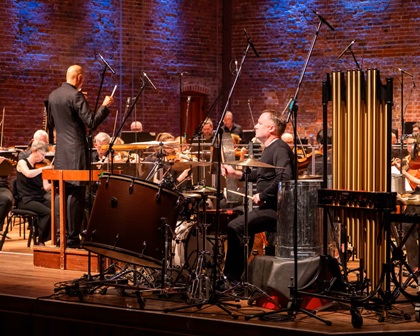
Colin Currie was the virtuosic soloist in the world premiere of Tansy Davies’s percussion concerto, Earthworks (2026). Situated at the front of the stage, to the right of the conductor, the tirelessly active soloist, who played almost continuously throughout, divided his time between two sets of percussion, a layered drum kit and a collection of mainly metallic items such as tubular bells, gongs, tin cans and a large metal dustbin. The title of the piece refers to monumental ancient structures built by indigenous peoples, such as the Uffington White Horse in Oxfordshire, which captured the composer’s imagination as a child, and those of the Amazon, uncovered by deforestation. The concerto envisages these geoglyphs as massive land art communicating to us in patterns and shapes from the ancient past. A tour de force of percussion writing, this tautly plotted, two-movement piece also provided many ear-catching orchestral effects, from edgily dynamic, recurring wind motifs to woozily gliding string chords. Capturing something of the inexorable persistence of Nature, the ritualistic, rugged material carried all before it. The virtuosity of the score and the performance were both hugely imposing, but underneath the surface brilliance and bravura of the music there seemed to lie, to this listener at least, some elusive, but heartfelt, truths about determination, survival and an eternal desire to be evermore yourself.
In the concert’s second half, Edusei and the BBC NOW gave a committed interpretation of Shostakovich’s Tenth Symphony (1953) that combined technical skill and emotional engagement. The formal grasp of the massive opening movement was particularly striking, inner tensions carefully sustained and flaring climaxes unerringly placed and accommodated for maximum impact. The following, compact Allegro had a terrifying volatility, the clarity of the instrumental detail here rendering this terse and savage eruption all the more disturbing. The following Allegretto had an uneasy introspection, the movement moulded by a series of yearning, repeated horn calls. Initially brooding, the finale’s subsequent hearty, dance-like section led to a monumental climax. This was a convincing, ardent interpretation of one of the twentieth century’s greatest symphonies, with moments of sheer beauty as well as violence. The musicians were rightly rewarded with sustained applause and acclamation.
The BBC NOW and Kevin John Edusei returned the following evening to the Snape Maltings Concert Hall in a programme of vividly scored works that showcased this musical partnership’s natural gift for storytelling and creating vibrant instrumental colours. Elizabeth Ogonek’s Sleep and Unremembrance (2018) opened the concert. The composer was inspired to write this piece after reading the poem While Sleeping by the Nobel prize-winning Polish poet Wisława Szymborska about a strange dream in which memories alter radically and then fade away altogether. From its tense, capricious opening to more sustained, visionary paragraphs, the work unfurled naturally, enticing the listener with myriad painterly effects. It is an elusive score with tiny darting motifs and subtle shifts in tempo and mood that the players realised ably. In a gratifying stroke of scheduling, the magical, hushed concluding bars appeared to pave the way for the following work on the programme.
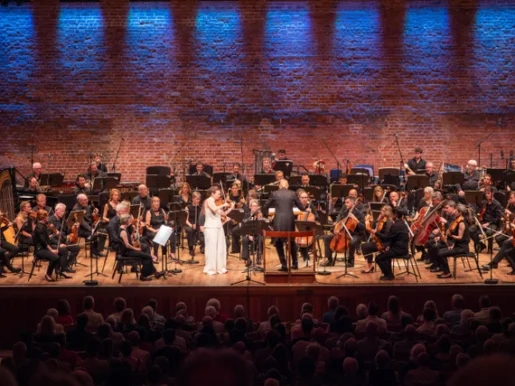
Freya Waley-Cohen’s The Dreamer (2026) was a 25-minute violin concerto written for her sister Tamsin Waley-Cohen, who now took centre-stage for the work’s world premiere performance. Growing out of the solo instrument’s lowest register, the opening movement had a loamy, folk-like quality, driven by arcadian, dance-like figures. Tubular bells, harp flourishes and vertiginous glissandos added to an enchanting sense of fantasy and illusion. Near the end of this often rapturous movement, a tenderly elegiac sequence for solo violin was joined by luminous, string textures. It was a visionary conclusion to a movement that conjured up impressions of myths, legends and remembrance. The ensuing, delicately scored song without words was buoyant and soothing, elevated by the soloist’s effortlessly fluent and radiant playing. Rhythmic and rustic, the scherzo brought infectious energy. In place of a ‘trio’ section, there was a refined duet for soloist and harp at the heart of the movement. In the finale, a repeated chorale’s tolling, processional solemnity was often playfully subverted by impish upper woodwind and the work ended in an ecstatic release of pure joy. A deeply personal concertante work of impressive scope and integrity, The Dreamer intrigued, captivated and consoled. In a solo part written especially for her, Tamsin Waley-Cohen played with warmth, technical assurance and expressive freedom, securely and instinctively accompanied by the BBC NOW musicians.
The concert closed with a characterful account of Rachmaninov’s Symphonic Dances (1940). Edusei’s tempos were sufficiently relaxed to allow instrumental details to emerge and blossom in all three movements, finding nostalgia as well as resolve in the opening, march-like movement, sensuousness along with languor in the central waltz and, in the intricate finale, apprehension followed by genuine vigour and, ultimately, jubilation. Striking a satisfying balance between revealing orchestral colour and elucidating formal structure, this searching rendition of the score secured a favourable reaction from a highly appreciative audience.
Paul Conway
For more about the Aldeburgh Festival click here.
Featured Image: Violinist Tamsin Waley-Cohen with the BBC NOW conducted by Kevin John Edusei © BPA