
 United Kingdom Various: Miró Quartet (Daniel Ching, William Fedkenheuer [violins], John Largess [viola], Joshua Gindele [cello]). Weill Recital Hall, Carnegie Hall, New York, 23.10.2026. (ES-S)
Schubert – Quartettsatz in C minor, D.70; String Quartet in G major, D.887
Caroline Shaw – Entr’acte
Webern – Langsamer Satz
Encore: Schubert – String Quartet No.12 (unfinished)
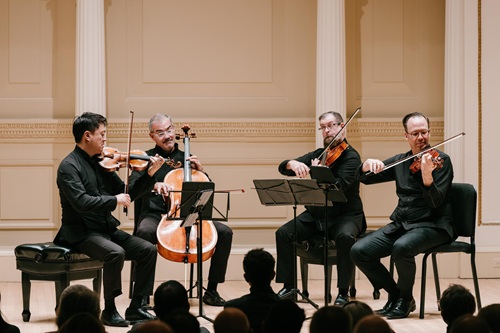
The Miró Quartet returned to the intimate setting of Carnegie Hall’s Weill Recital Hall with a program whose structure echoed the famous rhythmic motif that opens Beethoven’s Fifth Symphony: three short works followed by one exceptionally long one. Throughout the recital, the Mirós maintained their unusual split-violin seating arrangement: first violin, cello, viola and second violin, from left to right. This configuration seemed to enhance the clarity of the individual voices while preserving their blend.
The most substantial work was Schubert’s last string quartet, in G major, composed two centuries ago, as violist John Largess reminded the audience in his introductory remarks. The foursome approached the opening movement’s oscillation between major and minor not so much as a confrontation as a restless search. Each return of a motif brought a fresh nuance. The shimmering tremolos built tension that periodically erupted into Beethovenian drama. Amid this turbulence, the players never lost sight of Schubert’s lyrical impulses. Particularly affecting were the delicate yet assured exchanges between Daniel Ching’s first violin and John Largess’s viola, and between Ching and Joshua Gindele’s cello. The four voices remained clearly distinguishable even in the densest passages.
In the Andante un poco moto, Gindele’s beautifully phrased opening melody was seamlessly woven into the surrounding texture. The movement’s sudden, violent outbursts arose from the underlying musical tension, without theatrical exaggeration. As melodic fragments passed fluidly from one instrument to another, the Mirós sustained a coherent emotional arc through the shifts between lyricism and unrest. The Scherzo was fleet and animated, with only a few minor lapses in coordination. In the gentler Trio, the singing line introduced by the cello evoked one of the composer’s Lieder.
The finale revisited the restless energy of the opening movement in a more playful vein, its dance rhythms shifting between an earthy, weighty tread and moments of almost Mozartian légèreté. The alternation of major and minor tonalities and the sharply differentiated accents remained vivid throughout. Musical ideas again passed fluently among the four players who maintained secure balance and intonation throughout the most demanding passages.
The three shorter works performed in the recital’s first half spanned nearly as many years as had elapsed since Schubert composed his G major Quartet.
The first work on the program was also by Schubert: his Quartettsatz, D.703. This compact movement foreshadows the interplay of drama and lyricism that the composer would explore on a much broader scale six years later. The players gave the opening’s chromatic tremolos a nervous urgency without sounding hurried. Their judicious use of rubato shaped individual phrases while sustaining the musical flow. Accents and crescendos were sharply defined, never overstated. The sudden transitions between tempestuous agitation and pastoral lyricism felt natural.
True to its title, Caroline Shaw’s Entr’acte served as an interlude between Schubert’s Quartettsatz and Webern’s Langsamer Satz. Inspired by the Menuetto of Haydn’s Quartet Op.77, No.2, the piece explores the unexpected harmonic transformations that Shaw likened to crossing ‘to the other side of Alice’s looking glass’. The Mirós captured this sense of shifting perspectives while keeping the underlying minuet-and-trio structure clearly perceptible. Fragmentary melodies, whispering textures and unexpected pizzicato effects emerged and receded as the players moved between moments of poise, fragility and unease. The caesuras carried as much expressive weight as the surrounding sounds. The final plucked cello line brought an unexpectedly poignant close.
Like Schubert’s Quartettsatz, Webern’s Langsamer Satz had to wait until after the composer’s death for its first public performance. Written in 1905, the piece belongs to the late-Romantic world of the young Webern before his turn toward atonality. The opening melody, introduced by the first violin, unfolded like a tale beginning ‘Once upon a time’, with the viola and second violin taking up the narrative in turn. The phrasing was expansive yet purposeful. Beneath the lyrical surface, occasional hints of psychological unease evoked Vienna’s artistic climate in the years before the First World War. The climaxes developed organically, without relying on sheer volume, while the subsequent retreats followed the melodic lines with equal sensitivity. The quiet ending was restrained, free of sentimentality.
As an encore, the Miró Quartet returned to Schubert’s unfinished Twelfth String Quartet. Composed in 1820, its Quartettsatz was intended as the opening movement; the players performed the surviving fragment of the second, an Andante, ending with a solitary violin line suspended in midair. It was a fitting way to close the parenthesis opened by the recital’s first work.
Edward Sava-Segal