 Germany Verdi, Il trovatore: Soloists, Chorus of Staatsoper Hannover, Niedersächsisches Staatsorchester Hannover / Lorenzo Da Rio (conductor). Staatsoper Hannover, 22.10.2026. (DM-D)
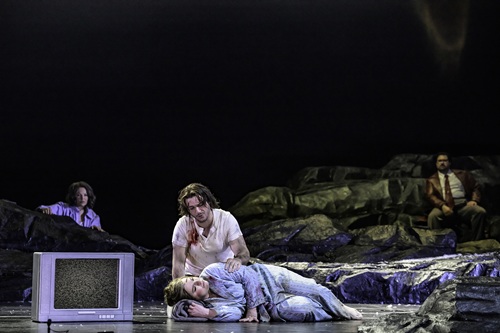
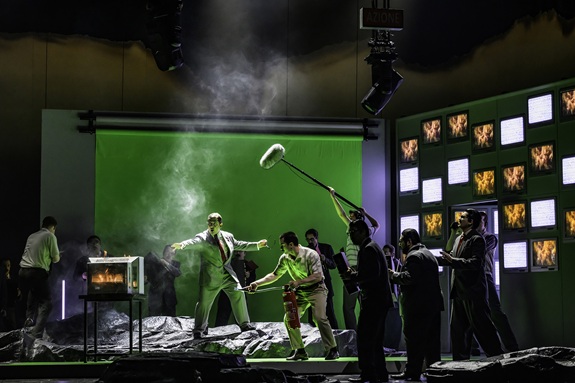
The set that Lisa Dässler had designed for this production of Il trovatore was predominantly a grey to brown landscape of barren rock-shaped plastic boulders which the characters could climb around on, or disappear behind or in between, sometimes visibly using an unseen staircase. Boxes appeared from the wings suggesting different environments, such as a TV studio in which Ferrando was filmed while narrating the context of the opera’s plot and characters. Here he was surrounded by his listeners all dressed in grey business suits complete with oversized bright-red Trump ties. For the first major scene between Manrico and Azucena, a different box represented Manrico’s childhood room. Later, the gitano chorus was shown as a choir rehearsal with the choristers singing from paper scores. A further chorus scene showed people dressed as the main perpetrators involved in the attempt at storming the Capitol in 2021. These attempts by director Wolfgang Nägele at bringing the opera into contemporary times were quite interesting to watch, came across as witty and quirky, did not add up to a holistic perspective but did not distract from the music either.
The performance I saw was conducted by Lorenzo Da Rio, who serves at Hanover State Opera predominantly as chorus director with a contractual obligation to take on some conducting duties – often the last of a series of performances, as on this occasion. He availed himself of this task very well, leading the orchestra with assurance and clarity. Orchestral music and the singing of soloists and chorus were particularly well coordinated. Da Rio chose brisk tempi, finishing the performance ten minutes before the announced time, and used the full range of volume to tease out the depth of emotions inherent in the score.
Cristina Oliveira sang Leonora. Her acting was decisive and determined, her voice clear and open, with an intriguing pattern of rising to the top notes on marked crescendos and as if breaking for a split second and shifting gear to allow additional bloom for the top notes.
Joseph Dahdah is a singer to be watched. His voice, singing Manrico, had particular sheen throughout, firmly grounded in a sound lower register without overly baritonal qualities, and able to rise to the top notes with complete ease, without forcing or audible pressure. Grga Peroš was very mellifluous, with well sustained legato, as Count di Luna.
Shavleg Armasi was convincing as Ferrando with his sonorous and well-controlled bass. Monika Walerowicz threw herself into the overbearing emotions of Azucena with all her strength. Her acting was very moving, eschewing the dangers of melodrama, a fine balance not easily achieved in a production that does not support acting based on any conceivable overall concept. Her singing of emotional extremes was equally strong, as she allowed her voice to sound powerfully beautiful and (almost) avoided ugly sounds when expressing ugly emotions.
Daniel Meyer-Dinkgräfe
Featured Image: Shavleg Armasi (centre, Ferrando) © Bettina Stöss
Production:
Director – Wolfgang Nägele
Revival Director – Valérie Junker
Stage designer – Lisa Dässler
Costume designer – Irina Preckelmeyer
Dramaturgy – Anno do Paço
Chorus director – Lorenzo Da Rio
Cast:
Count di Luna – Grga Peroš
Leonora – Cristiana Oliveira
Azucena – Monika Walerowicz
Manrico – Joseph Dahdah
Ferrando – Shavleg Armasi
Ines – Luisa Müller
Ruiz – Antonio Fernandez Brixis
Old Man – Sang-Ho Lee
Messenger – Steffen Thole