
 United Kingdom Catrin Finch, Notes to Self: Catrin Finch (harp), Dora Stoutzker Hall, Royal Welsh College of Music and Drama, Cardiff, 23.10.2026. (LJ)
Catrin Finch – 13; Adre; Môr Arianrhod; Black Holes; Who You Were; Kin; Together Again; There’s Always Time; Begone Begin; Final Letter / Angels (2026)
It is a rarefied treat to listen to music written and performed by a musician so at one with their instrument. Welsh harpist Catrin Finch’s performance of her latest album Notes to Self (ARC Music, 2026) at Cardiff’s Royal Welsh College of Music and Drama (RWCMD) afforded one such occasion. This was a one-woman show of the highest quality.
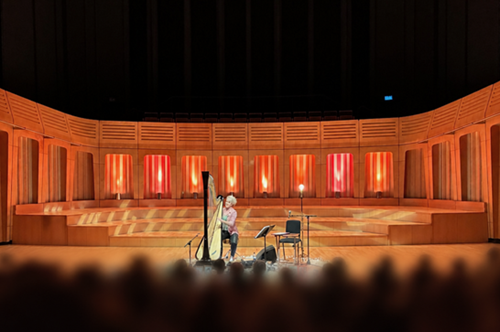
Finch sat encircled by fairy lights and framed photos from different periods of her life. As she quipped when greeting her audience: ‘I’ve brought my living room’ – and, yes, this performance did feel, as she put it, ‘deeply personal’. Through a setlist of ten original songs, Finch told the story of her life. The concert combined new music and letters that a now 46-year-old Finch read to her 13-year-old self. For the first time, the audience had access to the person behind the persona. Finch introduced us not to the internationally renowned harpist, but to ‘Katy’, as she is referred to by family and friends. And it was Katy we heard about in the letters, which delved into her personal struggles concerning her career, family, health, and sexuality.
Notes to Self is Finch’s first solo recording in a decade. The intervening years have seen her collaborate with violinist Aoife Ní Bhríain and with the kora player Seckou Keita. Due to the highly personal combination of music and letter writing in this album, it is only fitting that this was a solo recital. Next to the harp, she used looping pedals to layer clear melodic lines, repetitive patterns, and percussive rhythms. This helped to create an overarching mood of nostalgia. In her performance of Kin, about ‘the importance of time spent with those you love’, there was a deliberate slowness that encapsulated this wistful mood. This is not to say that the music reflects a rose-tinted view of the past. In a song like Black Holes, the expansive music, pulsing harmonic structure, and percussive textures (created by tapping on the soundboard with her fingertips and sliding her hand downward on the lower wire strings), which Finch captured with her looping pedals, evoked the feeling that ‘stress and worry are taking hold’, as she read in her corresponding letter. In its evocation of Finch’s recurring nightmare of the abyss, this note to self was more closely associated with trauma than nostalgia.
Finch’s music draws on folk, classical, and ambient electronic styles, but her voice is truly her own. Listeners of Max Richter, The Gentle Good, and GoGo Penguin may especially gravitate towards this album. Her skill as a composer could be heard in Môr Arianrhod. When describing this piece, Finch said that she was inspired by the story of a Welsh Goddess from the Mabinogion (a collection of Medieval Welsh stories) as it conveys the sentiment that ‘all we can do is surrender to our fate and live in the present’. In Môr Arianrhod, and across her playing throughout the evening, Finch used performance techniques like bisbigliando (tremolo trill), etoufée (creating a staccato sound), and rapid runs judiciously, giving just the right amount of colour and texture to the music.
Her encore was a piece by Robert ap Huw whose musical scores belong to the earliest surviving manuscript of harp music in Europe, housed at the National Library of Wales. Finch played ‘Caniad Y Gwyn Bibydd’ (‘The Song of the White Piper’), which, even though it was written over four centuries ago, sounded in keeping with Finch’s contemporary compositions.
Over two hours, Finch transported the audience from the concert hall into her world. This concert was an uplifting musical storytelling of the hurdles she has had to face. We empathised with her fears and anxieties (Black Holes), shared in her joy and regret (Kin), celebrated her liberation (Together Again), and marvelled at her courage and perseverance (Begone Begin). As Finch told us before commencing Begone Begin: ‘behind every scar is a story of survival, courage, and perseverance’. Indeed, how rarefied it is to watch and hear someone bare their soul. This performance demanded respect for both the virtuoso and the individual who is Catrin ‘Katy’ Finch.
Lucy Jeffery