 United States Courtney Bryan, Suddenly Last Summer: Soloists, Philadelphia Boys Choir, Members of the Opera Philadelphia Orchestra / Nathan Koci (conductor). Opera Philadelphia, Forrest Theatre, Philadelphia, 22.10.2026. (RP)
Few operas pack as much punch into an hour as Courtney Bryan’s Suddenly Last Summer, with a libretto by Gideon Lester and Daniel Fish. Fish’s production, first presented at Bard SummerScape last summer and revived at Opera Philadelphia, sharpens Tennessee William’s feverish drama into an inexorable battle over the truth.
Based on Williams’s one-act play, this psychological Gothic drama centers on Catherine Holly who refuses to be silenced about the circumstances surrounding her cousin Sebastian’s death. His mother, Mrs. Venable, is determined to bury the story, even if that means having Catherine lobotomized. A doctor’s investigation ultimately exposes the truth about Sebastian’s sexual encounters with young men and his horrific end, shattering the family’s carefully guarded respectability.
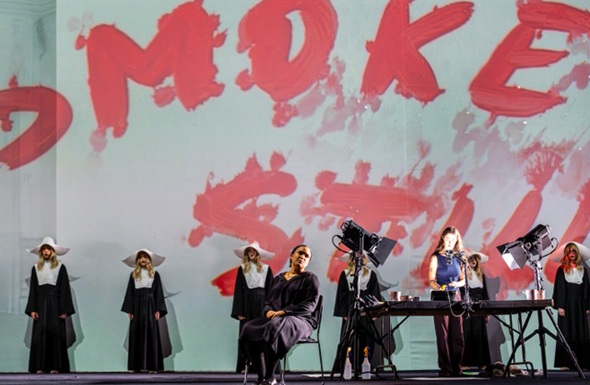
The libretto hews closely to the play, but of the five principal characters, only Catherine sings, apart from the boys’ chorus. The boys evoke the young men exploited by Sebastian, embody Sebastian himself and function as a kind of Greek chorus, observing and commenting on the action. They are arguably more menacing as the sisters at St. Mary’s, the private mental asylum where Catherine’s aunt has placed her, than as the boys themselves. Their voices also produce bird calls, a recurring motif in Williams’s play.
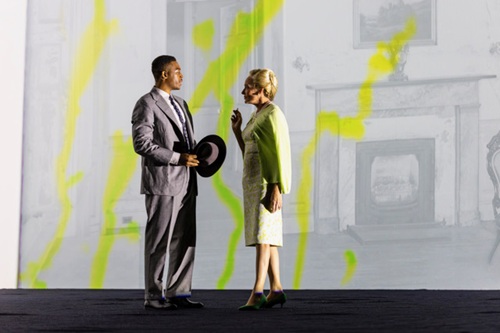
There is no set to speak of beyond a washed-out projection of Mrs. Venable’s grand New Orleans mansion. Black-and-chrome chairs, initially stacked against the wall, are eventually occupied by everyone on the stage. The production approaches delirium in its surrealism, thanks to paintings by Lucy Tarquinio, created in real time and projected onto the white rear wall. Abstract but evocative, they suggest the tropical plants Sebastian’s mother now tends, while intensifying the tension as Catherine recounts her story and Mrs. Venable recoils, ultimately frozen in horror.
The score is complex and exacting, yet remarkably accessible. During the post-performance talk, Courtney Bryan explained that Mrs. Venable is introduced musically by a 12-tone row reflecting the rigid order of her life, down to a frozen daiquiri served promptly at 5pm. As that order disintegrates, the row intersects with its retrograde form. The technical detail might escape the listener, but its impact is visceral.
Bryan’s music for Catherine is equally complex, blending blues-inflected melodies with sharply etched vocal lines. It creates an atmosphere of defiance, tempered by smugness and sensuous languor, that Mikaela Bennett inhabits completely. Bennett never plays Catherine as a victim. Instead, she is as intent on devouring her prey as the Venus flytrap Mrs. Venable describes in the opening scene.
Stephanie Roth Haberle’s Mrs. Venable was impossibly erect and elegant, without a hair out of place. She delivered Williams’s words with cut-glass precision, underscoring the character’s ruthlessness. Immaculately tailored dresses and gowns defined her milieu, but a nun’s habit put her in league with the devil.
Bryan said the interracial casting was intentional, designed to heighten the frisson. It also challenged – or at least invited a reading that challenged – the rigid racial segregation of the 1950s South. The effect was less apparent in Bennett’s Catherine than in the exchanges between Haberle’s Mrs. Venable and Branden Lindsay’s Dr. Cukrowicz, where a palpable sexual charge imbued their first scene.
Lindsay’s Cukrowicz was cool as a cucumber and as calculating as Mrs. Venable. He, too, exuded a slow-burning sensuality that was never acted upon. Sympathetic to Catherine’s story from the outset, he needed only to give her the space – and the help of a truth serum – to let it pour out.
The 1959 Hollywood adaptation, starring Katharine Hepburn, Elizabeth Taylor and Montgomery Clift, received an Oscar nomination for Best Art Direction – Set Decoration in Black-and-White. Fish pays homage to the film by introducing Miriam Silverman as Catherine’s mother and Nick Westrate as her brother in black-and-white film footage. Both have a stake in the outcome: Mrs. Venable has promised them a hefty payout if they can persuade Catherine to recant her story.
Fish brings these disparate elements into a coherent whole. The paintings and prerecorded performances could overwhelm the drama but instead they heighten the disquieting atmosphere Williams wove into the story.
Nathan Koci led 11 musicians drawn from the Opera Philadelphia Orchestra in a performance that captured the story’s dualities. Blues-inflected melodies, suspended harmonies, sliding phrases and birdlike sounds coalesced into a sensuous, often unsettling soundscape, poised between reality and illusion.
Opera Philadelphia’s first production at the historic Forrest Theatre was an apt choice of venue. Opened in 1928, the theatre is a rare survivor of the golden age of American theatrical architecture and commercial theatre. Williams’s Cat on a Hot Tin Roof had its pre-Broadway tryout there in 1955, making this return to the playwright’s work a fitting encounter between Philadelphia theatrical history and a compelling new interpretation of his play.
Rick Perdian
Featured Image: Mikaela Bennett (Catherine Holly ) and Lucy Tarquinio (Painter) © Dominic Mercier
Production:
Libretto – Gideon Lester & Daniel Fish
Original Director – Daniel Fish
Revival Director – Mikhaela Mahony
Sets – Marsha Ginsberg
Costumes – Terese Wadden
Lighting – Stacey Derosier
Revival Lighting – Christopher Frey
Projection – Joshua Thorson
Sound – Garth MacAleavey
Revival Movement direction – Mel Krodman
Philadelphia Boys Choir Conductor – Jeffrey R. Smith
Cast:
Catherine Holly – Mikaela Bennett
Mrs. Venable – Stephanie Roth Haberle
Dr. Cukrowicz – Branden Lindsay
Mrs. Holly – Miriam Silverman
George – Nick Westrate
Painter – Lucy Tarquinio